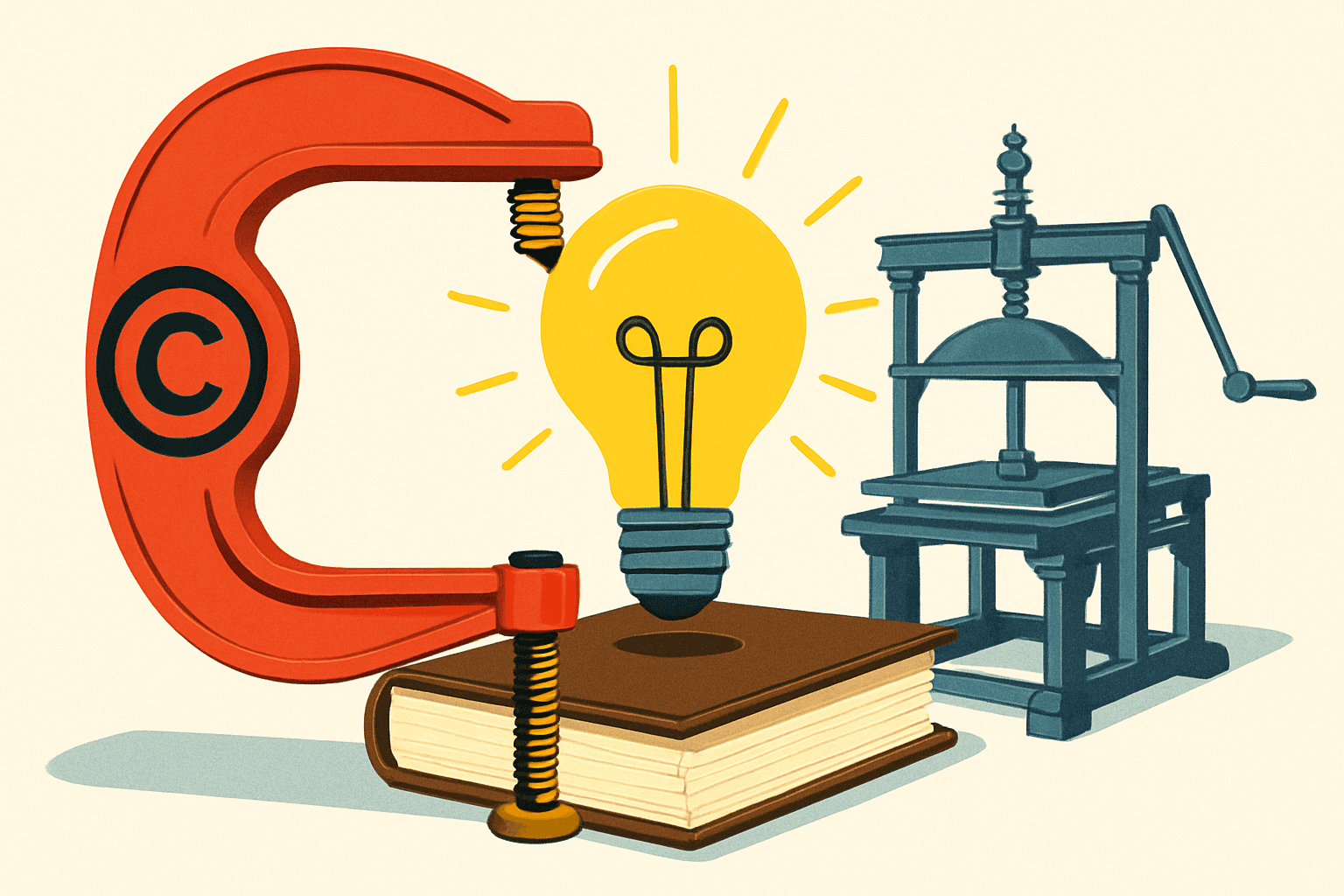
The story of copyright that most people carry around, a system designed to protect creative people and ensure they benefit from their work, is a usable summary of what copyright has become. It is a poor description of where copyright came from and a questionable description of what it primarily does now.
The first copyright law in the world was the Statute of Anne, passed in England in 1710. Its full title was "An Act for the Encouragement of Learning, by Vesting the Copies of Printed Books in the Authors or Purchasers of such Copies, during the Times therein mentioned." Notice that the Act is addressed to books, a specific technology, and that the purpose named in its title is the encouragement of learning, not the protection of authors.
What the Statute was actually solving
Before 1710, the printing of books in England was controlled by the Stationers' Company, a guild of London printers with a royal charter dating to 1557. The Stationers' Company had a monopoly on printing: works were registered with the Company, and the right to print a work belonged to whoever held the registration, typically the printer, not the author. Authors sold their manuscripts for a one-time payment and then had no further claim on what was done with them.
The Stationers' monopoly was, by 1710, a significant political problem. It concentrated control over what could be published in a small group of London tradesmen, allowed prices to be kept artificially high, and was increasingly seen as incompatible with the freer movement of ideas that the post-Glorious Revolution settlement implied. Parliament wanted to break the monopoly.
What happened to the author's copyright in practice
The Statute of Anne gave authors rights. Publishers then persuaded authors to assign those rights to them as a condition of publication. This is a pattern that has persisted, in various forms, for over three centuries. The legal fiction of authorial ownership and the commercial reality of corporate ownership have coexisted, somewhat awkwardly, ever since.
For most of copyright history, the major beneficiaries of copyright protection have not been authors but the companies that own the rights to their work. Publishers, record labels, film studios, and software companies have lobbied consistently and successfully for longer copyright terms, broader definitions of infringement, and stronger enforcement mechanisms. Authors and musicians have, generally, been less successful lobbyists, not because their interests are unimportant, but because they are diffuse, unorganised, and not backed by the same commercial stakes.
The consistent pattern in copyright legislation over the past century is extension. The United States Copyright Term Extension Act of 1998, widely known as the "Mickey Mouse Protection Act" because its timing coincided neatly with the impending expiry of the original Mickey Mouse copyright, extended terms by twenty years. The beneficiary was not any living author. It was the corporations that owned the rights to works created by people who had died decades earlier.
The public domain problem
Copyright has an adversary in the form of the public domain, the condition works enter when their copyright expires, at which point anyone can use them freely. The public domain is not a failure of the copyright system. It is part of the original design. The Statute of Anne set specific terms precisely because perpetual copyright was what the Stationers' Company had, and destroying that perpetuity was the point of the reform.
Every extension of copyright term is a removal of works from the public domain. Every work that remains under copyright is a work that cannot be freely built upon, translated, adapted, or republished. The creative traditions that modern artists draw on most heavily, folk songs, fairy tales, classical literature, early cinema, are predominantly in the public domain. The question of who owns the rights to contemporary culture, and for how long, is a question about what the next generation of artists will be free to use.
What protection artists actually receive
For the majority of working artists, writers, musicians, visual artists, copyright provides modest practical protection. Most creative work generates small returns; most creators lack the resources to pursue infringement in court; most rights are eventually assigned to intermediaries who bear the litigation costs but also capture most of the value. The artists whose work is genuinely protected by copyright's enforcement mechanisms are, disproportionately, the most commercially successful, the ones with publishers, labels, or studios willing to pursue infringement on their behalf.
This is not an argument that copyright should be abolished. It is an argument that copyright's function should be understood accurately. The system was not built around artists. It was built around the printing trade, modified for the digital age under pressure from entertainment conglomerates, and justified throughout by reference to authors and creators who are the system's nominal beneficiaries and frequently its practical afterthought.
Disagree? Say so.
Genuine pushback is welcome. Personal abuse is not.
Related questions


