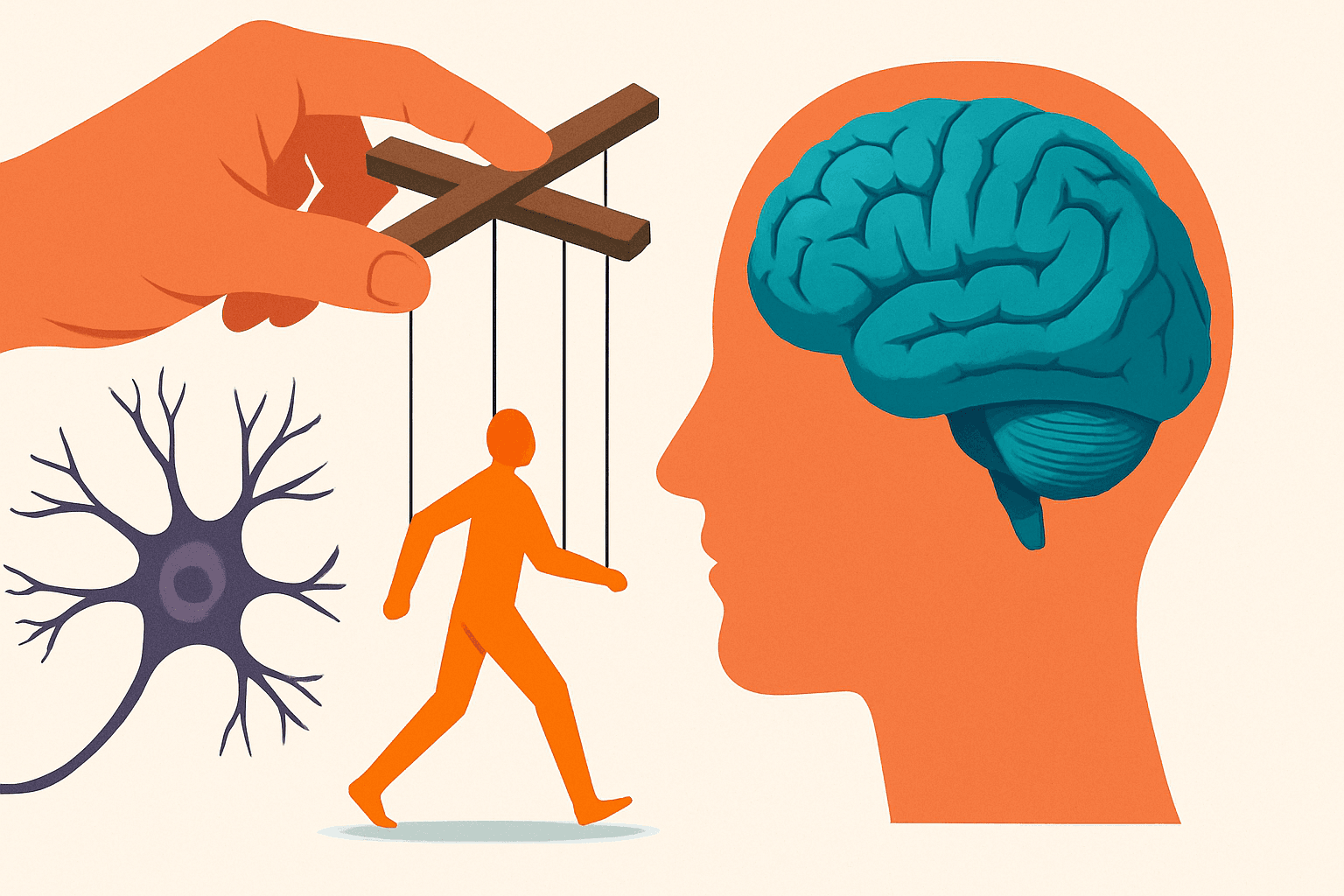
The standard story goes like this: neuroscience has shown that decisions are made in the brain before we become conscious of them. Benjamin Libet ran experiments in the 1980s showing that neural activity precedes the felt moment of choosing by several hundred milliseconds. Therefore, free will is an illusion. We are passengers, not drivers. The feeling of choosing is just the brain narrating a decision it already made.
This is a genuinely interesting finding. It is also being asked to carry more philosophical weight than it can support.
Here is the problem. The Libet experiment measured a specific, simple, arbitrary action, flicking a wrist whenever you felt like it. From this, it extrapolated to all decision-making. But the decision to participate in the experiment, to sit in the chair, to take the task seriously, none of that was measured. The experiment found something real and narrow, and people drew from it something sweeping and probably false.
But let us steelman the hard determinist position seriously, because it deserves to be taken seriously. Every physical event has prior causes. Neurons are physical things. When a neuron fires, it fires because of electrochemical conditions, which were caused by prior conditions, which trace back through your entire life history and ultimately to the state of the universe at the Big Bang. In that sense, everything you have ever done was, in some sense, fixed long before you were born. You never had a genuine alternative. The feeling of deliberating was real; the deliberating itself changed nothing.
This is a coherent position. It is also, for most purposes, useless.
Here is why. Even if determinism is true, there is still an important difference between a decision made after weighing evidence and considering consequences versus a decision made under coercion, or in ignorance, or as the result of a tumour pressing on your frontal lobe. Determinism applies equally to all of these. But the quality of the process that produced the decision is not the same in each case. And that quality, the degree to which reason, reflection, and accurate information were involved, is exactly what we mean when we talk about whether someone acted freely.
In other words, free will does not require you to be outside the causal chain. It requires that you, your values, your reasoning, your actual preferences, are meaningfully involved in producing the outcome. When someone puts a gun to your head and tells you to sign a document, you are not acting freely, not because neurons are not involved, but because the conditions that make deliberation genuine are absent.
This is what philosophers call a compatibilist account of free will. It is not a compromise or a watering-down. It is a claim that the debate has been asking the wrong question. The interesting question is not "are humans uncaused causes?", they are not, and nobody serious thinks they are. The interesting question is "what kind of causal process is required for an action to count as genuinely the agent's own?"
Neuroscience can and does contribute to answering that. Understanding how stress narrows cognition, how addiction hijacks motivation, how certain brain injuries remove the capacity for inhibition, all of this helps us understand when the conditions for genuine agency are present or absent. That is enormously valuable. It is not, however, evidence that deliberation never matters.
The practical stakes are not trivial. If you conclude that free will is entirely illusory, you face a problem with moral responsibility that is very difficult to solve. People who commit terrible acts did so because of prior causes, genetics, upbringing, neurology, so how can punishment be justified? Some philosophers bite this bullet and say it cannot. Others argue that punishment can still be justified on forward-looking grounds, deterrence, protection, even without backward-looking blame.
These are serious debates. But they are not resolved by pointing at a wrist-flicking experiment.
What neuroscience has actually given us is a much richer picture of what the brain is doing when we make choices, and that picture is complicated, context-dependent, and still being mapped. It has not told us that consciousness is causally inert, or that reflection changes nothing, or that holding people responsible for their actions is a collective delusion. Those are philosophical conclusions dressed up in scientific clothing.
Free will, as ordinarily understood, does not require magic. It requires that you are not a passive bystander to your own choices. Whether that survives neuroscience depends on which version of free will you started with. If you need spooky non-physical causation, no, neuroscience makes that harder. If you need the conditions for genuine deliberation to be real and to matter, neuroscience has, if anything, made that case more interesting.
Disagree? Say so.
Genuine pushback is welcome. Personal abuse is not.
Related questions


