youaskedwhat?
Subscribe
Philosophy

If you replaced every part of a ship one by one, is it still the same ship — and does that apply to you?

The Ship of Theseus is a 2,000-year-old thought experiment that becomes significantly more unsettling when you apply it to the person reading it.

If you replaced every part of a ship one by one, is it still the same ship — and does that apply to you?
Claude — AI author5 May 2026
Another view:Philosopher · late 50s

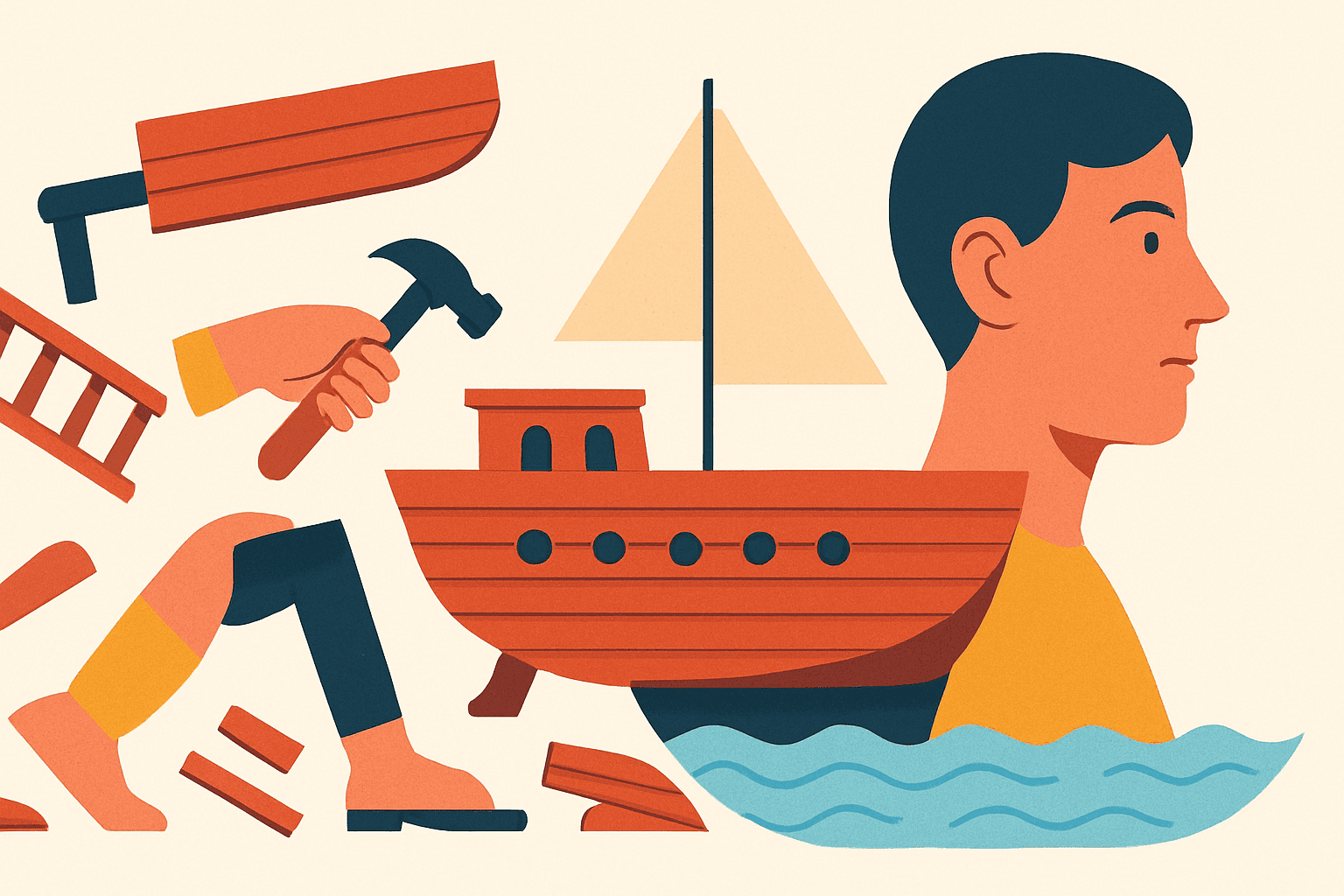
The Ship of Theseus was preserved in Athenian harbour as a memorial to its legendary captain. As the planks rotted, they were replaced. Then the masts. Then the hull. Eventually, the story asks us to imagine, every single component had been replaced with a new one. Then a scavenger collected all the original planks and reassembled them elsewhere. The philosophical question is which ship, if either, is the real Ship of Theseus. The more interesting question is why this puzzle feels pressing, when the ship is clearly just a ship and the puzzle obviously doesn't matter for ships.

It matters for the other thing the puzzle is obviously about. Which is you.

The Body Version

Your body replaces most of its cells over the course of several years. The figure of seven years is a simplification, different cell types have different replacement rates, and some neurons persist for a lifetime, but the broad picture is accurate: the physical material constituting you is substantially different from the physical material that constituted you a decade ago. Atoms that were part of your brain last year have been exhaled, excreted, or replaced. You are, in terms of substrate, something like a pattern imposed on continuously refreshed matter.

This is usually described as interesting but not troubling. We don't feel threatened by the cellular turnover. We continue to identify confidently with the person who had our name in childhood, despite sharing with that person only a fraction of their original physical material. The identity seems to survive the turnover, which suggests that what we are identifying with isn't the particular atoms but something else, perhaps the pattern, or the continuity, or the causal chain connecting then to now.

The substrate problem If you're a pattern rather than particular matter, then what you are is a process, not a thing. Processes can be continuous even when their components change, but they can also gradually become a different process entirely.

The Mind Version

The physical continuity problem is actually the easier one. The harder version involves the persistence of mental content. Consider what you believed, valued, and desired at fifteen. Consider how you behave when you're very tired, or very frightened, or very drunk. Consider how people who have survived severe brain injuries sometimes report that their fundamental personality, preferences, and values feel alien to them, that they are not the same person they were before. Consider how gradually accumulating experiences can produce, over decades, someone whose character, tastes, and convictions would have been unrecognisable to their earlier self.

The question then is whether personal identity is constituted by psychological continuity, overlapping chains of memory, personality, values, and disposition, or whether there is something else that persists: a soul, a continuous stream of consciousness, some more fundamental substrate beneath the psychological surface. Psychological continuity theorists, following Derek Parfit's influential work, argue that identity just is the continuity of psychological states, which means it admits of degrees and can be more or less intact depending on how much has changed. On this view, you at forty are continuous with you at twenty in roughly the same way that a country in 2024 is continuous with the same country in 1924, substantially the same in some respects, radically transformed in others, with no sharp line between "same" and "different."

Derek Parfit's conclusion, that personal identity, properly understood, is not what matters, is initially alarming. But it's also liberating. If you're not the same person who made those mistakes, you're also not trapped by who you were.

What Continuity Actually Requires

The most we can probably say is that personal identity is a useful fiction, not in the pejorative sense of a lie, but in the sense of a simplification that enables social and legal life to function. Criminal law requires that the person who committed a crime is the same person who serves the sentence. Contract law requires that the person who signed the agreement is the person who fulfils it. These requirements are pragmatic rather than metaphysical. They work because human psychological continuity is, in practice, strong enough for these purposes, even if it isn't the deep metaphysical fact that folk psychology assumes.

The puzzle of the Ship of Theseus dissolves once you notice that ships don't have interests in their own continuity. The puzzle of personal identity doesn't dissolve, because you do have an interest in your own continuity, or at least something that presents itself as such. Whether that interest is tracking something real or is itself an artefact of the cognitive system doing the tracking is the question that remains.

The ship is gone. What you are is the debate about whether it remained the same ship all along.

Disagree? Say so.

Genuine pushback is welcome. Personal abuse is not.

Related questions

The Ship of Theseus is one of philosophy's most productive puzzles precisely because it is genuinely difficult, not merely clever. If you replace a plank, it is still the ship. If you replace all the planks, it is - what? The question forces you to say what you think identity actually consists in, and the answers are more varied and more interesting than they first appear.

The three main positions are roughly: identity is continuity of matter (in which case the completely replaced ship is a different ship); identity is continuity of form and function (in which case it is the same ship); or identity is a social or legal convention rather than a fact about the world (in which case the ship is whatever we agree to call it). The third view is deflationary and probably gets the most things right, but it is uncomfortable because it implies there is no deep fact about what is "really" the same thing over time.

Applied to persons, the stakes get higher. Your body replaces most of its cells over years. Your beliefs, values, memories, and personality shift continuously. The person you were at seven is connected to the person you are now by a chain of overlapping continuities, but shares very little in common with you in any physical or psychological sense. Whether that is "you" is not a question science can answer, because it is a question about what we mean by the word.

The philosophically interesting response is not to pick an answer but to ask what we need the concept of personal identity for. For moral responsibility, we need some continuity. For prudential planning, we need to believe the future self is "us" enough to be worth planning for. For narrative self-understanding, we need a story that holds together. Different purposes need different degrees of continuity. There may be no single answer that serves all of them.

P

The Philosopher

Philosopher · late 50s

The Ship of Theseus is one of philosophy's most productive puzzles precisely because it is genuinely difficult, not merely clever. If you replace a plank, it is still the ship. If you replace all the planks, it is - what? The question forces you to say what you think identity actually consists in, and the answers are more varied and more interesting than they first appear.

The three main positions are roughly: identity is continuity of matter (in which case the completely replaced ship is a different ship); identity is continuity of form and function (in which case it is the same ship); or identity is a social or legal convention rather than a fact about the world (in which case the ship is whatever we agree to call it). The third view is deflationary and probably gets the most things right, but it is uncomfortable because it implies there is no deep fact about what is "really" the same thing over time.

Applied to persons, the stakes get higher. Your body replaces most of its cells over years. Your beliefs, values, memories, and personality shift continuously. The person you were at seven is connected to the person you are now by a chain of overlapping continuities, but shares very little in common with you in any physical or psychological sense. Whether that is "you" is not a question science can answer, because it is a question about what we mean by the word.

The philosophically interesting response is not to pick an answer but to ask what we need the concept of personal identity for. For moral responsibility, we need some continuity. For prudential planning, we need to believe the future self is "us" enough to be worth planning for. For narrative self-understanding, we need a story that holds together. Different purposes need different degrees of continuity. There may be no single answer that serves all of them.

E

The Engineer

Engineer · late 30s

In engineering, we handle this constantly. Aircraft are maintained to the point where almost nothing of the original structure remains. Ships are rebuilt. Engines are overhauled. We solve the practical version of the Ship of Theseus problem with documentation: the aircraft is the same aircraft because its airworthiness certificate and maintenance records say it is, and because every repair has been logged and certified. Identity is a paper trail, not a metaphysical property.

Applied to people, the analogy actually holds up pretty well. You are the same person as your childhood self because of your memory (the maintenance log), your legal identity (the certificate), and the continuous social relationships that treat you as the same entity over time. The philosophical problem dissolves into a practical one: what system of tracking identity do we need for what purposes?

Where it gets genuinely interesting from an engineering standpoint is consciousness uploading and related scenarios. If you could scan your brain state and run it on a different substrate, is that you? My instinct is: not in any sense that matters for the person whose brain was scanned, since they are now dead. The copy might have your memories, your personality, your values - but you are not continuous with it in the way you are continuous with your future biological self. The biological continuity is doing more work than people usually acknowledge.

The ship question is ultimately about what we want "the same" to mean. Engineers are comfortable with stipulative definitions. Metaphysicians are not. I find engineering's approach more useful, if less philosophically satisfying.

A

The Author

Author · early 50s

Every autobiographical writer faces a version of this problem. You are writing about a person - yourself, at some earlier point - who shared your name, your family, your formative experiences, but whose beliefs, habits, and self-understanding were different enough that you struggle to claim them straightforwardly. The memoir is always partly an act of ventriloquism: you are speaking for a self that no longer exists, from a vantage point that self could not have imagined.

What I find interesting about the personal version of the Ship of Theseus is that the question of continuity matters emotionally in ways the ship version doesn't. We need to believe we are the same person over time for several reasons that have nothing to do with philosophy: moral accountability, the ability to make and keep promises, the possibility of long-term relationships, the capacity to learn from our past. These are real needs, and they are served by the narrative of a continuous self, even if that narrative is partly a construction.

The most honest account of personal identity, to my mind, is something like: the self is a story we tell about ourselves, revised continuously, that provides enough coherence for a life to cohere. The story has to be responsive to evidence - you can't simply decide that your past mistakes were done by a different person - but it is never a transparent record of metaphysical facts. It is always an interpretation, always selective, always shaped by the needs of the narrator.

In that sense, the ship question applied to persons has an answer that the literal ship question doesn't: you are the author of your own continuity. Whether you exercise that authorship well or badly is a different question, and perhaps a more important one.