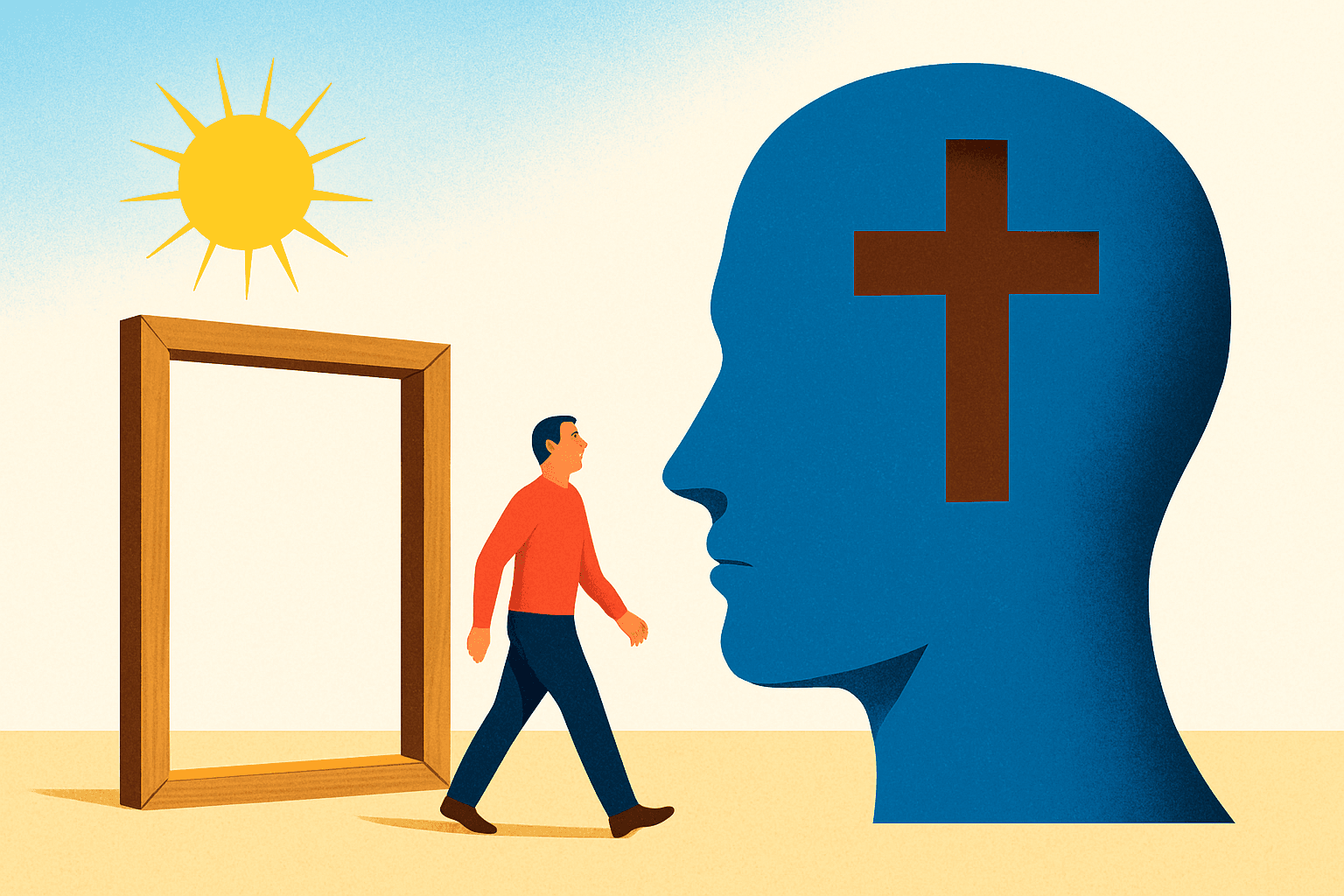
The standard defence goes like this: atheism is not a belief system, it is the absence of one. To call it a worldview is like calling bald a hair colour, or calling abstinence a sexual preference. It is defined entirely by what it is not. It has no positive content, no doctrine, no community, no rituals, no sacred texts. The claim is simple: I don't believe in God. Everything else follows from ordinary reasoning that doesn't require a label.
This is a good argument. It is also not a complete description of what atheism actually is in practice.
The descriptive and the prescriptive
There is a difference between what atheism is technically and what atheism has become culturally. Technically, it is simply the absence of theistic belief. But the atheism you encounter in bookshops, in online debates, and at dinner parties is something rather more structured than that. It tends to come with a set of additional commitments: that science is the primary means of establishing truth, that religion is generally harmful, that secular ethics is superior to religious ethics, that the natural world is all there is. These are not entailed by the mere absence of God-belief. They are a positive worldview.
Where it starts to look like faith
The comparison between confident atheism and religious faith is usually made by religious people and dismissed by atheists. But the parallel is worth examining on its merits rather than its source. Faith, in the traditional sense, is not simply belief without evidence, it involves a set of commitments that provide meaning, community, identity, and a framework for interpreting the world. Strip it of the God hypothesis and some forms of atheism have most of these features.
The certainty is the most telling indicator. Religious faith is often criticised for holding beliefs with more confidence than the evidence warrants. Confident atheism does something structurally similar: it holds that the God question is settled, that anyone who disagrees is either ignorant or dishonest, and that the correct position on a question that has genuinely puzzled careful thinkers for millennia is obvious. That level of certainty in metaphysics is not a product of evidence. It is a posture.
What the agnostics saw
Thomas Huxley, who coined the word "agnostic," was making exactly this point. He rejected both religious certainty and atheistic certainty on the same grounds: neither claim is adequately supported by what we actually know. Agnosticism is not a fence-sitting failure of nerve. It is an epistemically honest response to a question that remains genuinely open.
The interesting thing about the rise of confident new atheism in the early 21st century is that it arrived at the same time as neuroscience, cognitive science, and physics were making the hard questions harder, not easier. The question of consciousness remains intractable. The fine-tuning problem is real. The nature of time, causation, and emergence is murky in ways that don't obviously favour a materialist worldview. The confident atheist response to this uncertainty is to not pay it much attention.
The most honest position
You can be a person who doesn't believe in God, who finds the evidence insufficient, who finds religious explanations unsatisfying, who lives a life entirely without reference to the divine. That is a coherent and defensible position that requires no belief system to support it.
But if you are confident, if you are evangelical, if you feel the need to argue people out of their faith, if you have a sense of belonging to a community of the correctly-minded, you are probably doing something that isn't captured by "I just don't believe in God." You're doing something that looks, at some structural level, rather like what you're arguing against.
That observation doesn't make theism true. It just means the argument is more symmetrical than it's comfortable to admit.
Disagree? Say so.
Genuine pushback is welcome. Personal abuse is not.
Related questions


