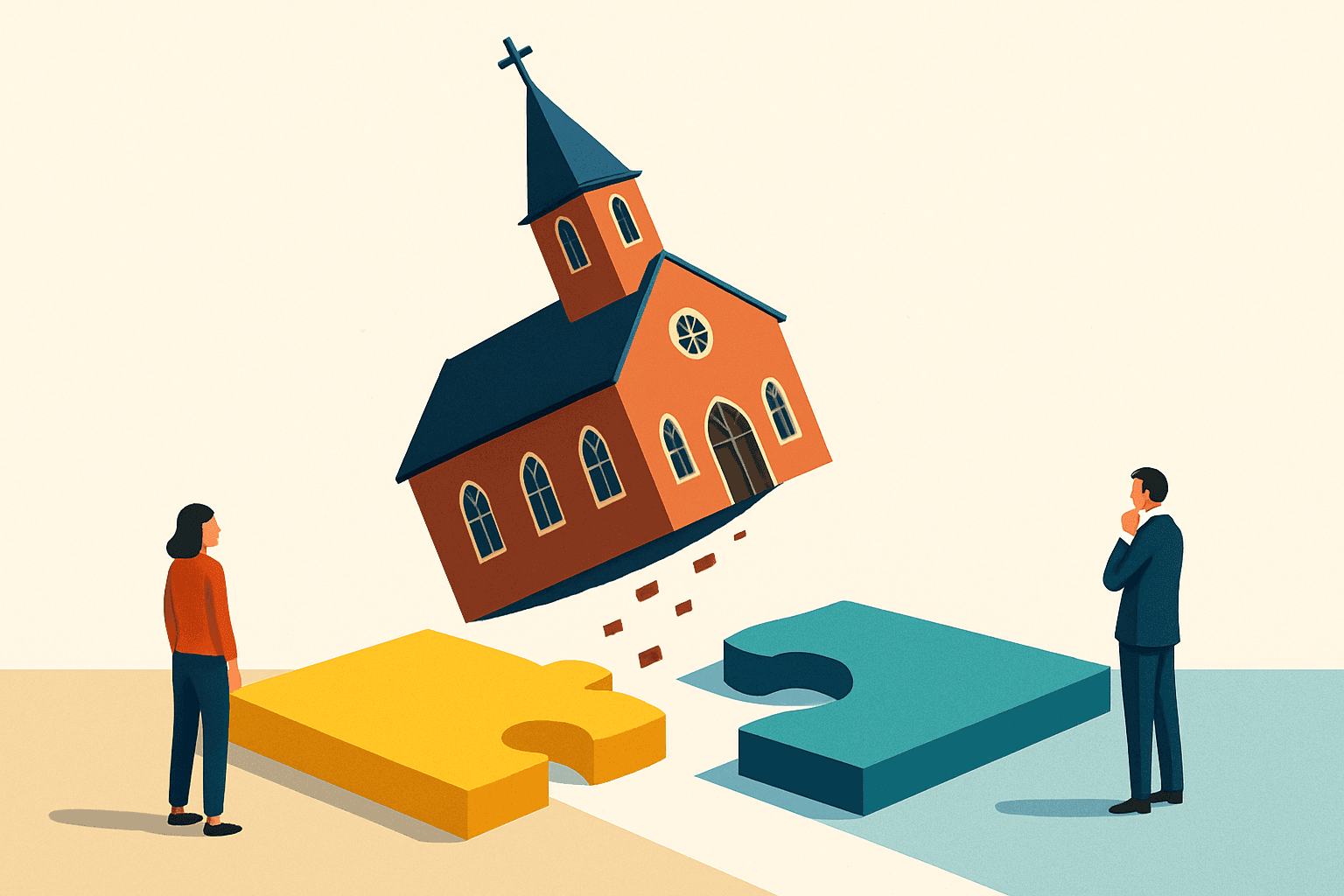
In 1800, more than 95 per cent of the global population identified with a religious tradition. In 2024, the figure is somewhere above 80 per cent, and the trend is unambiguous in the wealthiest, most educated, most economically secure societies: as material conditions improve, religious affiliation and practice decline. This pattern, sometimes called the secularisation thesis, partially discredited, partially revived, suggests something about the relationship between religion and need. When people have reliable food, healthcare, education, social support, and security against catastrophe, they turn to religion less. This says something about what religion was providing. It does not say that what it was providing was nothing.
The question of whether the decline is a loss or a liberation is usually answered by people who have already decided which values matter most. The honest answer requires holding both sides without forcing them to resolve.
What Is Being Lost
Religion at its functional best provided things that are genuinely difficult to replace. Community, not the thin, interest-based community of people who share a hobby, but the thick, obligation-laden community of people who are committed to each other across difference, over time, through difficulty. A weekly enforced pause from ordinary life, in a space designed to induce reflection, surrounded by people enacting the same pause. A framework for confronting death, not just intellectually but practically, with specific rituals, specific language, a specific community gathered around specific promises about what happens next. A common moral vocabulary that allowed ethical argument without first establishing first principles. A structured account of what a good human life looks like and what is required to live one.
The secular replacements for these functions are real but partial. Therapy addresses some of what pastoral care addressed, but it is expensive, individual, and oriented toward psychological function rather than moral formation. Civic organisations provide some of the community that congregations provided, but without the transcendent framing that gave belonging its particular weight. Philosophy and literature can provide moral vocabulary, but they do not provide community, practice, or the specific comfort of a framework for dying.
What Is Being Liberated
The honest accounting of what religion has also provided includes things worth losing. Coercion, formal in some cases, social in most, over belief, behaviour, and identity, applied to people who dissented from the community's norms. Exclusion: of women from leadership, of gay people from full membership and dignity, of the wrong kind of believer from the wrong community. Certainty wielded as a weapon: the conviction that the truth was known, that deviation from it was dangerous, and that the institutions holding it were authorised to enforce conformity. Violence, justified by cosmological frameworks that placed the correct ordering of the sacred above the safety of individuals.
These are not aberrations. They are recurring features of religious institutions across traditions and centuries, most visible at the points of maximum power. The Protestant Reformation reduced some of this; it produced some of its own. The long history of religious coercion is not a contingent feature of religion poorly practised. It follows from the nature of institutions that claim access to final truth and the authority to shape lives in accordance with it.
Voltaire's observation, "those who can make you believe absurdities can make you commit atrocities", was not abstract. It was drawn from specific, documented events. The liberation from institutional religious authority in Europe was a liberation from genuine and serious harms, not merely from superstition.
Why Neither Side Has the Full Story
The secular view that religious decline is simply progress, the gradual supersession of superstition by reason, fails to account for what the data actually shows. The most secular societies in the world, Scandinavia, Western Europe, urban East Asia, are not producing people who are more morally serious, more connected to their communities, or more at peace with mortality. In many cases, they are producing people who are better off materially but lonely, purposeless, and anxious about death in ways that earlier generations managed, with religious scaffolding, rather better. The secular answer to mortality is philosophically clean and emotionally thin.
The religious view that the decline represents a tragedy of disconnection from the sacred also fails to account for what is genuinely being shed. The freedom to love whom you choose, to believe what seems true rather than what you're required to profess, to leave a community without social destruction, these are real gains. The person who could not openly be gay in their village in 1960 without risking everything was not experiencing a spiritual loss when that constraint eroded. They were experiencing a liberation, and it was real.
Loss and liberation are both true. The mistake is thinking they apply to different people, when they mostly apply to the same ones.
Disagree? Say so.
Genuine pushback is welcome. Personal abuse is not.
Related questions


