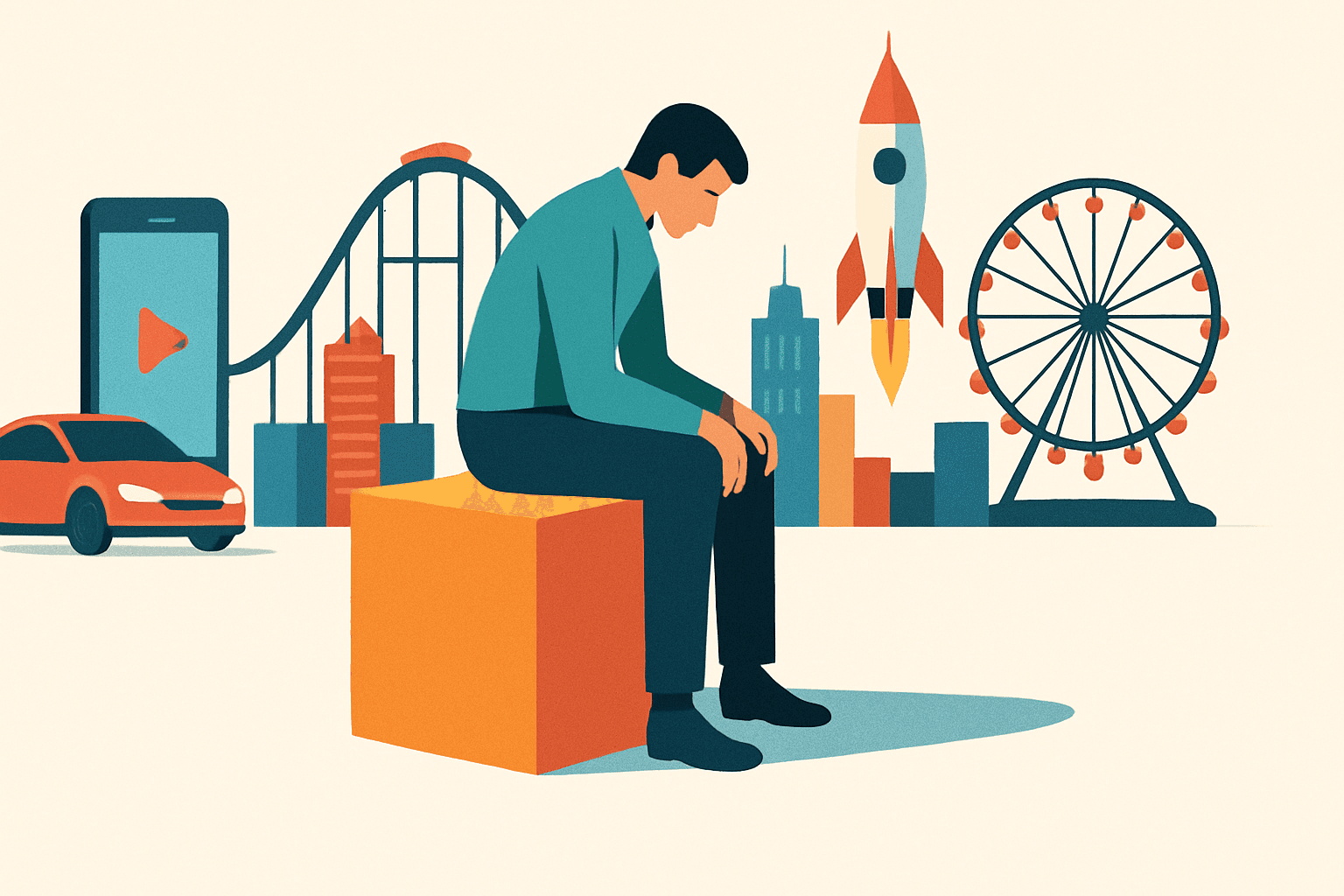
The average person now unlocks their phone 96 times a day. That is once every ten minutes of waking life. The typical motivation for each unlock is not the need for specific information. It is the avoidance of an unoccupied moment, the brief gap between tasks, the wait for a bus, the thirty seconds of standing in a queue. Boredom, in the traditional sense of having spare time with nothing filling it, is now rarer than almost any previous generation has experienced, at least in the developed world. We have collectively devoted enormous ingenuity to eliminating it. This is one of the more significant self-inflicted harms of the smartphone era, and it is almost never described as a harm.
The case for boredom is not romantic. It does not rest on nostalgia for a slower age or disapproval of technology. It rests on what boredom is, neurologically and psychologically, and what it therefore does when you have it.
What Boredom Actually Is
Boredom is the cognitive signal that the mind has spare processing capacity and nothing in the current environment is demanding it. It is uncomfortable, that is the point, because the discomfort is designed to motivate a search for engagement. In the ancestral environment, a mind with spare capacity was a resource that could be deployed: thinking about tomorrow's hunt, building a social plan, imagining solutions to recurring problems. The discomfort of boredom drove people toward productive mental work when the environment wasn't demanding immediate attention.
The brain state associated with boredom and unoccupied mind-wandering is also the state associated with the Default Mode Network, a set of brain regions that become more active during unfocused thought and less active during directed tasks. The DMN is associated with autobiographical memory consolidation, future planning, perspective-taking, and the kind of free-associative thinking that precedes creative insight. Neuroscientists now have substantial evidence that an unoccupied, slightly bored mind is doing important work, integrating experiences, working through unresolved problems, generating novel associations. It is not empty. It is doing something that directed, task-focused attention cannot do.
What the War on Boredom Has Produced
The research on smartphone use and creativity is limited but suggestive. Studies have shown that people who are allowed to be bored before a creative task outperform people who have been entertained beforehand. Mind-wandering, the state that boredom facilitates, is associated with higher rates of novel idea generation. Anecdotal accounts of where significant creative ideas arrive, the shower, the walk, the long drive, all describe states of mild boredom and unfocused attention rather than directed effort. Newton, famously, was sitting under a tree. He was not checking his notifications.
More concerning than the effect on creativity is the effect on reflection. Sustained self-examination, thinking about what you want, whether your current trajectory is actually heading there, what you value and whether your actions are consistent with those values, requires extended unoccupied time. It is not possible to conduct this kind of introspection in the ten-second gap between content items. The elimination of boredom may therefore be contributing to a reduction in the depth of self-knowledge available to people who have grown up in permanently stimulated environments. This is difficult to measure and easy to dismiss. It is not obviously wrong.
Blaise Pascal observed in the seventeenth century that all of humanity's problems stem from man's inability to sit quietly in a room alone. He did not have Reel notifications. One suspects he would have found the current situation confirmatory rather than surprising.
The Tolerance Problem
There is also a practical problem that goes beyond creativity and reflection. The constant availability of stimulation has, in many people, reduced the threshold below which boredom is experienced as intolerable. People who have grown up with permanent access to entertainment find unoccupied time more uncomfortable than previous generations did, not because they are weaker but because the system has adapted. The tolerance for boredom, like any tolerance, decreases with disuse. This creates a ratchet: as the avoidance of boredom becomes easier and more habitual, the boredom itself becomes harder to sit with, which drives stronger avoidance.
The output is a population that is very good at being entertained and increasingly poor at being alone with their thoughts, which turns out to matter, because some important things can only happen when you're alone with your thoughts.
Boredom is the precondition for a great deal of what makes people interesting. We have been eliminating it at scale, and calling it progress.
Disagree? Say so.
Genuine pushback is welcome. Personal abuse is not.
Related questions


