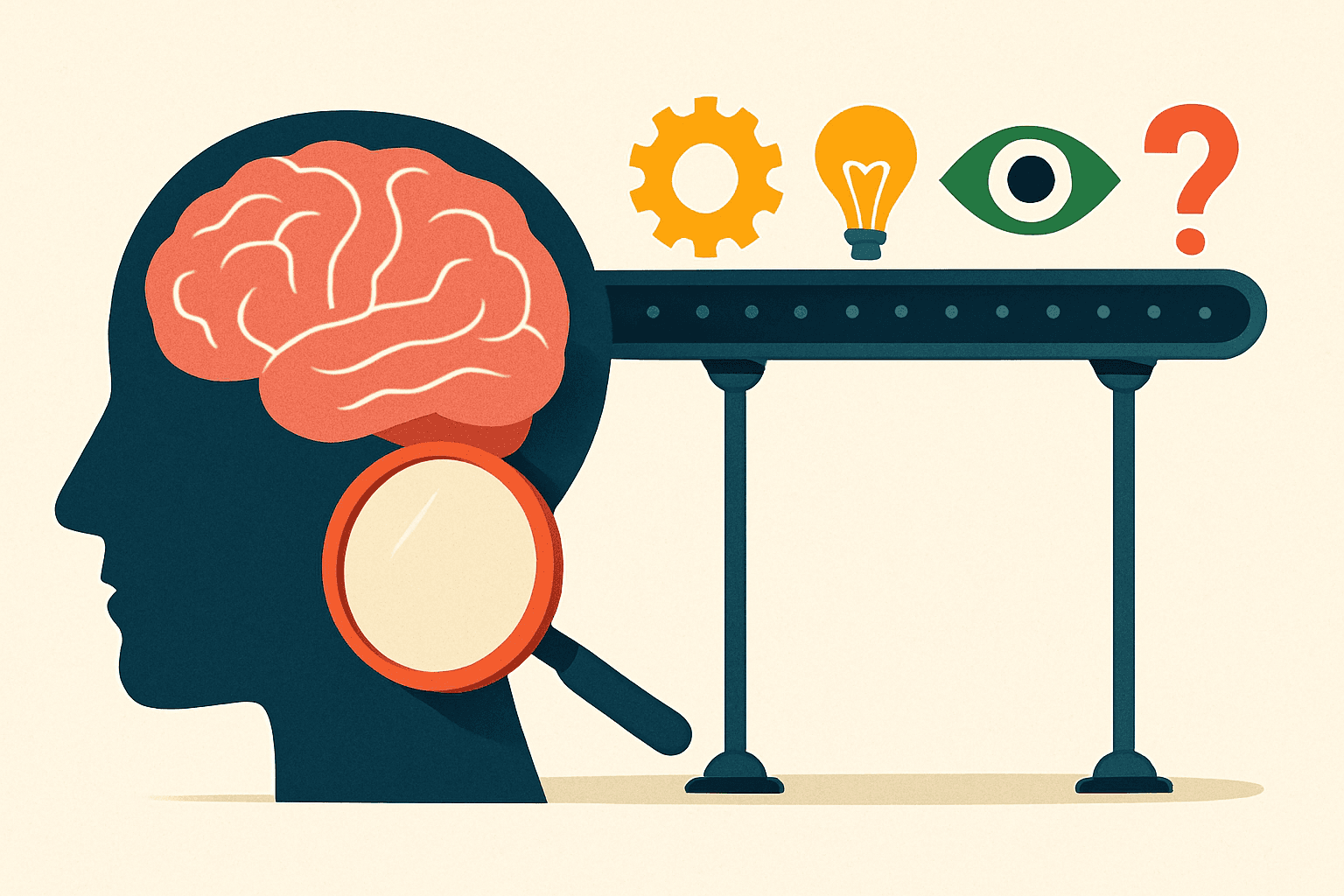
There is something it is like to read this sentence. You are not merely processing symbols and returning outputs. There is an experience occurring, words appearing, meaning assembling, perhaps mild interest or mild boredom, a sense of engaging with an idea. That experience, the felt quality of it, the fact that there is something it is like to be you right now, is what philosophers call phenomenal consciousness, and it is genuinely one of the strangest facts about the universe.
It is strange because everything we know about physics describes processes and relationships, causes, effects, information, energy, mass. Nothing in that description obviously explains why there would also be experience. The lights could all be on, computationally speaking, and the theatre empty. The question of why they're not empty, why there is experience at all, is what David Chalmers called the "hard problem," and it has remained obstinately unsolved for thirty years.
The Easy Problems and the Hard One
There is a useful distinction between what Chalmers called the "easy problems" of consciousness and the hard one. The easy problems are, in practice, extremely difficult, they include explaining attention, memory, introspection, the integration of information across brain systems, and the ability to report on internal states. But they are "easy" in the sense that they are tractable: we know in principle what kind of answer we're looking for (a neurological mechanism), and we're making progress on finding it. Brain imaging, neuroscience, and computational modelling are producing genuine insight into how these things work.
The hard problem is different in kind. It asks not how the brain processes information but why that processing is accompanied by experience at all. Why isn't there just the computation, the neuronal firing, the information integration, without any felt quality? Why does information processing in a brain produce the redness of red, the painfulness of pain, the taste of coffee? These seem like the same questions asked in different ways, but they're not. The first set has functional answers. The second one seems to resist them.
The Two Major Camps
The physicalist position, held by most neuroscientists and many philosophers, is that consciousness is what complex information processing feels like from the inside. On this view, the hard problem is not an unsolved problem so much as a confused one: we're asking why water is wet, when wetness just is what water is like at the scale we encounter it. Experience is what certain patterns of neural activity are, not something in addition to those patterns. The difficulty of imagining how matter gives rise to experience is a limitation of imagination, not a sign that something extra is needed.
The difficulty with this view is that it doesn't obviously answer the question, it reframes it. Saying "experience is what information processing feels like from the inside" still leaves open why information processing has an inside at all. The physicalist can say that it just does, and that this is an empirical fact about complex systems, but this feels less like an explanation than a relabelling of the mystery.
The alternative positions, panpsychism (consciousness is a fundamental feature of everything), dualism (mind and matter are genuinely separate), mysterianism (the answer is beyond human cognitive capacities), all have their adherents, and all have serious problems. Panpsychism avoids the hard problem at the cost of attributing experience to everything, including thermostats. Dualism has the interaction problem: how does an immaterial mind affect a physical brain? Mysterianism concedes defeat but is at least honest about it.
The hard problem is hard not because we lack data but because it's unclear what kind of data would solve it. That's unusual in science, and suggests either that we're asking the question wrong or that we're genuinely up against something fundamental.
Why It Matters
This isn't purely academic. Questions about consciousness have urgent practical implications for how we treat animals, what we make of vegetative states, and what status we should give increasingly sophisticated AI systems. If consciousness is what complex information processing feels like from the inside, then sufficiently complex AI might already have experiences we can neither detect nor communicate about. If consciousness requires something specific to biological systems, then none of it does. We currently have no reliable way to distinguish these possibilities.
Consciousness is clearly a thing, you are having an experience right now, and the fact of that experience is as certain as any fact can be. What it is, where it comes from, and why it exists are questions we're still genuinely, embarrassingly far from answering.
Disagree? Say so.
Genuine pushback is welcome. Personal abuse is not.
Related questions


