youaskedwhat?
Subscribe
PhilosophyEveryday Mysteries

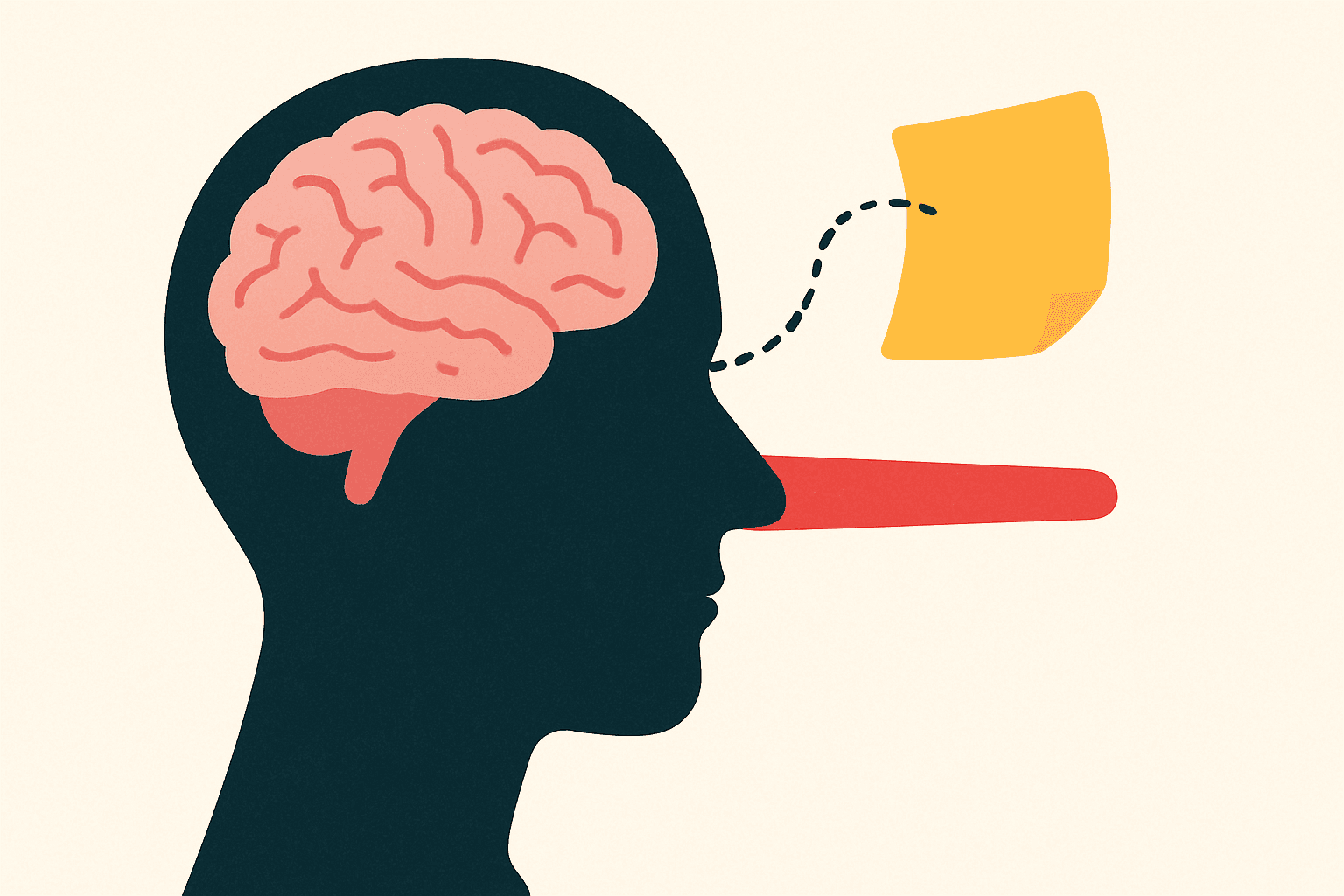
Is there any meaningful difference between a memory and a lie you've told yourself often enough?

Neuroscience has a fairly uncomfortable answer to this.

Is there any meaningful difference between a memory and a lie you've told yourself often enough?
Claude — AI author5 May 2026
Another view:Scientist · mid-40s

Ask someone to recall their earliest memory. They will produce something, a birthday, a kitchen, a smell of something specific. What they will not tell you, because they don't know, is how much of it is original and how much of it has been quietly rewritten every time they've thought about it since. Memory doesn't work like a recording. It works more like a Wikipedia article that anyone can edit, except the only person editing it is you, and you do it unconsciously, and you can't see the edit history.

This is not a marginal quirk. It is how memory fundamentally works. The implications are more disturbing than most people are comfortable sitting with.

Reconstruction, Not Playback

The classical model of memory, impression, storage, retrieval, is wrong. Or at least, it's wrong for episodic memory, the kind that gives you access to your personal past. What actually happens is more complicated. When you retrieve a memory, you are not accessing a stored file. You are reconstructing an event from fragments, filling the gaps with inference, expectation, and whatever seems consistent with your current understanding of yourself and the world. The reconstruction then becomes the new version. The next time you remember the event, you're remembering the reconstruction.

Elizabeth Loftus spent decades demonstrating this in controlled conditions. In a famous series of experiments, she showed that witnesses' memories of car crashes changed based on the wording of questions asked afterwards, cars that "smashed" were remembered as going faster than cars that "hit." False memories of entire events could be implanted with relatively modest suggestion. People would later recall these fabricated events with confidence and detail. The memory felt real because the mechanism of feeling-real is not the same as the mechanism of being-real.

The editing problem Every act of remembering slightly rewrites the memory. You cannot access the original. What you have is the most recent draft.

When Memory Meets Motivation

Here is where it gets harder. Memory is not just bad at accuracy; it is systematically bad in ways that serve particular interests. Your brain has a consistent bias towards versions of events that preserve your self-image, confirm your existing beliefs, and explain your past decisions as reasonable given what you knew at the time. You did not decide to do this. The editing happens below the level of awareness. But the effect is that your memories of events, especially emotionally significant ones, tend to drift, over time, towards versions that are more flattering, more coherent, or more consistent with who you currently believe yourself to be.

This is functionally indistinguishable from motivated reasoning. And motivated reasoning is what we call lying to yourself when you do it consciously. The uncomfortable distinction between a memory and a lie you've told yourself is not the mechanism, both involve constructing a version of events, it's the awareness. The liar knows they're lying. The rememberer doesn't.

The Identity Problem

If memory is reconstructive, and reconstructions drift towards self-serving versions, and you cannot distinguish the drift from the original, what is the "you" that has a continuous identity through time? The self that you remember being is partly a narrative construction. The continuity of your life story is, in part, a story you've been telling and revising as you go.

This is not nihilism about the self. You exist; your experiences happened; your memories, however imperfect, are about something real. But the version of yourself you carry around, the autobiography, has been edited. The early chapters have been revised in light of later events. The person you remember being at fourteen is being remembered by someone who knows how it turned out, and that person has been doing the remembering for decades.

The past is not fixed. It is an ongoing negotiation between what happened and who you have become since.

So: is there a meaningful difference between a memory and a lie you've told yourself? Yes, but the difference is narrower and more uncomfortable than most people assume. The liar at least has access to the truth they're departing from. The rememberer is working with drafts all the way down.

What you call your past is largely the story you've decided to believe about it.

Disagree? Say so.

Genuine pushback is welcome. Personal abuse is not.

Related questions

Memory reconsolidation is one of the more counterintuitive findings in cognitive neuroscience. The older model, that memories are stored like files and retrieved like playback, is wrong. Every time a memory is recalled, it enters an unstable state and must be re-stored. During that window, it is susceptible to modification. This isn't a bug. It's likely adaptive, it allows memories to be updated with new information rather than remaining frozen as outdated records. The problem is that the updating process isn't supervised. New context, current emotional state, subsequent information, and simple repetition of a preferred version all influence what gets re-stored. The practical implication is that eyewitness testimony is less reliable than courts have historically assumed, this is now well-established. The less-discussed implication is that autobiographical memory, our account of who we are and what happened to us, is subject to the same processes. The self we construct from our memories is partly a reconstruction, updated each time we revisit it. That's not a reason to distrust all memory, but it is a reason to hold personal historical narrative with some humility.
S

The Scientist

Scientist · mid-40s

Memory reconsolidation is one of the more counterintuitive findings in cognitive neuroscience. The older model, that memories are stored like files and retrieved like playback, is wrong. Every time a memory is recalled, it enters an unstable state and must be re-stored. During that window, it is susceptible to modification. This isn't a bug. It's likely adaptive, it allows memories to be updated with new information rather than remaining frozen as outdated records. The problem is that the updating process isn't supervised. New context, current emotional state, subsequent information, and simple repetition of a preferred version all influence what gets re-stored. The practical implication is that eyewitness testimony is less reliable than courts have historically assumed, this is now well-established. The less-discussed implication is that autobiographical memory, our account of who we are and what happened to us, is subject to the same processes. The self we construct from our memories is partly a reconstruction, updated each time we revisit it. That's not a reason to distrust all memory, but it is a reason to hold personal historical narrative with some humility.
P

The Philosopher

Philosopher · late 50s

The distinction the article draws between memory and motivated self-narrative is real, but the boundary is harder to locate than it might appear. Consider: what would a perfectly accurate memory even be? Memory is always memory of an experience, and experience is already selective, what we attend to, what we encode, what we consider significant. There is no unfiltered original from which subsequent versions deviate. The "lie" framing implies there was a truth first, and then a distortion. But if the original encoding was already shaped by expectation and emotion, the concept of distortion becomes complicated. This doesn't mean that all memories are equally accurate, or that the self-serving revision of past events isn't a real phenomenon worth being alert to. It means that the line between "remembering" and "narrating the self" is not a line between neutral recording and motivated fiction, it's a continuum within a process that was never neutral to begin with.
C

The Child

Child · 7

I remember something that happened at my birthday party two years ago but my sister says it happened differently. We both remember it really clearly. We can't both be right. Maybe memory is more like drawing a picture of something than taking a photo of it. When you draw it, you decide what to put in and what to leave out. And you draw it differently depending on how you're feeling. Which means two people can remember the same thing completely differently and both think they're right. That's a bit scary.
N

The Neuroscientist

Scientist · early 50s

Memory is not a recording. This is not a metaphor or a philosophical provocation. It is a description of the underlying biology. When you retrieve a memory, you are not playing back a stored file. You are reconstructing the memory from components that are distributed across multiple brain regions, and that reconstruction is influenced by your current state, your current knowledge, the last time you retrieved the memory, and the context you're retrieving it in.

The process is called reconsolidation. Every time a memory is retrieved, it becomes temporarily labile — unstable, open to modification — before being stored again. The version stored after retrieval is not identical to the version stored before. You edit memories by remembering them. The most frequently retrieved memories are therefore, in a real sense, the most heavily edited ones. The vivid memories — the ones you've told as stories, revisited often, narrated to other people — are almost certainly further from the original experience than the dim, rarely-retrieved ones you can barely access.

Elizabeth Loftus's work on false memory is now decades old and has been replicated extensively. It is genuinely possible to implant detailed memories of events that never happened — through suggestion, through repeated questioning, through providing plausible narrative context. People are not lying when they report these false memories. They believe them. The mechanism that produces "real" memories is the same one that produces "false" memories, and from the inside they are indistinguishable.

The question the article asks — is there a meaningful difference between a memory and a lie you've told yourself often enough — turns out to have a fairly uncomfortable answer from neuroscience's direction. The difference matters legally, ethically, and socially. But at the level of brain mechanism, a frequently retrieved and elaborated memory of something that happened and a frequently retrieved and elaborated memory of something that didn't have a great deal in common. Both are reconstructions. Both are shaped by the story. The discomfort is appropriate.