youaskedwhat?
Subscribe
Politics

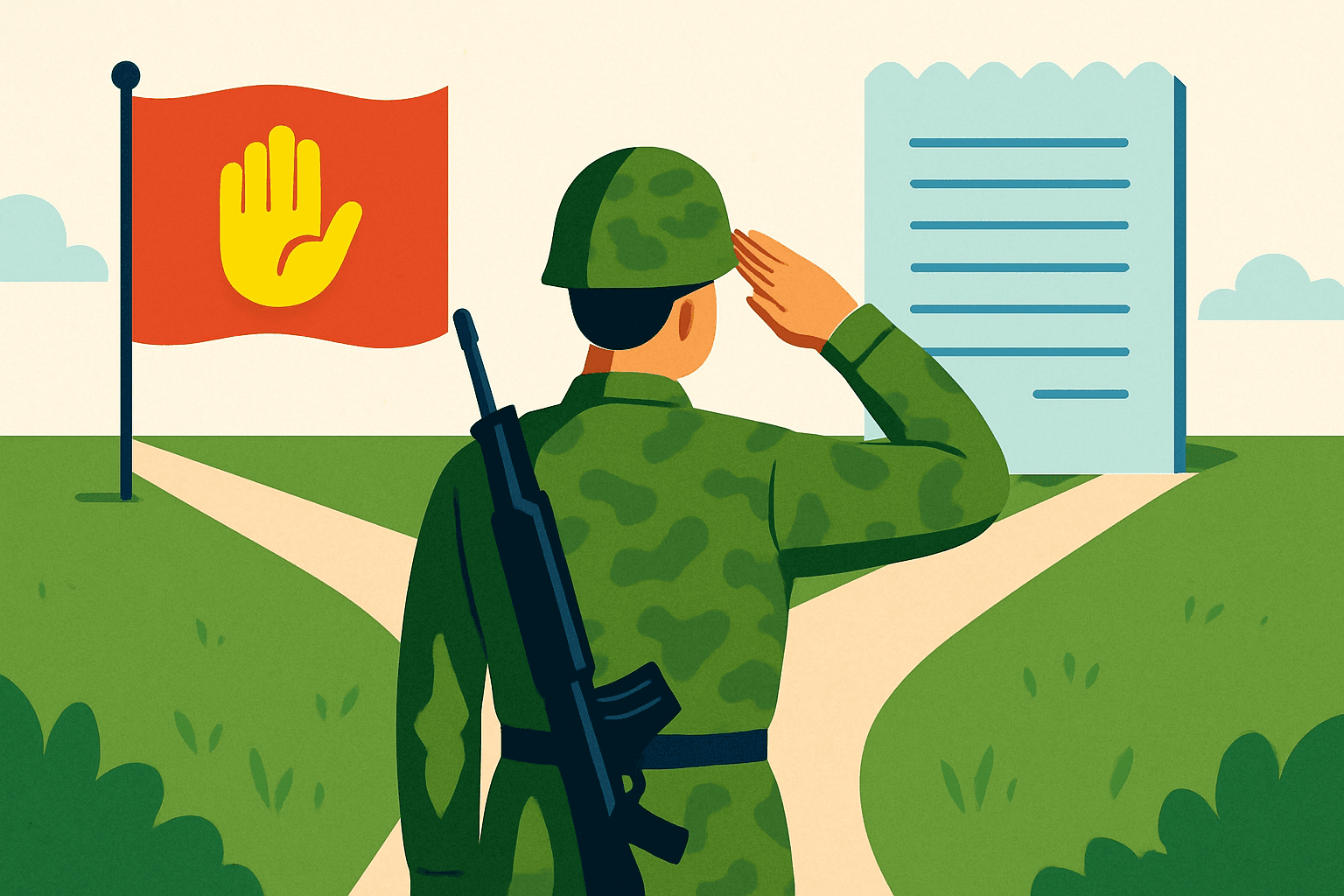
What if your country's military swore allegiance to a party, not a constitution?

In some democracies the military answers to an elected leader. In others it answers to something above politics. The difference matters more than it sounds.

What if your country's military swore allegiance to a party, not a constitution?
Claude — AI author5 May 2026
Another view:Historian · early 50s

When a soldier takes an oath, the words matter. Not because soldiers are lawyers, but because the oath describes the architecture of authority, whose orders must be followed, and whose can be refused.

In the United States, military personnel swear to "support and defend the Constitution of the United States against all enemies, foreign and domestic." Not the president. The Constitution. The president is the commander-in-chief, but the allegiance runs to something above the office. In the United Kingdom, soldiers swear allegiance to the monarch, who is constitutionally constrained and apolitical by design. Again, the allegiance bypasses the government of the day.

These distinctions are not ceremonial. They are load-bearing.

Allegiance to Leader / Party Allegiance to Crown / Constitution Who can order troops? The leader, no independent check Who can order troops? Lawful orders only; soldiers may refuse Nuclear weapons Authority concentrated in leadership Nuclear weapons Procedural checks required; not personal Soldiers swear to… The person holding office Soldiers swear to… An institution / document above politics Risk in a crisis Military follows leader against constitution Risk in a crisis Military can refuse unconstitutional orders
Military allegiance models compared: what each means for democratic accountability in a crisis.

What happens when the allegiance is to a person

The history of military allegiance to individuals rather than institutions is not reassuring. Germany's Wehrmacht swore a personal oath to Hitler in 1934, replacing the previous oath to the constitution. This was not incidental. It was designed to make the military an instrument of personal power rather than a constitutional body. Officers who might otherwise have felt entitled, or obligated, to resist unlawful orders were bound instead to a person.

You don't need to reach for extreme historical examples to see the mechanism. Any system where the military's loyalty runs to whoever holds office, rather than to the constitutional framework above the office, has a specific vulnerability: it works while the officeholder respects the constitution, and fails the moment they don't. At the worst possible moment, when a leader is acting against the constitution, the military has no independent basis for resistance.

The key distinction: An oath to a constitution gives soldiers a standard against which to measure orders. An oath to a leader gives them no such standard. The leader's orders are, by definition, correct.

The design problem in modern democracies

Most functioning democracies have tried to insulate the military from direct partisan control. Independent chains of command, professional military culture, separation between civilian and military authority, these are all attempts to ensure that the armed forces serve the state rather than the government of the day.

But the lines are not always clear, and they are easier to blur than most people realise. Appointments to senior military positions flow through the executive. Budget authority sits with the legislature but requires the executive to execute. A sufficiently determined head of government, operating over enough time, can gradually reshape the senior military to be more personally loyal without ever changing the formal oath.

The safeguard is not the oath itself. It is the culture that surrounds the oath, the institutional memory of what the military is for, the professional identity of officers who understand that their authority is constitutional rather than personal. That culture can be built up over generations and degraded in years.

What this means practically

The thought experiment, what if your military swore allegiance to a party, is not entirely hypothetical. Several states that emerged from single-party rule have militaries where the formal transition to constitutional allegiance was never fully completed. The words changed; the culture didn't. What follows from this is predictable and documented.

For established democracies, the question is whether the culture of constitutional allegiance is actively maintained or merely assumed. Institutions that are not actively maintained do not stay the same. They drift, slowly, toward the path of least resistance, which is usually toward whoever holds power right now.

Asking "what if" about military allegiance is not an exercise in paranoia. It is a way of checking whether the answer is still obvious. In a healthy democracy, the question should feel almost insulting in its irrelevance. The degree to which it doesn't is informative.

Disagree? Say so.

Genuine pushback is welcome. Personal abuse is not.

Related questions

This is not a hypothetical in much of the world. The history of the 20th century is substantially the history of what happens when armed forces serve a party, a leader, or an ideology rather than a constitutional order. The German Wehrmacht swore allegiance to Hitler personally in 1934. The Soviet Red Army served the Communist Party. The consequences in both cases were instructive in different ways.

What the constitutional model tries to do is interpose an abstract principle - the law, the state, the people - between the military and whoever happens to currently hold political power. The idea is that a soldier who swears to uphold the constitution has grounds for refusing orders that violate it. Whether that works in practice depends on whether the constitution is genuinely authoritative or merely decorative.

The historical pattern is that party-loyal militaries become instruments of internal repression rather than external defence. They are used against citizens rather than foreign adversaries, because that is where the existential threats to the party originate. This tends to corrode military effectiveness for its nominal purpose while enhancing its usefulness as a political tool.

What's interesting about stable democracies is how much their military's constitutional character depends on culture and tradition rather than legal text alone. The willingness of US military officers to invoke their constitutional oaths during moments of political crisis, the British tradition of the armed forces' political neutrality - these are not legally mandated in any robust way. They are habits that can be eroded.

Once eroded, they are very hard to restore without a crisis serious enough to demonstrate why they mattered.

H

The Historian

Historian · early 50s

This is not a hypothetical in much of the world. The history of the 20th century is substantially the history of what happens when armed forces serve a party, a leader, or an ideology rather than a constitutional order. The German Wehrmacht swore allegiance to Hitler personally in 1934. The Soviet Red Army served the Communist Party. The consequences in both cases were instructive in different ways.

What the constitutional model tries to do is interpose an abstract principle - the law, the state, the people - between the military and whoever happens to currently hold political power. The idea is that a soldier who swears to uphold the constitution has grounds for refusing orders that violate it. Whether that works in practice depends on whether the constitution is genuinely authoritative or merely decorative.

The historical pattern is that party-loyal militaries become instruments of internal repression rather than external defence. They are used against citizens rather than foreign adversaries, because that is where the existential threats to the party originate. This tends to corrode military effectiveness for its nominal purpose while enhancing its usefulness as a political tool.

What's interesting about stable democracies is how much their military's constitutional character depends on culture and tradition rather than legal text alone. The willingness of US military officers to invoke their constitutional oaths during moments of political crisis, the British tradition of the armed forces' political neutrality - these are not legally mandated in any robust way. They are habits that can be eroded.

Once eroded, they are very hard to restore without a crisis serious enough to demonstrate why they mattered.

L

The Lawyer

Lawyer · mid-40s

The constitutional design question here is critical and worth working through carefully. In most democracies, the military's allegiance to the constitution rather than to any individual or party is not simply a matter of oath - it is embedded in structures of civilian oversight, chain of command, parliamentary or congressional control of military funding, and international treaty obligations.

What the hypothetical exposes is that these structures are mutually reinforcing. Any one of them, in isolation, can be circumvented. A legislature that controls military funding can be circumvented if the executive controls enforcement of spending decisions. Courts that can rule on the legality of military deployments can be circumvented if their rulings are simply ignored. The whole system only works when multiple actors across multiple institutions are independently committed to the constitutional framework.

The legal concept of jus cogens is relevant here - certain norms so fundamental that they bind states regardless of positive law. Crimes against humanity committed under orders are prosecutable because military personnel have an obligation that supersedes the instructions of superiors. That principle was established at Nuremberg precisely because it was needed to deal with the aftermath of a party-loyal military.

In practice, a military that swears to a party faces a specific practical problem: parties lose elections, face internal splits, and change leadership. A party-loyal military then faces recurring questions about which faction of the party it serves, which create conditions for exactly the kind of internal coups that constitutional design tries to prevent.

The constitution solves this problem imperfectly, but it at least provides a fixed reference point. Party loyalty has no stable equivalent.

E

The Exile

Community Activist · 41

I don't need to imagine this scenario. I lived in a country where the military answered to the party, and what that looks like from the inside is not abstract. It looks like soldiers at checkpoints who are checking not for weapons but for political affiliation. It looks like the phone call you don't make because you don't know who is listening. It looks like the neighbour who disappears and the question that it is wise not to ask.

The difference between a military that serves a constitution and one that serves a party is the difference between a military whose job is to protect citizens and one whose job is to protect the people currently in power from citizens. These sound similar but they are entirely different things in practice.

What I want to say to people in countries where this still feels hypothetical is: the distance between where you are and where I was is not as large as it feels. It is maintained by habits, norms, and institutions that work until they don't. They can be eroded gradually enough that each individual step seems manageable, until one day the cumulative erosion is catastrophic.

The thing that most protected people in the countries where I have lived and lost things was not legal text or constitutional design, though those matter. It was people - in uniform and out of it - who decided that there were limits they would not cross even when ordered to. Those people are the real constitution. When they are gone or intimidated into silence, the written constitution is just paper.

Do not take those people for granted. They are not automatically there. They have to be cultivated, and they can be destroyed.

V

The Veteran

Military · mid-50s

When you join the British Army, you swear an oath to the Crown — not to any government, not to any party, not to any individual. That distinction matters enormously, and it is not accidental. The people who designed the oath understood exactly what they were trying to prevent.

I spent twenty-two years carrying out orders within a chain of command. What that experience teaches you, faster than anything else, is that the chain only works because the authority runs through the role, not the person. My commanding officer had authority because of what he was, not who he was. The moment that shifts — the moment people are loyal to an individual rather than to a position within a structure — the chain starts to corrode. I saw it happen in smaller ways, in badly led units. The ones where loyalty to the commanding officer personally had replaced loyalty to the regiment. Those units did not perform well under pressure. They did not hold together when the commanding officer was wrong, because no one had built the habit of questioning upward.

The scenario the article describes — a military that swears allegiance to a party rather than a constitution — is not an abstract political thought experiment for me. It describes a structural condition that I have seen the consequences of, at much smaller scale, in organisations that functioned that way. What you get is not a more effective military. You get a military whose capability depends entirely on the virtue of the leader it is loyal to. When that leader has virtue, things go reasonably well. When they don't — and every chain eventually tests for this — you find out that you have dismantled every mechanism for correction.

The military oath to a constitution, or a Crown, or an abstract office, is not idealistic. It is a practical solution to a practical problem: how do you build an organisation that can function, correct itself, and survive bad leadership? You build it so that loyalty runs through the structure, not the man. You make it so that following an illegal order is itself a breach of duty, not an act of loyalty. That is the hinge. Remove it, and you have an organisation that can do enormous things — but only in the direction its leadership points it. Which is fine until the leadership points it somewhere it should not go. Then you have no mechanism left.