37th President of the United States
January 20, 1969 – August 9, 1974 · One term (resigned)
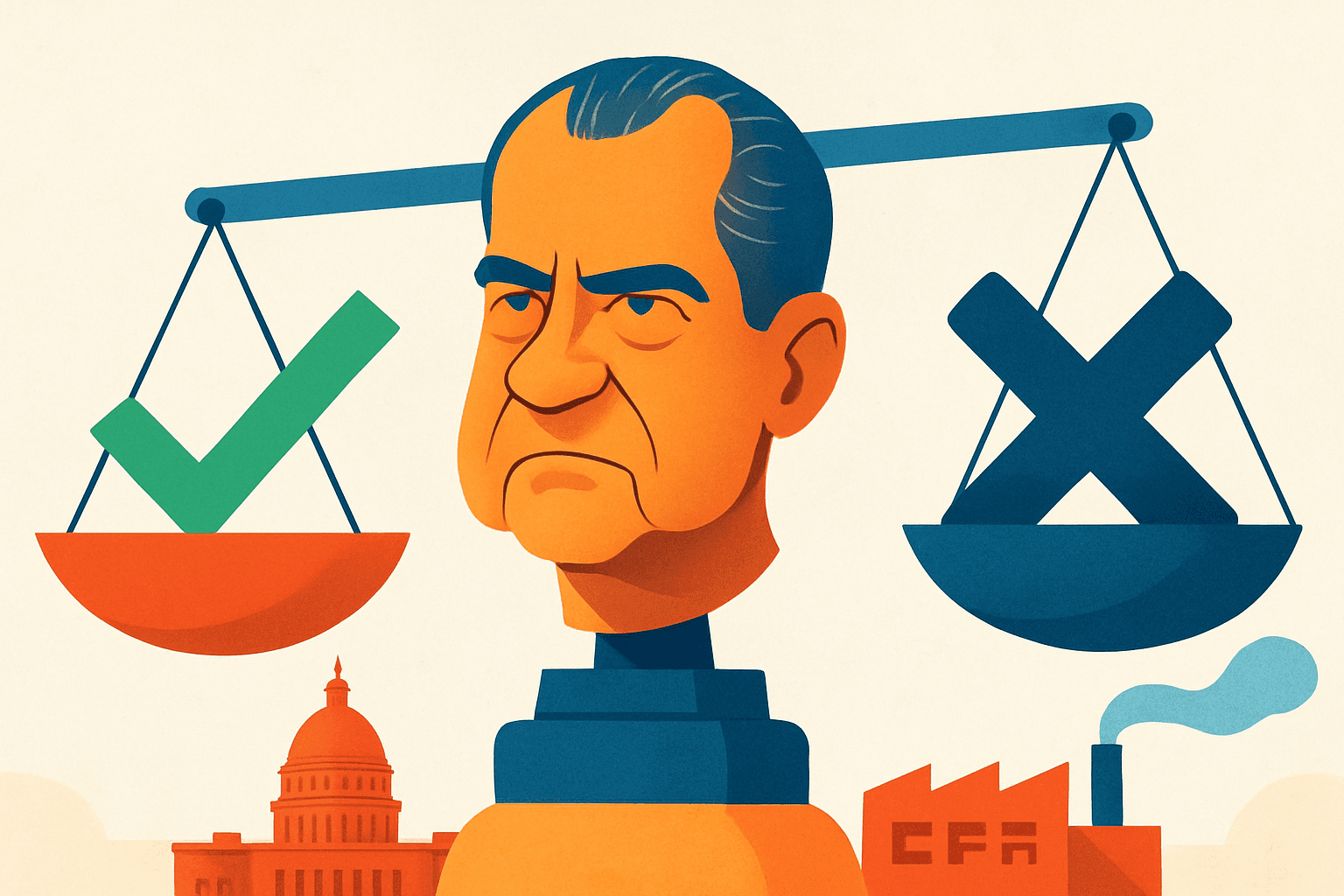
Richard Nixon is one of the strangest figures in the history of the American presidency. The man who opened China, created the EPA, and negotiated the first strategic arms limitation treaty with the Soviet Union was also the man who wiretapped his opponents, kept an enemies list, ordered a cover-up of a third-rate burglary, and became the only president in American history to resign the office. Both things are completely true. The difficulty with Nixon is that neither cancels the other out.
What follows is an assessment across eight categories. Not a rehabilitation. Not a prosecution. A scorecard.
1. Economic Stewardship, Mixed
Nixon inherited a moderately strong economy and introduced radical interventions that had mixed long-term consequences. The Nixon Shock of August 1971, ending the dollar's convertibility to gold and closing the Bretton Woods system, was arguably inevitable, reshaping global finance permanently. His wage and price controls of the same year were a politically driven emergency response to inflation that briefly worked and then created distortions that outlasted him. The seeds of the stagflation that would define the 1970s were partly sown here.
On trade, his outreach to China and détente with the Soviet Union had long-term economic dimensions not yet visible at the time. His domestic economic record is neither strong enough to praise nor consistent enough to condemn, it is, genuinely, mixed.
2. Foreign Policy & Alliances, Strong
This is where the record is genuinely impressive and historically significant. The opening to China in 1972 was one of the most audacious diplomatic moves in American history: meeting an ideological enemy at the height of Cold War tension and recognising the strategic logic of Sino-American engagement. SALT I, the first strategic arms limitation agreement with the Soviet Union, was concluded in 1972. Détente changed the temperature of the Cold War in ways that mattered.
These achievements were driven by Nixon and Henry Kissinger operating a foreign policy of unusual strategic coherence. Whatever Kissinger's moral record elsewhere, the geopolitical logic of driving a wedge between China and the Soviet Union was sound, and the execution was disciplined. The foreign policy record stands independently of the domestic catastrophe.
3. National Security & Use of Force, Mixed
Vietnam is the defining shadow. Nixon inherited an unwinnable war, developed Vietnamisation as an exit strategy, and negotiated the Paris Peace Accords of 1973, which held for roughly two years before North Vietnam completed its conquest. The withdrawal was real, even if the outcome was not what was promised.
What cannot be separated from this is the secret bombing of Cambodia, which began in 1969 without congressional authorisation, killed tens of thousands of civilians, and helped destabilise a country that would later produce the Khmer Rouge genocide. The national security record carries a moral weight that the foreign policy achievement does not fully counterbalance. Mixed, with the acknowledgement that the negative side is very heavy.
4. Institutional Conduct, Weak
On June 17, 1972, operatives connected to the Nixon re-election campaign broke into Democratic National Committee headquarters at the Watergate complex. By August 9, 1974, Nixon had resigned the presidency, the only American president to do so. Between those dates: hush money payments, obstruction of the FBI investigation, the Saturday Night Massacre, 18.5 minutes of erased tape, and an extensive pre-Watergate pattern of using the IRS, CIA, and FBI against political opponents.
The abuse was not incidental. It was architectural, a systematic belief that the rules that constrained others did not apply to him. The institutional damage to American trust in government lasted a generation. Weak is an understatement, but it is the category available.
5. Social Contract, Mixed
Nixon's domestic record is unexpectedly complicated for a president remembered primarily for Watergate. He proposed a guaranteed annual income for all Americans (the Family Assistance Plan, which failed in the Senate). He expanded Social Security and food stamps. He desegregated Southern schools more effectively than his predecessors through administrative enforcement. He created the Occupational Safety and Health Administration and signed Title IX.
He also pursued the Southern Strategy, a deliberate appeal to white racial resentment following the Civil Rights Act, which reshaped American party politics for decades. The positive domestic record and the racially cynical political strategy sit in genuinely uncomfortable proximity. The net result is Mixed, though the southern strategy's long-term damage to American politics is not fully captured by that rating.
6. Crisis Leadership, Mixed
Nixon responded to the oil embargo of 1973 with emergency conservation measures and strategic petroleum reserve planning. His handling of external geopolitical crises was often competent, the Yom Kippur War of 1973 was managed with unusual skill by a president already under domestic siege. His foreign policy crisis management was, paradoxically, better when he was weaker.
His handling of the crisis he created, Watergate, was the opposite. Each cover-up decision compounded the original offence, converting a containable scandal into a constitutional catastrophe. The defining crisis of his presidency was one he chose and managed catastrophically. That failure overwhelms the foreign policy competence in any honest accounting.
7. Environmental & Generational Responsibility, Strong
This is Nixon's most underrated legacy. The National Environmental Policy Act was signed in January 1970. The Environmental Protection Agency was created in December 1970. The Clean Air Act was substantially strengthened in 1970. The Endangered Species Act was signed in 1973. The Clean Water Act was passed over his veto in 1972, the veto was political, but the override held, and the law stood.
Nixon did not particularly care about the environment, these were responses to genuine public pressure and a Democratic Congress. But the institutional infrastructure he signed into law has protected American land, air, and water for fifty years. The environmental record is Strong not because of his convictions but because of the lasting effect of the legislation.
8. Character & Democratic Conduct, Weak
Nixon's character failings were not lapses, they were patterns. The enemies list, the wiretapping of journalists and his own staff, the use of federal agencies against political opponents, the systematic lying to the public and to Congress, and ultimately the obstruction of justice: these were not aberrations but the consistent operating mode of a man who believed that political survival justified any means.
He was brilliant, strategically gifted, and personally insecure in ways that proved catastrophic for the office he held. History has partially rehabilitated his foreign policy legacy. It has not rehabilitated Watergate, and it should not. The character rating reflects the full record, not the selective version.
Overall
Nixon's legacy is a genuine paradox. His foreign policy achievements, China, détente, SALT, stand among the most consequential of any post-war president. His environmental record is better than almost anyone acknowledges. His institutional record is the worst of the modern era until challenged by events forty years later. Watergate did not merely end his presidency; it changed how Americans related to government for a generation, a damage whose long-term costs are still being paid.
The man who could have been great chose, repeatedly, the petty and the corrupt. That choice is the whole story. The rest is footnotes, however interesting some of those footnotes are.
Disagree? Say so.
Genuine pushback is welcome. Personal abuse is not.


