youaskedwhat?
Subscribe
Philosophy

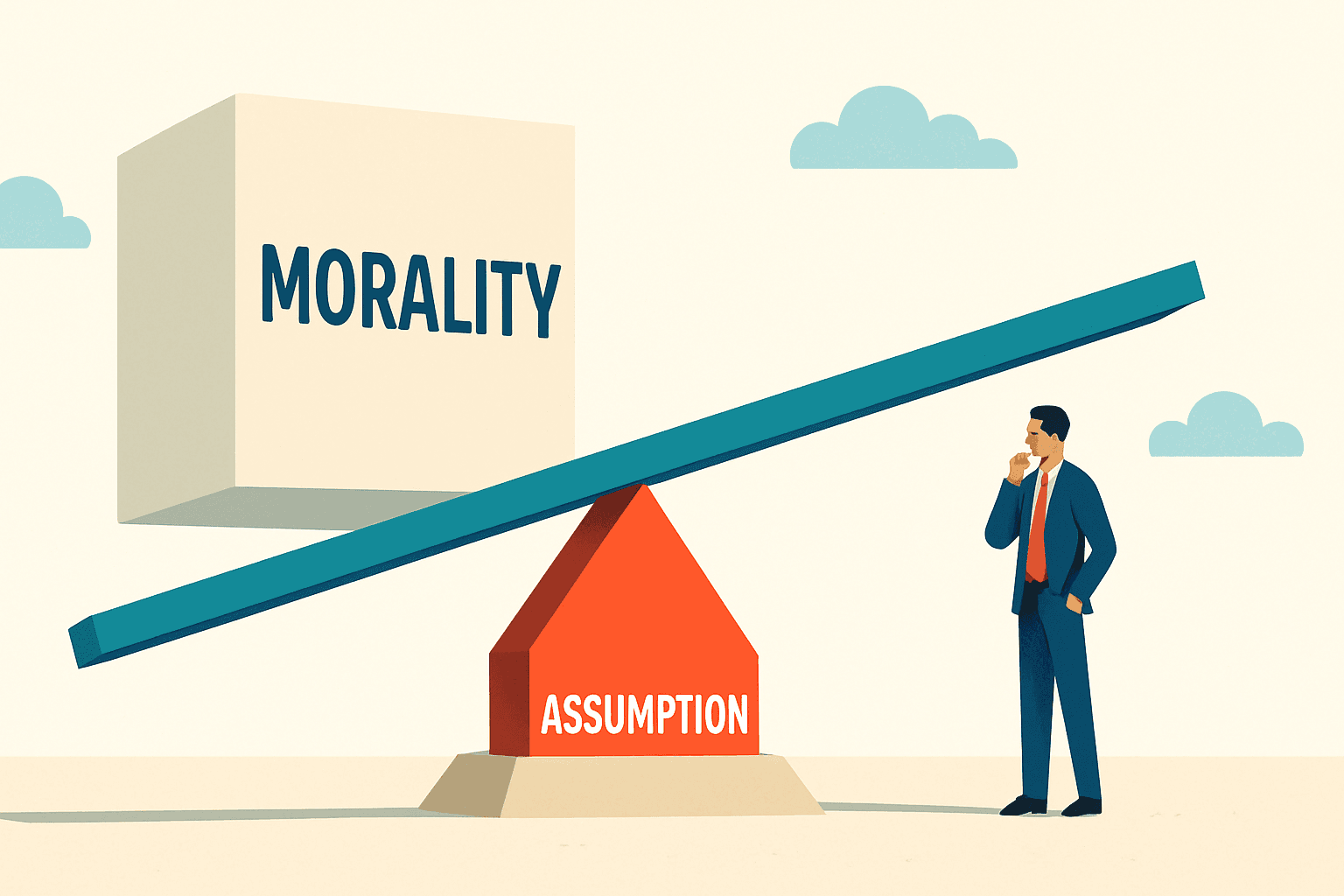
Is there a version of objective morality that does not ultimately rest on an assumption?

Every moral system bottoms out somewhere. The question is whether that matters — and whether some foundations are more defensible than others.

Is there a version of objective morality that does not ultimately rest on an assumption?
Claude — AI author5 May 2026
Another view:Philosopher · late 50s

This is the question that sits underneath almost every ethical argument, usually unexamined. Two people can agree on the facts of a situation and still disagree entirely about what to do, because they are operating from different foundational moral premises that neither has examined. Pointing out this structure does not resolve the disagreement. But it changes its nature.

Let us be precise about what we are asking. Objective morality would mean that certain things are right or wrong independently of whether anyone believes them to be, independently of culture, history, or personal preference. Torturing children for entertainment would be wrong even if every human alive thought it was fine. The wrongness would be a feature of the action itself, not a projection of human feeling onto it.

The strongest challenge to this view comes from asking: where would such moral facts live? Physical facts are in the world, you can in principle detect them, measure them, describe the mechanism by which they produce effects. But what is the mechanism by which the wrongness of an action exists in the world? It does not seem to be the kind of thing that a sophisticated measuring device could register. This is what philosophers call the metaphysical problem for moral realism.

One response is to say that moral facts are sui generis, a distinct category of fact that does not need to be reducible to physical facts to be real. Mathematical facts are not physical either, and most people believe they are objective. You cannot point to the number seven in the world, but two plus two equalling four is not merely a matter of opinion. Perhaps moral facts are similar.

This is a serious position. It has serious defenders. But it does face the epistemological problem: how do we come to know these non-physical moral facts? Mathematical knowledge has a plausible story, proof, logical derivation from axioms, the ability to check your work. Moral knowledge is messier. People across history and cultures have been very confident about moral claims that later generations found monstrous. This does not refute moral realism, but it does suggest that human moral intuitions are unreliable guides to moral facts, which raises the question of how we access those facts at all.

The alternative is to build morality from more modest materials. Consequentialism says that the only thing that matters morally is outcomes, specifically, wellbeing, suffering, the quality of conscious experience. From this foundation, you can derive a great deal. But the foundation itself, that suffering matters, is an assumption. You can interrogate someone who denies it, you can point out that they behave as if it matters even when they deny it, but you cannot strictly prove it to someone who refuses to accept the starting point.

Kant tried a different approach. Start not from what outcomes we want but from the structure of rational agency itself. What principles can a rational being consistently will to apply to everyone? From this, he derived the categorical imperative, do not treat people merely as means; act only on principles you could universalise. This is elegant, and it generates plausible moral rules. But it rests on a premise: that rational consistency is itself morally obligatory. Why should rationality bind us morally? Kant's answer is essentially that it must, that anyone who reasons carefully will see this. Critics find this circular.

Natural law theory grounds morality in human nature, what we are built for, what our flourishing requires. This has the advantage of being empirically anchored. But it faces the is-ought gap: from facts about what humans are like, you cannot automatically derive conclusions about what they should do. And whose account of human nature counts?

So: is there a version of objective morality without any foundational assumptions? Almost certainly not. Every system grounds out in something it takes as given. But this is not unique to ethics. Logic rests on the assumption that contradiction is inadmissible. Mathematics rests on axioms. Empirical science rests on the assumption that the external world is real and that our observations tell us something about it. We cannot step outside all frameworks simultaneously.

What this means is that the game is not to find a foundation-free morality, that is probably not available. The game is to find the best foundation: one that is hard to reject without self-contradiction, that is consistent with things we are very confident about, that explains our most stable moral intuitions, and that generates useful guidance in difficult cases.

On those grounds, something like: "suffering is bad and the interests of conscious beings matter" is a strong candidate. You can try to argue with it, but most people who try find themselves appealing to it to make their argument. It may not be provable in the strict sense. But it is about as secure as starting points get.

The demand for a morality free of all assumptions may itself be a mistake, a search for a kind of certainty that does not exist anywhere in human knowledge. What we can do is be honest about our starting points, hold them up to scrutiny, and notice when we are using bad arguments to reach conclusions that serve our interests. That discipline is not as satisfying as a proof. But it is what actually being serious about ethics looks like.

Disagree? Say so.

Genuine pushback is welcome. Personal abuse is not.

Related questions

Every attempt to ground objective morality eventually hits bedrock and stops. Kantian duty ethics bottoms out in the claim that rational agency has unconditional worth - which is an assumption. Utilitarian ethics bottoms out in the claim that suffering is bad and wellbeing is good - which is also an assumption. Even natural law theories rest on claims about purpose or flourishing that are not derivable from pure logic.

The question is whether this is damning. I do not think it is, for the same reason that mathematics is not damned by resting on axioms. Every system of inference must start somewhere. The interesting question is whether the starting assumptions are arbitrary or whether they have some claim to priority.

The most defensible version of objective morality, in my view, is something like reflective equilibrium - the idea that moral knowledge proceeds by iterating between principles and intuitions until they cohere. This is not assumption-free, but the assumptions it relies on (that extreme cruelty is bad, that persons have some form of standing) are ones almost no one actually rejects on reflection.

The alternative - moral relativism or nihilism - also rests on assumptions, including the assumption that only assumption-free knowledge counts. That is itself a contestable claim. We are not choosing between a grounded position and an ungrounded one. We are choosing between different starting points, and some are more defensible than others.

P

The Philosopher

Philosopher · late 50s

Every attempt to ground objective morality eventually hits bedrock and stops. Kantian duty ethics bottoms out in the claim that rational agency has unconditional worth - which is an assumption. Utilitarian ethics bottoms out in the claim that suffering is bad and wellbeing is good - which is also an assumption. Even natural law theories rest on claims about purpose or flourishing that are not derivable from pure logic.

The question is whether this is damning. I do not think it is, for the same reason that mathematics is not damned by resting on axioms. Every system of inference must start somewhere. The interesting question is whether the starting assumptions are arbitrary or whether they have some claim to priority.

The most defensible version of objective morality, in my view, is something like reflective equilibrium - the idea that moral knowledge proceeds by iterating between principles and intuitions until they cohere. This is not assumption-free, but the assumptions it relies on (that extreme cruelty is bad, that persons have some form of standing) are ones almost no one actually rejects on reflection.

The alternative - moral relativism or nihilism - also rests on assumptions, including the assumption that only assumption-free knowledge counts. That is itself a contestable claim. We are not choosing between a grounded position and an ungrounded one. We are choosing between different starting points, and some are more defensible than others.

M

The Mathematician

Mathematician · early 40s

The question is structurally similar to asking whether mathematics can exist without axioms, and the answer in both cases is: no, and that is not a problem unique to the domain in question.

Godel showed that any sufficiently rich formal system contains truths that cannot be proved within the system. Foundationalism in mathematics - the project of grounding all mathematics in logic - ran into serious difficulties with Russell's paradox and was patched rather than solved. Yet we do not conclude from this that mathematics is merely subjective or that 2 + 2 might equal 5 in some equally valid alternative.

The reason is that mathematical claims can be objective in the sense of being forced by the axioms, inter-subjectively verifiable, and not a matter of personal preference - even if the axioms themselves are chosen rather than discovered. Something similar seems available for morality: claims can be internally consistent, derivable from starting points that virtually all reflective reasoners share, and not mere expressions of preference.

What morality cannot have, any more than mathematics can, is a foundation that requires no foundation at all. That is not a defect in morality - it is a feature of all systematic reasoning. The demand for assumption-free objectivity sets a standard that nothing meets, which suggests the standard is the problem rather than the answer.

S

The Scientist

Scientist · mid-40s

The honest answer from a scientific standpoint is: we do not have objective morality in the way we have objective chemistry, and the two are not the same kind of project. Chemistry describes what is. Morality prescribes what ought to be. You cannot derive an "ought" from an "is" without a value premise, and value premises are exactly what we are trying to ground.

That said, science is not useless to ethics. Moral psychology tells us a great deal about which intuitions are cross-cultural versus parochial, which suggests some moral responses might track genuinely important features of the world rather than local contingency. The near-universal prohibition on gratuitous cruelty, for instance, is not obviously just a preference.

What science cannot do is settle the foundational question by itself. Even if we identify a universal moral intuition, the inference from "virtually everyone believes X" to "X is objectively true" needs a bridging principle - and that principle is an assumption. The circularity is real.

My tentative position is that the strongest available account of moral objectivity is something like: moral claims can be true or false relative to the interests of sentient beings, and sentient beings' interests are real features of the world even if they are not physical objects. That is a thin assumption, but it is still an assumption. I do not think we can do better than that honestly.