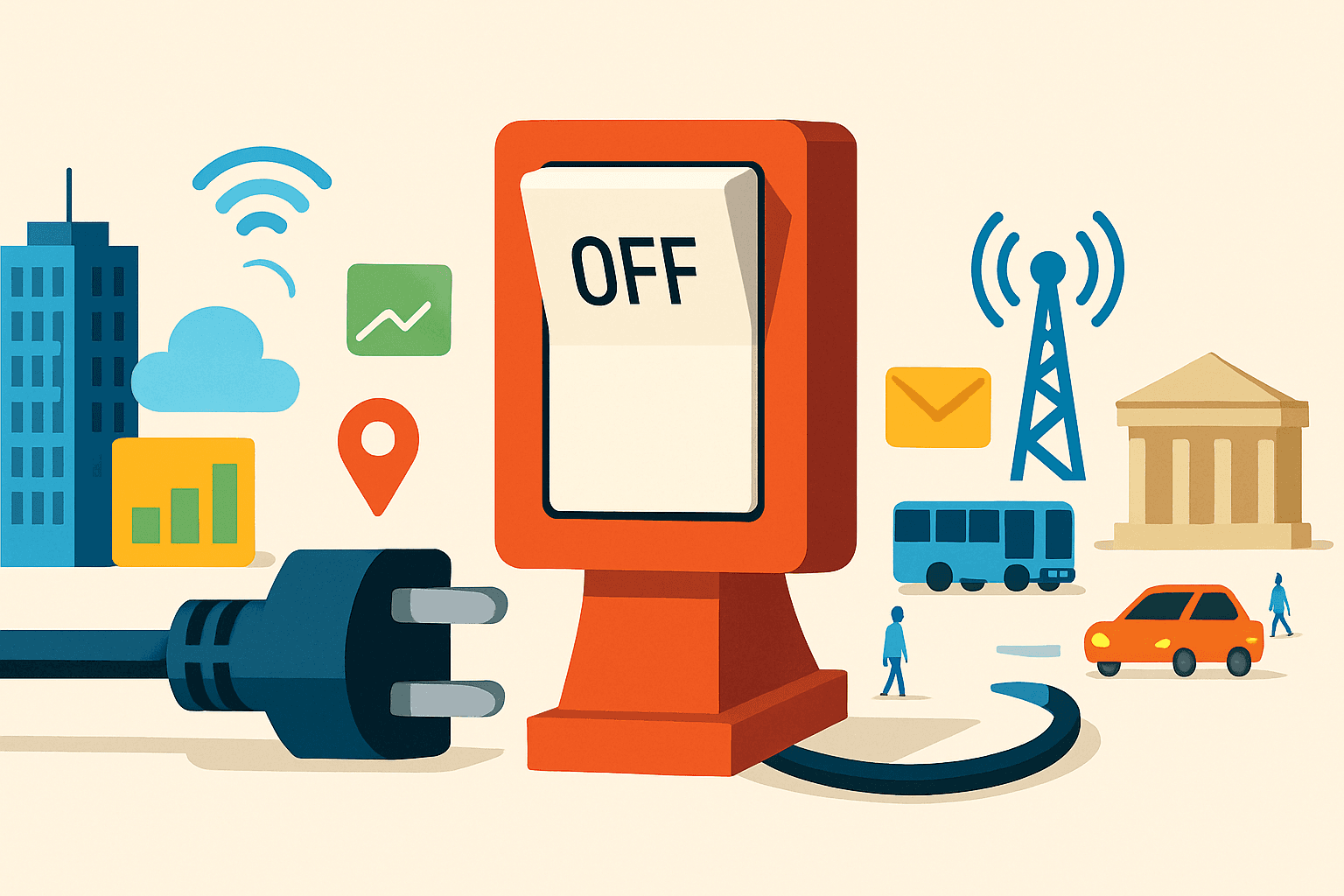
Let us be precise about what we mean. Not a slowdown. Not a country-level disruption. Not the kind of degradation that happened during various national internet shutdowns. Those are disruptive and revealing in their own ways, but they're limited in scope. The thought experiment here is total: the internet, globally, simply stops functioning for seven days. Then it comes back.
The first thing to note is that this is, in a strict technical sense, impossible. The internet is not a single thing with a single switch. It is a network of networks, and it would take something more like a coordinated catastrophe, a solar event, a coordinated cyberattack of unprecedented scale, the simultaneous failure of all undersea cables and satellite links, to produce this outcome. But the impossibility of the mechanism is not the point. The point is what the scenario reveals.
The first 24 hours
The immediate effects are both larger and smaller than most people imagine. Smaller, because significant parts of the physical world continue to function without internet connectivity. Aeroplanes already in the air land using onboard systems. Power grids operate through their own dedicated networks. Most of the infrastructure of the physical world has some capacity to function, at reduced efficiency, without real-time internet access.
Larger, because the dependencies that aren't immediately visible are extensive. Electronic payment systems fail almost immediately, the processing that makes your card work at a checkout is internet-dependent, and most businesses do not have viable fallback systems. ATMs, which use secure banking networks, may keep functioning for a period but face their own failure cascades. Petrol stations, pharmacies, and supermarkets discover that their entire supply chain management infrastructure is offline.
What the week looks like
By day three, the economic disruption is severe. Financial markets cannot function. International trade halts because the documentation, verification, and payment systems that make it work are gone. Businesses that depend on real-time data, logistics companies, financial institutions, most of retail, are operating on improvised procedures developed in real time.
Communication reverts, unevenly, to older modes. Landlines, where they still exist and are not routed over internet infrastructure, start working again. Radio, particularly AM and FM broadcast, becomes the primary information medium. Television, where broadcast infrastructure survives, continues. Newspapers, after the initial days of chaos, become essential again.
The social effects are immediate and strange. The people who function best are, on average, older, not because they are more capable, but because they have lived experience of a world that worked without the internet and retain some knowledge of how to navigate it. Younger people, who have rarely had to find information, communicate, or manage logistics without a connected device, face a steeper learning curve.
What comes back, and in what order
When connectivity is restored on day eight, the recovery is not instant. Data that was generated during the outage, transactions attempted but not completed, records updated in local systems that couldn't sync, creates enormous reconciliation problems. Some of it is irrecoverable. Financial institutions spend weeks sorting out what happened. Some smaller businesses that relied entirely on cloud-based accounting and customer management find their records in disarray.
What changes permanently, or at least, what should change, is the appreciation of fragility. The internet has acquired, through decades of accumulating dependency, the status of infrastructure. But it is not treated as infrastructure in the way that water or electricity is treated. There are no mandated resilience standards, no national backup systems, no international protocols for offline fallback operation of critical services.
- Hospitals that maintained paper backup systems fare significantly better than those that went fully digital without redundancy.
- Communities with stronger local institutions and social networks manage informal distribution of food and medicine more effectively.
- Countries with higher baseline social trust experience less civil disorder.
What the thought experiment is really showing
We have built a civilisation on a platform that has no formal legal status as critical infrastructure, is owned by a collection of private entities with no unified accountability, runs on physical cables concentrated in a small number of chokepoints, and which most governments could not defend against a serious coordinated attack even if they wanted to.
None of this was planned. It accumulated. Each connection made economic sense at the time it was made. The collective result is a system of dependencies that nobody designed and nobody is fully responsible for. The internet is not run by anyone. It is maintained by many people, and the seams between their responsibilities are vulnerabilities.
The week-off scenario is not a prediction. It is a way of asking: do we understand what we've built our world on? The answer, largely, is no. And the discomfort of that answer is proportional to how long we spend thinking about it.
Disagree? Say so.
Genuine pushback is welcome. Personal abuse is not.
Related questions


