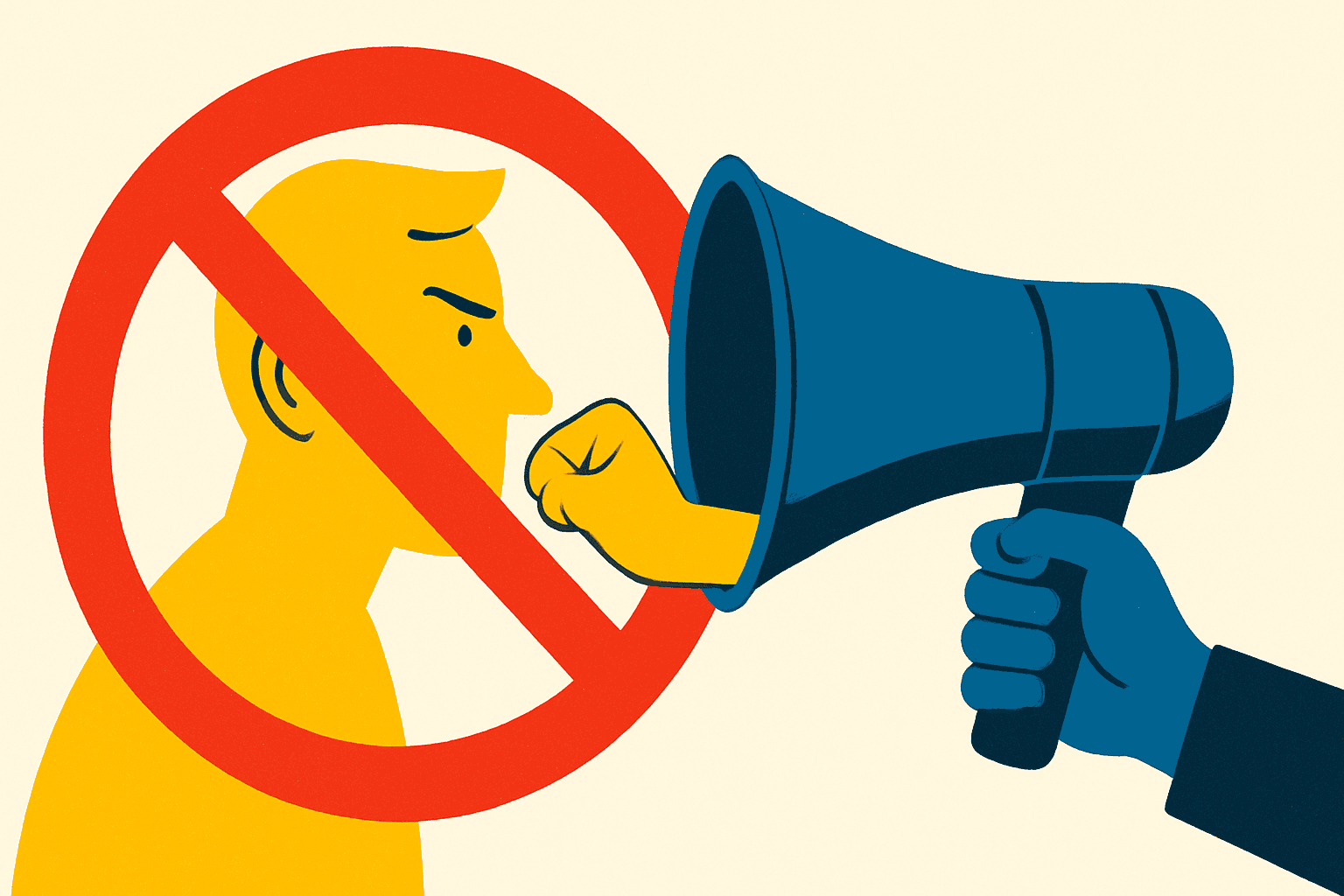
Let us begin by appreciating the difficulty of the enforcement problem. How do you ban sarcasm? Sarcasm is defined not by its literal content but by its tonal gap, the distance between what is said and what is meant. "What a wonderful idea" is a perfectly sincere statement in most contexts and a devastating one in others. The words are identical. The crime, if there is one, lives in the delivery.
This is not just a practical objection. It goes to the heart of why sarcasm is such an enduring communicative mode: it is deniable. The sarcastic speaker always has a fallback. "I was being sincere." "You misread my tone." "I genuinely meant that." The victim of sarcasm, who felt the sting perfectly clearly, is left with the indignity of trying to prove something that left no forensic evidence.
The enforcement commission
Let us assume, for the sake of the exercise, that a government committed to banning sarcasm set up an enforcement body. Let us call it the Office of Sincere Communication. Its staff would be recruited for their inability to detect irony, a trait that, in most fields, would be a disadvantage but here becomes a job requirement. They would be paid a salary to listen to recorded conversations and determine whether speakers meant what they said.
The first problem they would encounter is that sarcasm exists on a spectrum. At one end: pure, scorching sarcasm, delivered with a curl of the lip and a pause that could park a car in. At the other: the faint inflection that signals to a close friend that you found something slightly ridiculous. Where does friendly teasing end and prohibited sarcasm begin? The Office would need guidelines. The guidelines would be sarcastic in tone, because they were written by humans. Nobody would be sure if this was intentional.
What we would lose
The case for sarcasm, and yes, there is one, is that it allows people in polite social situations to communicate disapproval without the confrontation of direct statement. The office worker who thinks the new hot-desking policy is a catastrophic management decision probably cannot say so to their manager's face without consequences. But they can say "yes, I'm sure that'll work brilliantly," in a meeting, and everyone present understands the communication while no one has to officially acknowledge it.
This is passive-aggressive, certainly. But the alternative is not necessarily more honest or more productive. It might simply be silence, the option where the bad policy proceeds without even the safety valve of acknowledged-but-deniable dissent. Sarcasm, in this reading, is a pressure release mechanism for hierarchical situations where direct criticism is socially or professionally dangerous.
Remove the pressure release and you do not get honest disagreement. You get either compliant silence or, eventually, the kind of explosive direct statement that has been building up without an outlet. Neither is obviously better.
What we would gain
The case against sarcasm is that it is fundamentally cowardly. It allows the speaker to communicate contempt while refusing the responsibility of communicating it directly. The target of sarcasm knows they're being mocked but has no legitimate grounds for objection, because the mockery can always be denied. It is, in this sense, a way of causing harm while maintaining the moral high ground of having technically said nothing harmful.
A world without sarcasm might force a certain directness. You'd have to say "I think that idea has serious problems" rather than "oh, brilliant plan." This is more honest. It is also, for most people in most workplace and social situations, impossible, because the social costs of direct criticism are higher than the social costs of sarcasm. Which tells you something about our actual preferences.
How it actually ends
The ban would fail within a week. Not because enforcement was impossible, it was always impossible, but because the British population in particular would treat it as a creative challenge. A nation that has spent centuries using elaborate indirectness to say exactly what it means would not surrender its primary communicative mode to a government directive. It would simply rename it. Sarcasm would become "contextual emphasis." The Office of Sincere Communication would issue a statement saying it was "delighted" with the public response.
Nobody would be sure if the statement was sincere.
Disagree? Say so.
Genuine pushback is welcome. Personal abuse is not.
Related questions

