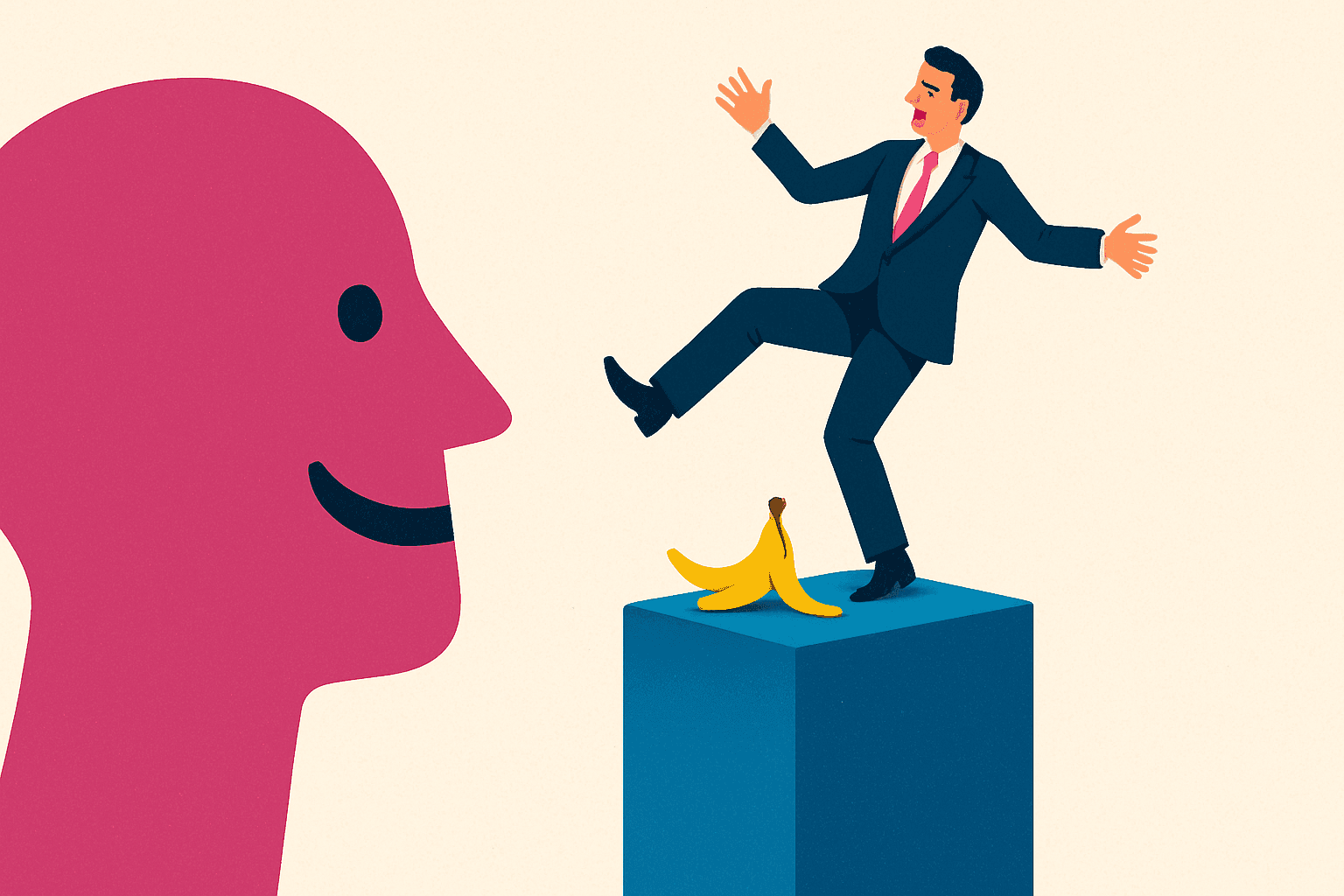
A man trips on a kerb. Mildly amusing. A man who has just finished a speech about his physical prowess trips on a kerb. Funnier. A man who has spent the week publicly announcing how unlike other people he is trips on a kerb while getting into a private jet. Considerably funnier. The pleasure scales with the gap between the person's self-presentation and what just happened to them.
This is schadenfreude, the pleasure taken in another's misfortune, and while it is usually presented as something we should be vaguely ashamed of, understanding why it exists tells you something that the shame response tends to obscure.
The social function of comeuppance
Experimental research on schadenfreude consistently finds that it is strongest in three conditions: when the target has been particularly arrogant or confident, when the misfortune seems connected to the arrogance (the confident driver who crashes), and when the observer has lower status than the target. The emotion is not random. It is tracking something about fairness and social hierarchy.
Humans are intensely sensitive to status, to who has more than they deserve, who is claiming precedence they haven't earned, who is confident in a way that isn't backed by reality. We track this across social groups with great precision. When someone at the top of the hierarchy stumbles, the pleasure experienced further down it is a response to what feels like a correction. The world briefly resembles its proper shape.
Why the confident fall is especially funny
The specific comedy of watching an important person fail depends on a structural feature of status. High-status individuals, almost by definition, present themselves with confidence. That confidence is partly genuine and partly performative, it is itself a claim to status, and it is a claim that others are either deferring to or quietly contesting. When the confidence is punctured by events, the audience of quiet contesters experiences the vindication simultaneously.
There is also a cognitive element. Comedy frequently derives from incongruity, from the juxtaposition of two things that don't fit together. High status and humiliation are a particularly potent incongruity, because high status is precisely supposed to be the condition that protects you from certain forms of humiliation. The important person falling on ice is not just a person falling on ice. It is a vivid demonstration that status is contingent, that dignity is fragile, and that the universe does not in fact respect anyone's self-image.
The unflattering part
The uncomfortable implication is that the pleasure we take in powerful people's failures is not entirely about justice. Some of it is competitive. We gain relative status when others lose it. The person below the hierarchy rises, in a sense, when the person above it stumbles. Schadenfreude has a zero-sum quality that doesn't sit comfortably with the self-image of people who like to think they want good outcomes for everyone.
It is also, when examined honestly, often present when the failure of the important person doesn't benefit us in any way and doesn't particularly serve justice. We enjoy the clip of the confident pundit being comprehensively wrong. We enjoy the report of the self-proclaimed efficient manager's botched meeting. The correction is satisfying independently of any consequences.
The schadenfreude impulse is not something to suppress or apologise for, it is telling you something true about how social hierarchy actually works, how status is constantly contested, and how much of the seriousness with which important people are treated is collaborative and revocable. The comedy comes from remembering that it's revocable.
Disagree? Say so.
Genuine pushback is welcome. Personal abuse is not.
Related questions

