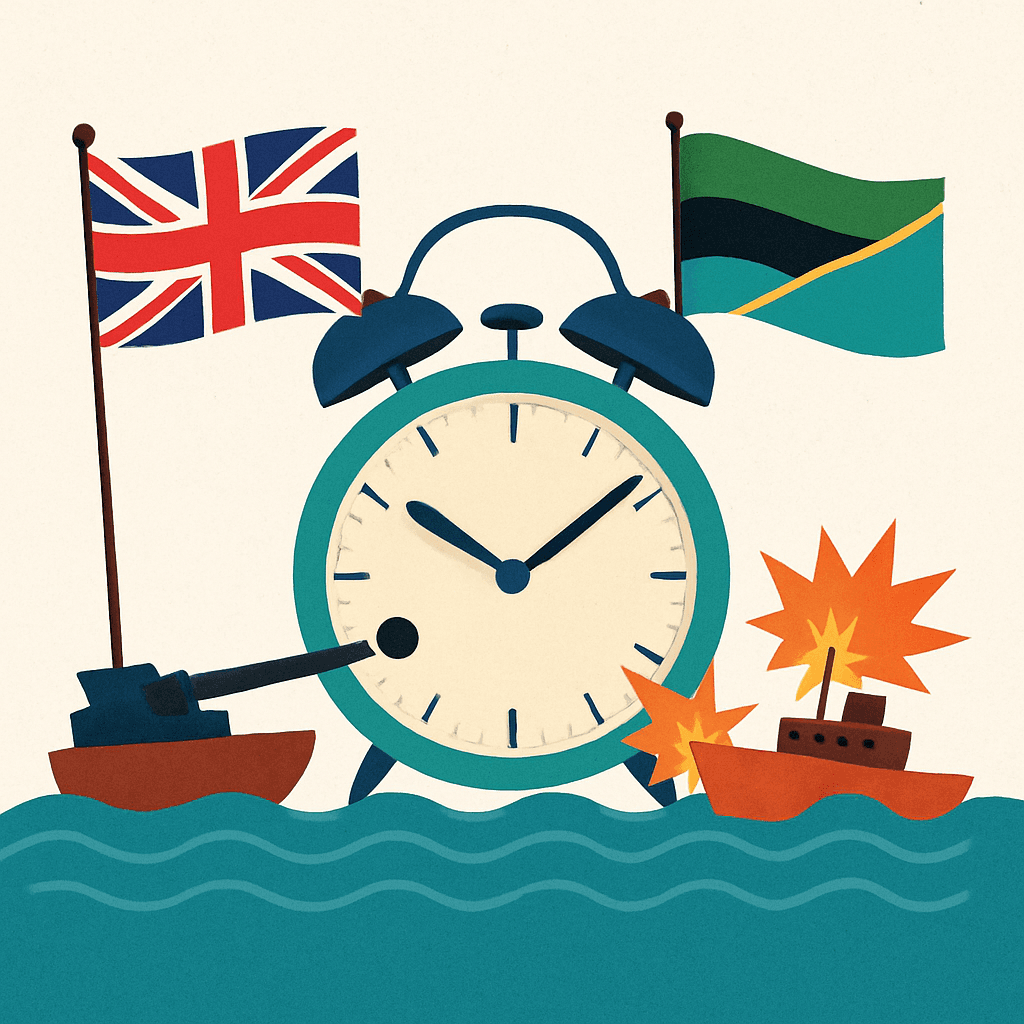
At 9:02 on the morning of 27 August 1896, British warships in the harbour of Zanzibar opened fire on the palace of Sultan Khalid bin Barghash. By approximately 9:40, it was over. The sultan's flag had been shot down, his forces had scattered, and Khalid himself had escaped through a back door and taken refuge in the German consulate. The Anglo-Zanzibar War, the shortest war in recorded history, had lasted somewhere between 38 and 45 minutes depending on which account you use for the ceasefire time.
What Caused It
The background was the standard machinery of late Victorian imperialism. Zanzibar was a British protectorate. This meant that when a sultan died, the British expected to be consulted before a successor was installed. When Sultan Hamad bin Thuwaini died on 25 August 1896, his cousin Khalid bin Barghash moved immediately to seize power without waiting for British approval. He gathered his supporters, barricaded himself in the palace with roughly 2,800 men, and announced himself sultan.
The British consul, Basil Cave, issued an ultimatum: stand down by 9am on the 27th or face the consequences. Khalid did not stand down.
The 38 Minutes
When the deadline passed without compliance, British ships opened fire. The Zanzibari artillery fired back briefly. The royal yacht was sunk in the harbour. The palace, an ornate building not designed to withstand naval bombardment, was heavily damaged within minutes. The Zanzibari flag, flying from the palace, was shot down. When there was no longer a flagpole flying colours, the ceasefire was called.
Casualties were almost entirely on the Zanzibari side: around 500 killed or wounded, including a significant number of civilians who had been sheltering in the palace complex. On the British side, one rating was wounded. Not killed. Wounded.
What Happened After
Khalid bin Barghash spent the next few years in the German consulate before being allowed to go into exile. He was eventually captured by the British during the First World War in German East Africa and brought back to Zanzibar, where he was allowed to live out his life quietly. He died in 1927.
The British installed their preferred candidate, Hamud bin Mohammed, who was compliant and who also, when pressed, banned the slave trade in Zanzibar, something his predecessors had resisted. The British therefore got both the political outcome and a moral cause to attach to it.
The 38-minute war is often cited as a curiosity, a footnote, a pub quiz answer. But it is also a precise and slightly disturbing demonstration of what overwhelming force asymmetry looks like. A "war" is not always two roughly matched sides deciding something. Sometimes it is 38 minutes of one party discovering exactly what the balance of power means in practice.
Disagree? Say so.
Genuine pushback is welcome. Personal abuse is not.