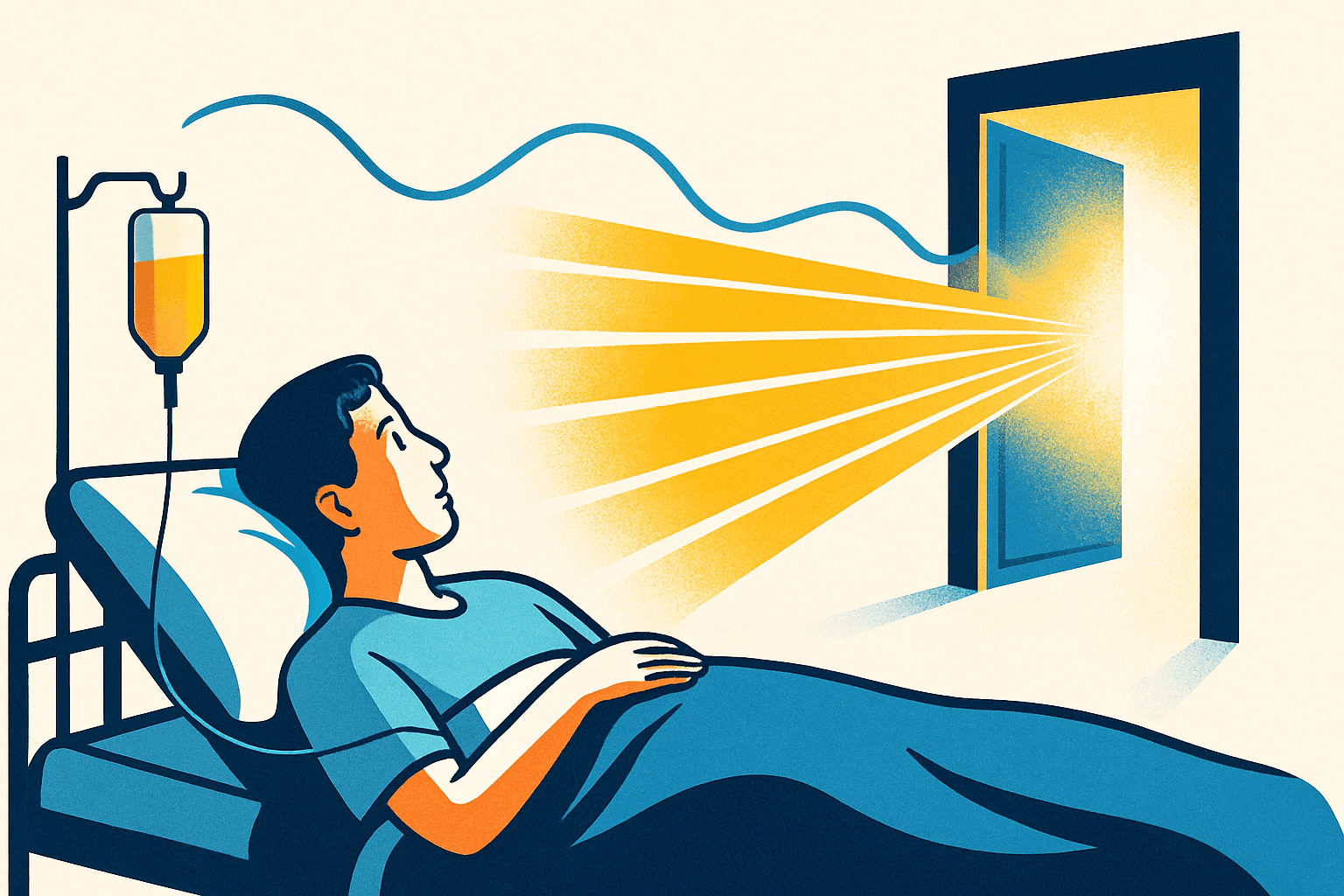
In 1975, Raymond Moody published Life After Life, documenting accounts from people who had been clinically dead and resuscitated. They described tunnels of light, encounters with deceased relatives, a sense of profound peace, a panoramic review of their life, and a distinct reluctance to return. The book sold millions of copies. It also, somewhat awkwardly, described experiences that were remarkably consistent across patients who had no contact with each other, who came from different cultures and different religious backgrounds, and who had varying degrees of prior belief in an afterlife. The consistency was real. It required an explanation.
Several decades of subsequent research have produced a great deal of data. The explanation that has emerged from that data is fascinating, neurologically rich, and conspicuously silent on the question of what happens after death.
What the Research Actually Shows
Near-death experiences (NDEs) are not rare. Studies suggest that between 10 and 20 per cent of people who are resuscitated from cardiac arrest report some form of NDE, and the proportion rises when interviews happen promptly. The experiences share a recognisable structure: the feeling of leaving the body, moving through a tunnel or into a light, encountering deceased relatives or spiritual figures, experiencing a life review, reaching a boundary, and returning. This structure is consistent enough that researchers have developed standardised scales to measure how "deep" a near-death experience is.
The neurological correlates of these experiences are increasingly well understood. REM intrusion, the insertion of dream-state activity into a waking or semi-conscious brain, can produce hallucinations, the sense of presence, and visual experiences including tunnels and lights. Oxygen deprivation produces consistent visual phenomena including the characteristic bright tunnel, because the visual cortex's peripheral neurons deplete faster than its central ones. Temporal lobe activity during extreme stress produces feelings of profound significance, déjà vu, and the sense that time has stopped. The life review appears to be the result of rapid autobiographical memory consolidation under extreme stress. None of this requires anything supernatural. The brain under extreme physiological stress does strange and remarkable things, and those things have a consistent shape because all human brains share the same architecture.
What They Cannot Tell Us
The question people actually want answered is: do near-death experiences provide any evidence for survival after death? The honest answer is almost certainly no, and the reason is structural rather than dismissive. Every near-death experience is an experience of a living person, someone whose brain, however compromised, was still functioning. We have no accounts from people who were actually dead. "Clinical death" is a medical term meaning that the heart has stopped; it is not a statement about brain activity, which can persist for some minutes after cardiac arrest and is the period during which NDEs appear to occur.
The attempts to establish that NDEs contain veridical information, things the patient could not have known while clinically dead, have produced mixed results. Some accounts seem to include accurate observations of the resuscitation room. Many do not. The methodological challenges are severe: people who have just been resuscitated are in a highly suggestible state, medical staff inadvertently provide cues, and memories are reconstructed rather than recorded. The AWARE study, the most rigorous attempt to test out-of-body perceptions using hidden targets in resuscitation rooms, produced essentially null results after eleven years of data collection.
The vividness and emotional intensity of a near-death experience is not evidence of its metaphysical content. Dreams can be extraordinarily vivid. Psychedelic states are more real-feeling than ordinary reality. Intensity of experience is a property of the brain, not a measure of external truth.
Why They Still Matter
None of this makes near-death experiences uninteresting or unimportant. They are profound, often transformative events for the people who have them. People who have had deep NDEs reliably report lasting changes: reduced fear of death, increased compassion, diminished interest in material achievement, greater concern for others. These changes appear to be genuine and durable. Whatever is happening neurologically, something real is occurring, an experience so powerful that it reorganises a person's priorities. That deserves serious study regardless of its metaphysical status.
There is also something worth noting about the consistency of the peace and acceptance people describe. Whether that peace is a glimpse of what awaits or simply the brain's final act of self-protection, releasing a flood of endorphins and dimethyltryptamine as the lights go out, the experience is real to the person having it. The brain, in extremis, appears to know how to make dying bearable. That is not nothing.
Near-death experiences tell us something extraordinary about the human brain, and almost certainly nothing about what lies beyond it.
Disagree? Say so.
Genuine pushback is welcome. Personal abuse is not.
Related questions


