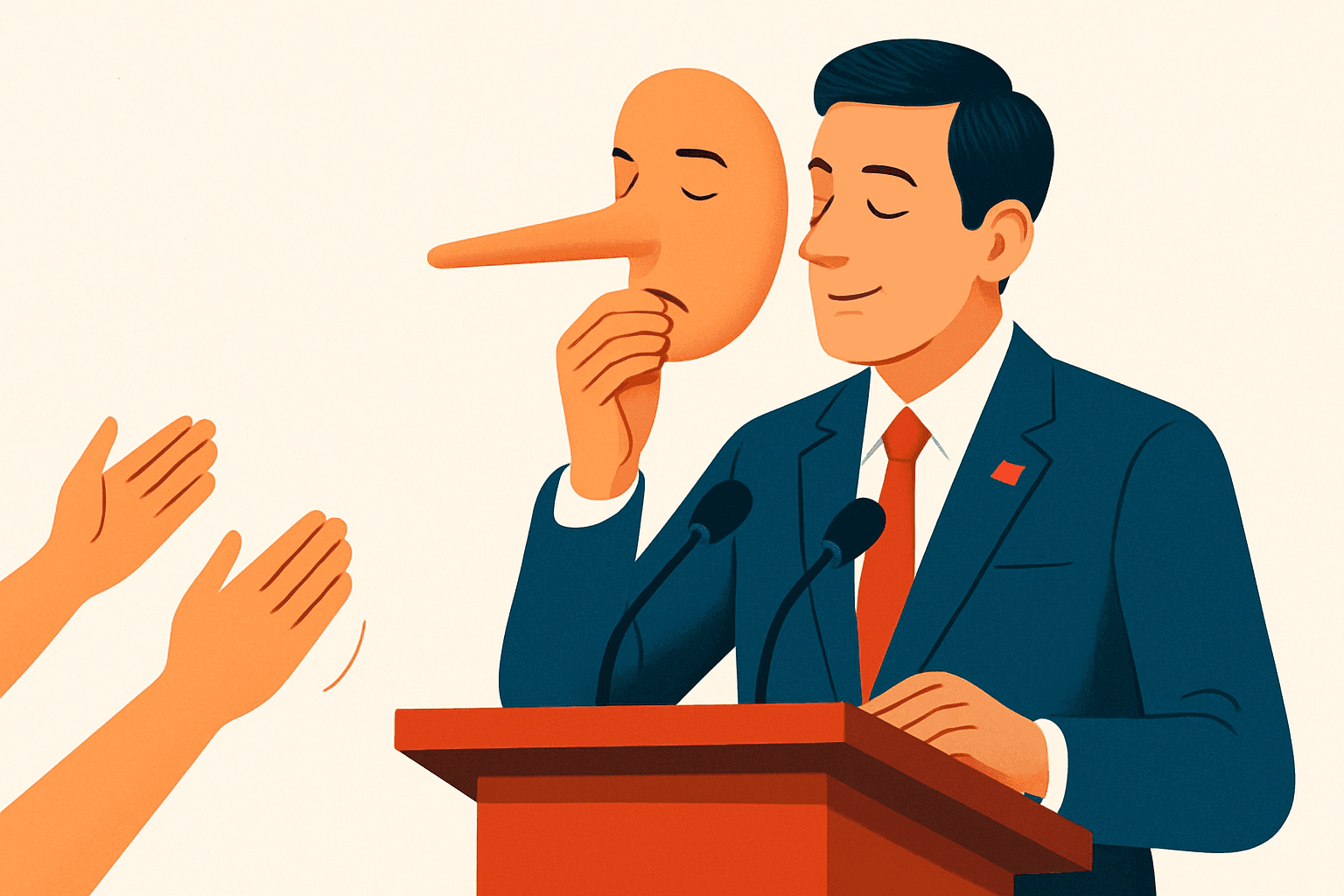
In 2010, Nick Clegg told the British public that, as prime minister, he would not raise tuition fees. Then his party joined a coalition government and raised tuition fees. The response was volcanic, protests, effigy burning, a near-total collapse of the Liberal Democrats' electoral support that took a decade to even partially recover. This is worth examining carefully. Because what killed Clegg wasn't dishonesty. The decision to raise fees was arguably correct given the economic conditions and coalition constraints of the time. What killed him was the breach of a clear specific promise. The interesting thing is what happened to politicians who were honest about the trade-offs in advance.
They largely didn't get elected.
The Punishment of Honesty
There is a consistent pattern across democracies: politicians who describe the actual difficulty of governing, who say "this will require sacrifice," "there are no easy choices here," "the thing you want and the thing that will work are not the same thing", perform worse electorally than those who promise clean, painless solutions. The austerity politicians of the 2010s who ran on honesty about fiscal constraints mostly lost to those who promised to protect everything. The politicians who told voters that immigration involves real trade-offs between economic benefit and social change mostly lost to those who said the trade-offs were false.
This is not a fringe observation. Experimental research has tested it directly. Studies giving people the choice between a politician who describes a policy with both its benefits and its costs versus one who describes only the benefits consistently show preference for the latter, even when subjects are told the cost-describer is more accurate. We punish accuracy when we don't like what it implies.
Why We Say We Want Honesty
The polling is unambiguous: across every democratic country surveyed, voters consistently rank honesty as the quality they most want in politicians. The gap between this stated preference and actual voting behaviour is large enough to constitute a reliable phenomenon. The explanation is probably not that people are lying in polls, they do genuinely value honesty in the abstract. It's that in the specific moment of a choice between a comforting story and a difficult truth, comfort wins.
This is a very human thing. Cognitive dissonance is uncomfortable; optimism feels better than realism; the pain of a hard truth now is vivid where the pain of a bad policy later is abstract. We're not being hypocrites when we say we want honesty and vote for something else. We're being people, operating under normal human cognitive conditions, in an environment specifically designed by political consultants to exploit those conditions.
The System We've Built
Campaigns are optimised for attention and activation, not for accuracy. The most honest political statement is rarely the most memorable or the most motivating. Negative advertising works better than positive. Simple messages outperform nuanced ones. Emotional appeals outlast rational arguments. None of this is secret, it's the basic operating knowledge of every campaign team in every democratic country. The system has been tuned, over decades, to produce messaging calibrated to what wins rather than what informs.
The solution isn't "politicians should be more honest." Some are, and they lose. The solution, insofar as one exists, is changing the conditions under which political communication operates, longer campaign cycles, stronger requirements for factual accuracy in political advertising, civic education that builds genuine tolerance for complexity. All of these face the same problem: they have to be implemented by the politicians currently benefiting from the status quo.
We get the politicians we vote for. The uncomfortable thing is that we also get the ones we deserve, and those two descriptions match more closely than we'd like to believe.
Disagree? Say so.
Genuine pushback is welcome. Personal abuse is not.


