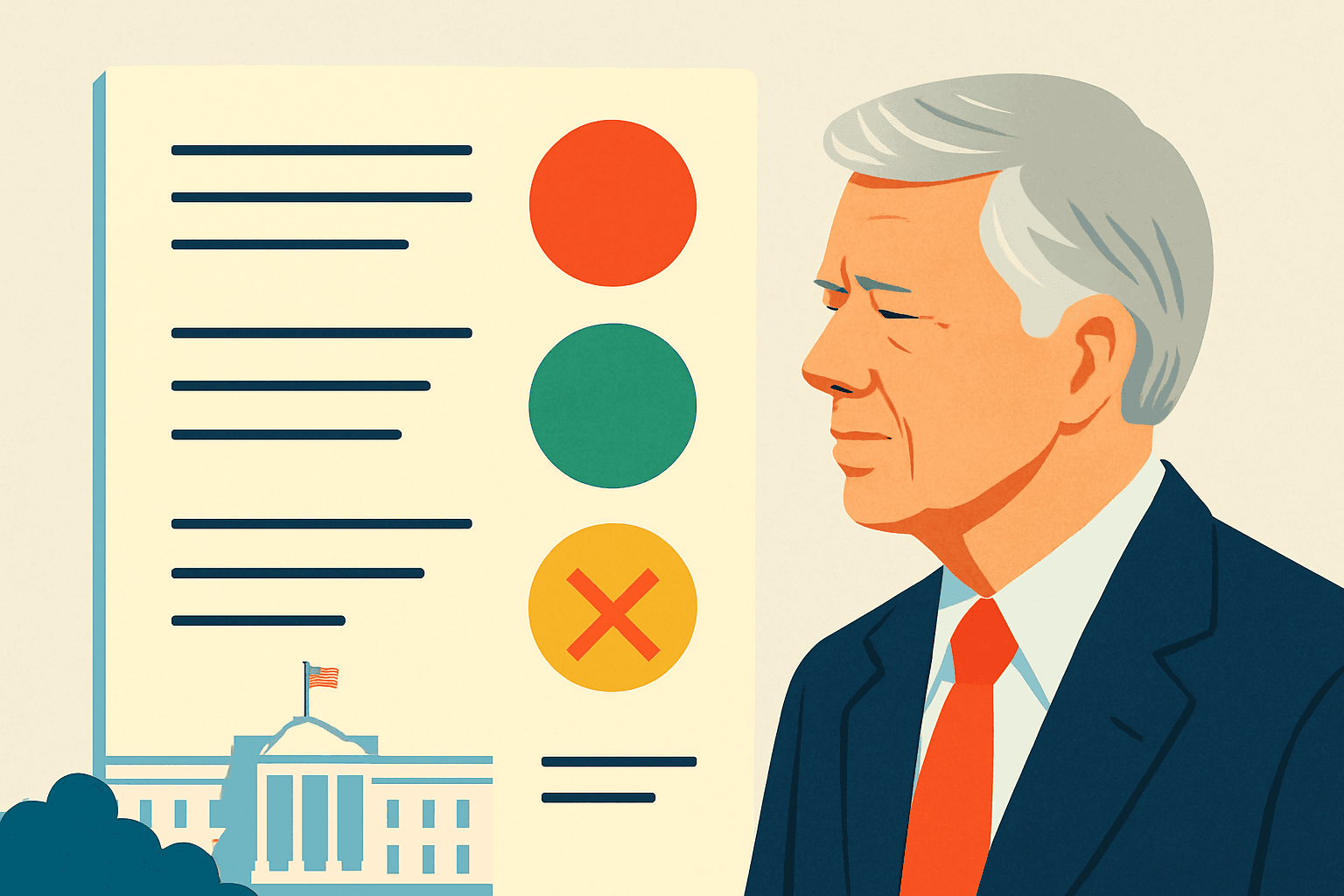
39th President of the United States
January 20, 1977 – January 20, 1981 · One term
Jimmy Carter is perhaps the most difficult president to assess in the modern era, because the gap between what he attempted and what he achieved is so large, and the gap between his personal quality and his political effectiveness is larger still. He was right about energy before it was fashionable, right about the limits of American power before it was acceptable, and out of office before any of it mattered.
The cruel irony of Carter's presidency is that his greatest legacy, a post-presidential life of genuine humanitarian achievement, was made possible by the political failure that ended his term. He was, in many respects, a better ex-president than president. Both halves of that sentence are important.
1. Economic Stewardship, Weak
Carter's economic record is defined by stagflation, the combination of high inflation and high unemployment that had been theorised as impossible and proved emphatically real. By 1980, the misery index (inflation plus unemployment) had reached nearly 22%. Interest rates hit 20%. The Federal Reserve's Volcker shock, the high interest rate policy that eventually broke inflation, was set in motion by Carter's appointment of Paul Volcker in 1979, but the pain arrived during Carter's term and the credit went to his successor.
Carter's energy policies were more farsighted than his contemporaries recognised: the Department of Energy was created, fuel efficiency standards were strengthened, and alternative energy investment was expanded. None of it was sufficient to the scale of the crisis he inherited and partly mismanaged. The economic record is Weak.
2. Foreign Policy & Alliances, Mixed
Camp David is Carter's masterpiece and one of the genuine diplomatic achievements of the post-war era. In September 1978, he brought Menachem Begin and Anwar Sadat to a Maryland retreat for thirteen days and personally brokered the first peace treaty between Israel and an Arab neighbour, an agreement that has held for more than four decades, surviving wars, uprisings, and multiple changes of government in both countries. The Panama Canal Treaties, though politically costly domestically, were strategically correct.
Against Camp David must be set Iran. The fall of the Shah, the seizure of the US embassy, and the 444-day hostage crisis represented a failure of intelligence, strategy, and operational competence that overshadowed everything else. The foreign policy record is genuinely Mixed: one of the great diplomatic achievements alongside one of the defining failures.
3. National Security & Use of Force, Weak
The 444-day Iran hostage crisis is the defining national security failure of the post-Vietnam era. Sixty-six American diplomats were seized when Iranian revolutionaries stormed the embassy. Operation Eagle Claw, the April 1980 rescue attempt, ended in the Iranian desert with mechanical failures, a mid-air collision, and eight dead American servicemen. The hostages were released on the exact day Reagan was inaugurated, in a timing that has never been fully explained to public satisfaction.
The Soviet invasion of Afghanistan in December 1979 added a second simultaneous security crisis. Carter's response, a grain embargo and Olympic boycott, was a statement of displeasure rather than a strategic response. The national security record, taken as a whole, is Weak.
4. Institutional Conduct, Strong
Carter was the most personally honest president since Eisenhower, and his institutional conduct reflected that. He created the Office of Government Ethics. He signed the Foreign Intelligence Surveillance Act, establishing judicial oversight for domestic intelligence operations in direct response to the Nixon-era abuses. He promoted human rights as a genuine foreign policy principle, not merely a rhetorical one, conditioning aid on human rights performance in ways that cost him relationships with useful but brutal allies.
His civil service reform reduced patronage and introduced merit-based federal hiring. His malaise speech, formally titled 'A Crisis of Confidence', was an honest attempt to tell Americans something true about their situation. He governed as though the public were adults capable of hearing difficult truths. They did not reward him for it, but the conduct stands.
5. Social Contract, Mixed
Carter presided over the creation of the Department of Education and expanded community health centres. The Airline Deregulation Act and the Motor Carrier Act, both bipartisan projects, eventually lowered prices for consumers, though with complex labour market consequences. His welfare reform proposals were inadequate to the scale of poverty. Urban decline, particularly in midwestern industrial cities, accelerated during his term without effective federal response.
The stagflationary economy fell hardest on working-class and poor Americans. Carter understood the structural problems better than most of his contemporaries, but understanding structural problems and solving them are different capabilities, and on the latter, his administration was insufficient.
6. Crisis Leadership, Weak
Carter faced three simultaneous crises at the end of his term, Iran, Afghanistan, and the domestic energy crisis, and managed none of them well. The malaise speech diagnosed the problem with unusual precision and prescribed solutions that proved inadequate. The Iran rescue mission failed in the planning as much as the execution. The Afghanistan response was gestural. The common thread is an administration that identified problems with clarity and lacked the political and operational capacity to solve them.
Crisis leadership requires not just intelligence but the ability to project confidence, mobilise institutions, and make decisions under pressure with incomplete information. Carter had the intelligence. The rest proved elusive when most needed.
7. Environmental & Generational Responsibility, Strong
Carter's environmental record is his least-discussed major achievement. He expanded the Alaska National Wilderness preservation system by 104 million acres through the Alaska National Interest Lands Conservation Act, the largest single land conservation action in American history. The Department of Energy was created with a mandate that included renewable energy development. Solar panels were installed on the White House roof. Fuel efficiency standards for vehicles were strengthened.
His 1977 energy address described oil dependence as the 'moral equivalent of war' and called for a serious national transition to renewable energy. He was mocked for it. The subsequent four decades of oil wars, petrostates, and climate disruption have not been kind to those who did the mocking.
8. Character & Democratic Conduct, Strong
Jimmy Carter is, by broad consensus, the most personally decent human being to hold the modern presidency. His post-presidential career, Habitat for Humanity, election monitoring in dozens of countries, the Carter Center's work on disease eradication, the Nobel Peace Prize in 2002, is without parallel among former presidents. He disclosed his cancer diagnosis publicly, as he had disclosed everything else throughout his political life.
His democratic conduct was exemplary: he lost in 1980 and left. No delegitimisation, no claims of fraud, no attempt to use the levers of government to stay in power. Character is Strong. The frustrating thing about Carter's presidency is that the character and the effectiveness were so dramatically mismatched.
Overall
Carter's presidency is the strongest argument that good character and political effectiveness are not the same thing. He was right about energy, right about the Middle East, right about the structural limits of American power, and right at the wrong time with insufficient political tools. His post-presidential career has been longer, more distinguished, and more practically valuable to humanity than his time in office.
That is part of the record too. Not every presidency is best judged by what happened in Washington.
Disagree? Say so.
Genuine pushback is welcome. Personal abuse is not.


