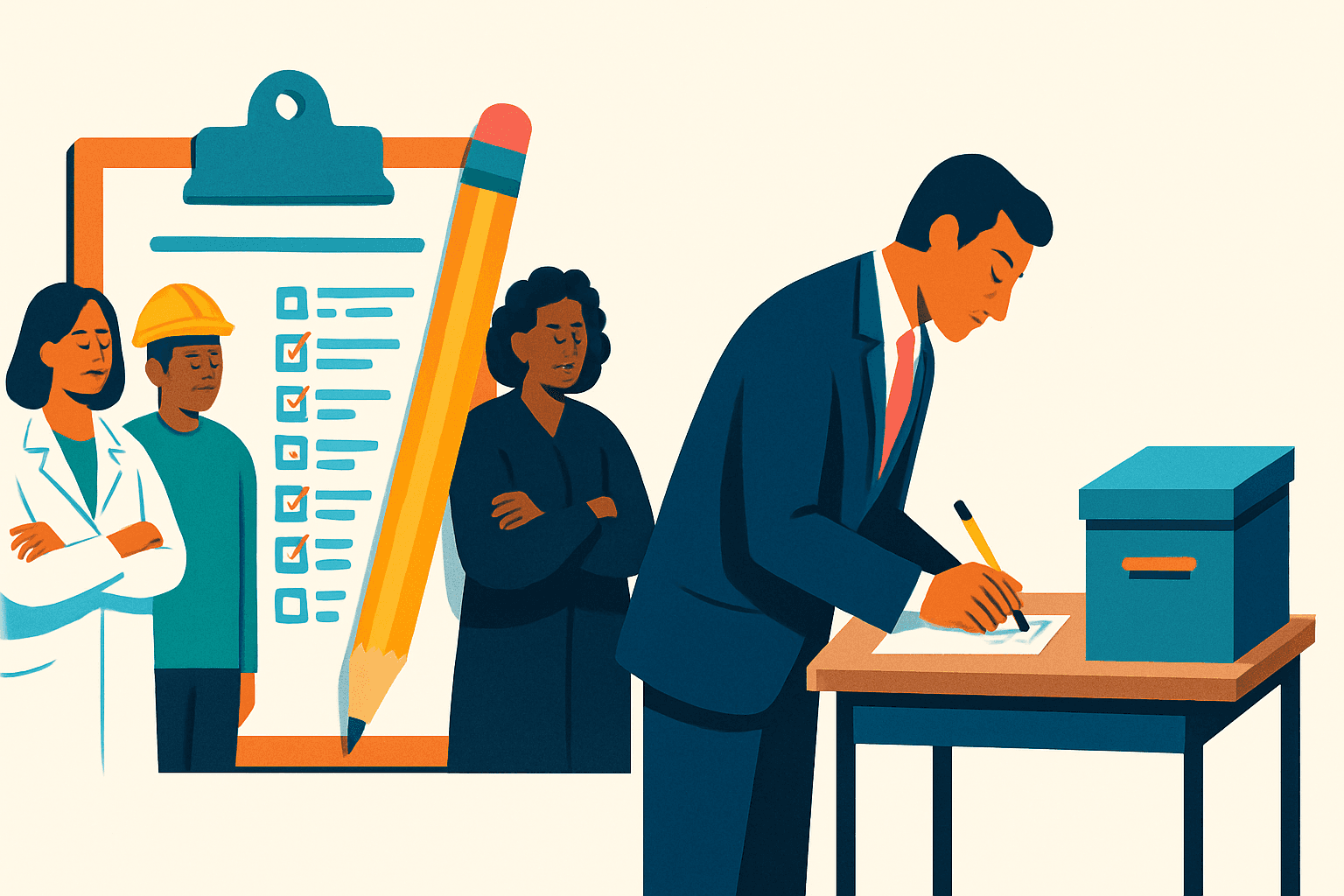
Consider the following asymmetry. The person who flies you from London to Edinburgh has passed written examinations, spent thousands of hours in simulators, demonstrated practical proficiency under assessment, and must prove continued competence through regular medical and skills reviews. The person who decides whether to go to war with someone has passed none of these tests. The only thing standing between a candidate and power over the lives of millions is the ability to give a sufficiently convincing speech.
We find this normal. We should find it strange.
The Inconsistency We've Normalised
The reasoning behind competency testing is consistent everywhere it's applied. We don't trust a pilot because they seem confident. We don't let a surgeon operate because they've read about surgery and feel strongly that they'd be good at it. We've decided, collectively, that when someone's decisions directly affect the health or safety of other people, the minimum condition for being allowed to make those decisions is demonstrating that you're capable of making them correctly.
That reasoning stops, inexplicably, at the door of elected office. A newly elected MP can vote on monetary policy, military action, health legislation, and environmental regulation without having demonstrated any understanding of any of these areas. This is not hypothetical: people who have spent their entire careers as professional politicians, mostly talking, attending events, and fundraising, do vote on these things, every day. And we've arranged the system so that there is no formal check on whether they have any idea what they're doing.
The Objection, and Why It Doesn't Work
The usual response to this is: voters are the test. If politicians are incompetent, they'll be voted out. The problem with this argument is that it assumes voters have the information and expertise to assess competence, which collapses the objection entirely. You can't argue that voters are wise enough to identify incompetence without also arguing that voters have some baseline level of political knowledge, which is a different thing to check.
The more sophisticated objection is that a competency test would be political, whoever designs the test controls who passes it, which is just incumbent bias with extra steps. This is a real concern. It doesn't prove that no test is possible; it proves that test design matters and requires careful separation from whoever benefits from its outcomes. We've solved this in other professional contexts. There's no particular reason it couldn't be solved here.
There's also the democratic principle argument: surely voters should be able to elect whomever they choose. Yes, but we already restrict this. You can't stand for Parliament if you're under 18, if you're a convicted prisoner serving time, or if you're certifiably insane. We've already decided that some minimum conditions apply. The question is just where to draw the line, not whether to draw it at all.
What a Test Would Actually Achieve
A basic competency test, constitutional law, macroeconomics, how legislation actually works, the mechanics of public finance, wouldn't produce experts. It would simply ensure that the people voting on these things had once been required to think about them. That's a low bar. It is, notably, lower than the bar we set for the person operating the till at your local chemist, who must complete a regulated training programme before they're allowed to advise you on paracetamol.
The real resistance to politician competency tests isn't principled. It's that the people who would have to pass them are also the people who would have to design and implement them, and they have very little incentive to introduce any mechanism that might rule them out.
We've built an entire system for scrutinising everyone except the people in charge of everything.
Disagree? Say so.
Genuine pushback is welcome. Personal abuse is not.
Related questions


