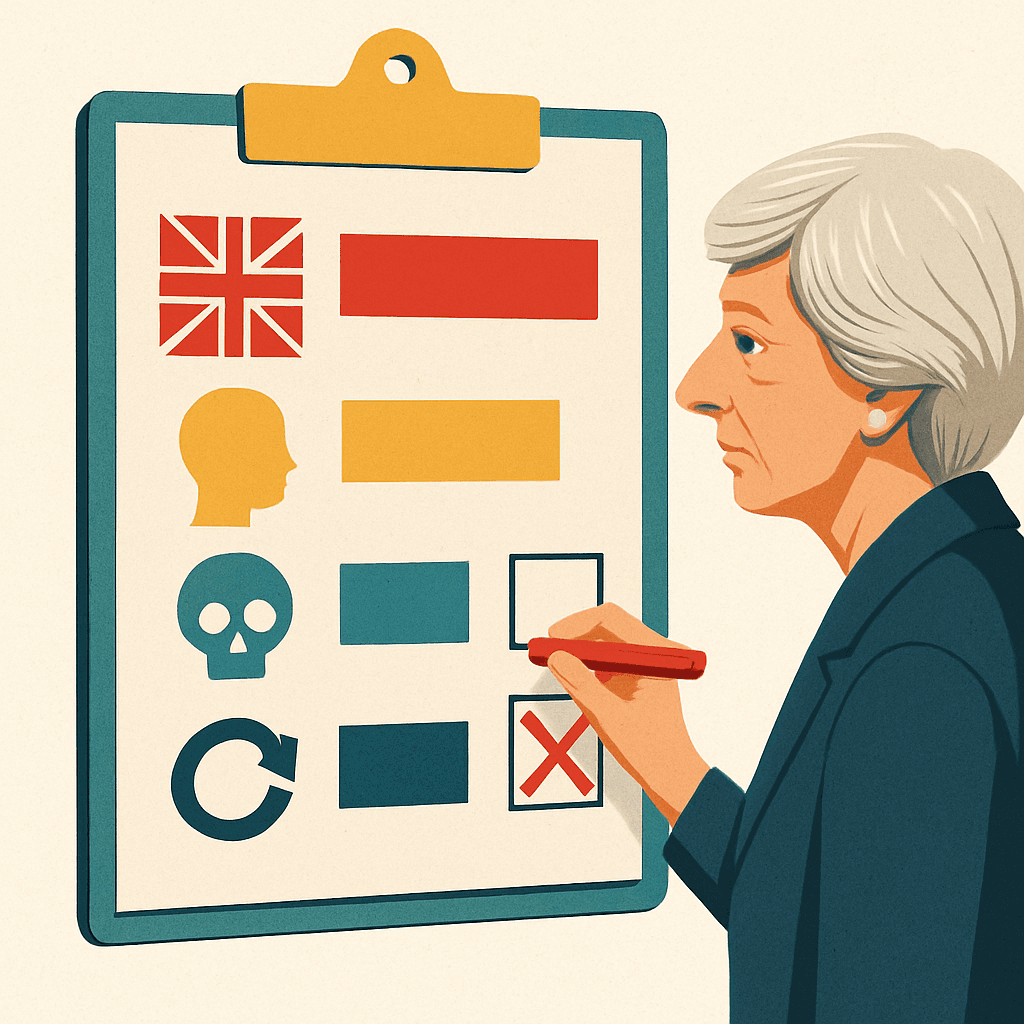
Prime Minister of the United Kingdom
July 13, 2016 – July 24, 2019 · Three years · Conservative
Theresa May was given an impossible task, implementing a Brexit she had privately opposed, against a parliamentary majority that didn't exist for any specific version of it, with a divided cabinet and a country split almost exactly in half, and she discharged it with a rigid determination that made compromise impossible and eventual failure inevitable.
Her three years as Prime Minister were almost entirely consumed by Brexit, leaving everything else, domestic policy, public services, the Windrush scandal, either underfunded or undirected. She was not a dishonest politician or a corrupt one. She was a politician whose character, methodical, inflexible, instinctively secretive, was precisely the wrong character for the situation she inherited.
1. Economic Stewardship, Mixed
Brexit uncertainty dominated British economic life for three years. Business investment stalled as companies waited for clarity about the terms of the UK's future relationship with its largest trading partner. The pound fell sharply following the referendum and did not recover during her tenure. GDP growth slowed relative to comparable economies. The direct costs of this uncertainty are impossible to precisely calculate and impossible to ignore.
Domestically, May spoke of a 'burning injustice' in her first speech as Prime Minister, acknowledging the inequality and unfairness that the Conservative Party had been reluctant to confront. The words were not matched by policy: public services remained under austerity constraints, the housing crisis was unaddressed, and the domestic programme was overwhelmed by the Brexit process. The economic record is Mixed: not actively damaging in conventional terms, but constrained and overshadowed throughout.
2. Foreign Policy & Alliances, Mixed
The Salisbury poisoning of March 2018, the Russian use of the Novichok nerve agent against Sergei and Yulia Skripal on British soil, was handled with considerable diplomatic skill. May expelled 23 Russian diplomats, coordinated an international response that resulted in the largest collective expulsion of Russian intelligence officers in history, and maintained the diplomatic position under sustained Russian denial and disinformation. This was crisis management of a genuinely high standard.
The Brexit negotiations consumed most of the foreign policy bandwidth. The Withdrawal Agreement negotiated with the EU, rejected three times by the House of Commons, was a reasonable settlement of the terms of departure that subsequent analysis has largely vindicated, even if it was politically unsellable in the parliamentary arithmetic of 2018–19.
3. National Security & Use of Force, Mixed
The Salisbury poisoning response was the defining national security event of May's premiership, and it was handled well. The attribution of the attack to Russian military intelligence, the diplomatic expulsions, and the sustained international coalition she built were genuine achievements under considerable pressure. The decision to conduct limited airstrikes against Syrian chemical weapons facilities in April 2018, without a parliamentary vote, relying on prerogative powers, was constitutionally controversial, following the precedent Cameron had established in reverse in 2013.
The national security infrastructure, counter-terrorism operations, intelligence services, the military, functioned adequately during her tenure without significant failures attributable to governmental decisions.
4. Institutional Conduct, Mixed
May's institutional record is complicated by the Windrush scandal. The 'hostile environment' immigration policy, originally designed and implemented by May as Home Secretary from 2012, produced the wrongful detention, deportation, and denial of services to hundreds of British citizens who had arrived from the Commonwealth decades earlier and had every legal right to remain. The policy's institutional mechanisms were cruel in their design and catastrophic in their application to people who were unambiguously British.
May's response when the scandal broke in 2018, genuine remorse, apologies, the Windrush compensation scheme, was more honourable than some of her predecessors' handling of comparable failures. But the policy she had created as Home Secretary was the cause of the harm, and that history cannot be separated from the premiership.
5. Social Contract, Mixed
May talked about 'burning injustices' without producing legislative responses to them. The domestic programme she had sketched, workers on company boards, housing reform, mental health parity, was not delivered. Brexit absorbed the parliamentary timetable, the cabinet bandwidth, and the political capital that domestic reform would have required.
The Grenfell Tower fire of June 2017, in which 72 people died in a social housing block whose cladding was known to be unsafe, became a symbol of the consequences of deregulation and underfunded housing management. May's response at Grenfell, failing to meet survivors in the initial days, appearing cold and distant in a moment that required human warmth, was a political and personal failure that compounded the institutional one.
6. Crisis Leadership, Weak
May's Brexit strategy, 'Brexit means Brexit', the Lancaster House speech, the red lines on the single market and customs union, the triggering of Article 50 before a negotiating position was agreed, committed the country to a specific negotiating posture before the consequences had been fully thought through. The subsequent three years were an extended exercise in discovering why those initial commitments were incompatible with the outcomes that had been promised during the referendum campaign.
Having failed to get her deal through Parliament three times, May called a snap election in 2017 that she did not need to call, lost her majority, became dependent on DUP support, and was subsequently unable to deliver a deal that the Democratic Unionist Party could accept. The crisis leadership was inflexible where flexibility was required and decisive where more consultation was needed.
7. Environmental & Generational Responsibility, Mixed
The commitment to net zero carbon emissions by 2050, enshrined in law through an amendment to the Climate Change Act in June 2019, one of May's final acts as Prime Minister, was a genuinely significant environmental decision: the first G7 country to make a net zero target legally binding. This is a lasting achievement that has shaped British energy and climate policy significantly.
The domestic plastic waste strategy and the 25-year environment plan both represented genuine, if modest, steps forward. The tension between the net zero commitment and continued aviation expansion and road-building investment remained unresolved during her tenure. The environmental record is Mixed: the headline commitment was historic, the policies to support it were insufficient.
8. Character & Democratic Conduct, Mixed
May's political character was defined by secrecy, stubbornness, and a difficulty with human warmth that proved politically costly in a media environment that rewards accessibility. She was not corrupt. She was not dishonest in the way that her immediate successors were. She accepted the verdict of her party and left Downing Street with evident personal pain but without attempting to contest or undermine the process.
The Windrush policy, created when she was Home Secretary, defended for too long after the harm became evident, is the most significant character test of her political career, and it is not one that resolves cleanly in her favour. The hostile environment was her policy. The people it harmed were people she was responsible for protecting.
Overall
May's three years in office were almost entirely consumed by managing the consequences of a decision she had not made and privately opposed. The net zero commitment is a genuine legacy. The Salisbury response was impressive. Everything else was Brexit, and Brexit was not resolved.
She is a politician who was given a task that was, in the parliamentary arithmetic available to her, close to impossible. Her inability to make it possible was partly a failure of character and partly a failure of circumstances. History will probably find both elements real.
Disagree? Say so.
Genuine pushback is welcome. Personal abuse is not.
Related questions


