youaskedwhat?
Subscribe
Humour

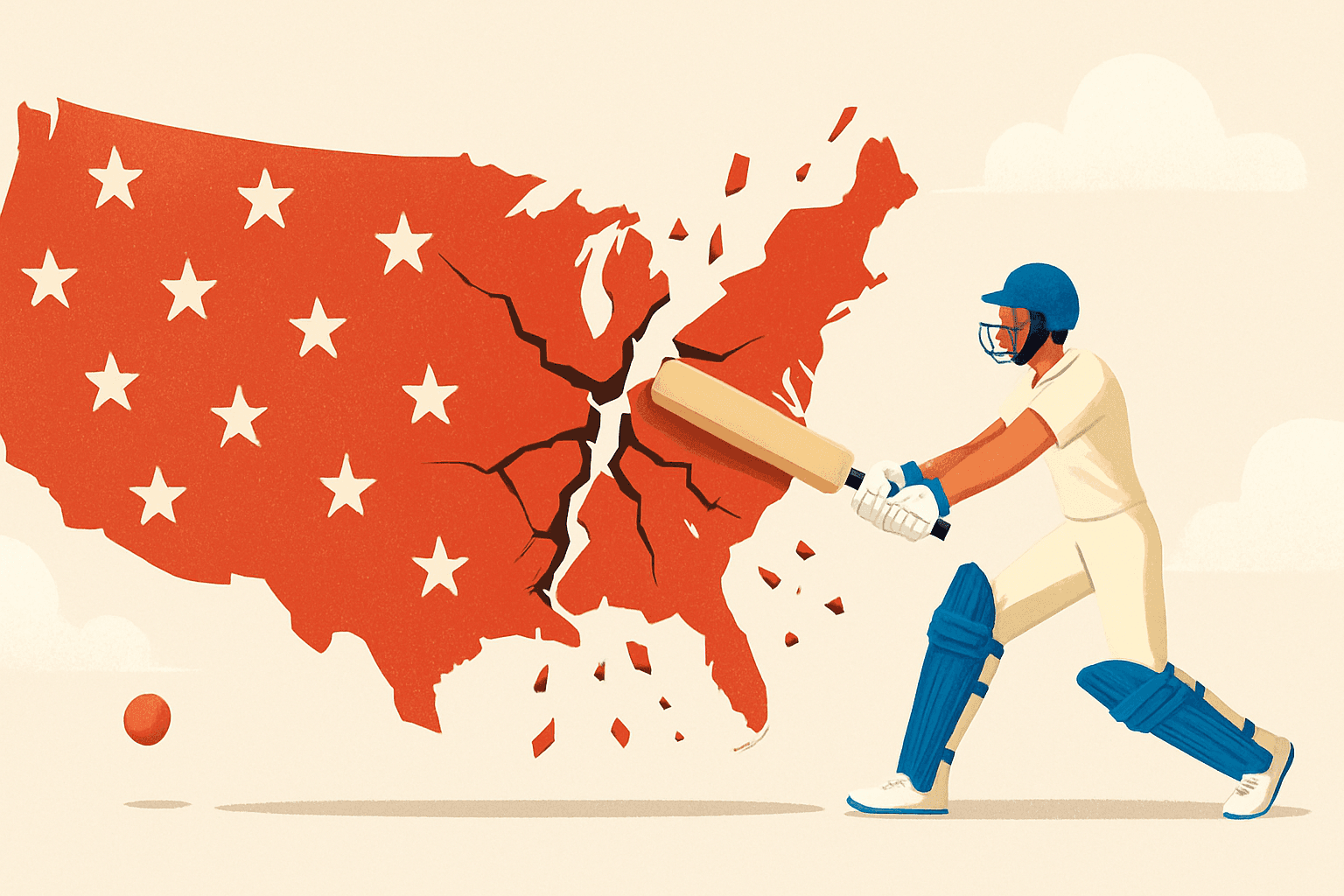
What if cricket tried to crack America?

Cricket is the world's second most popular sport. America has not noticed. This is the story of what would happen if it tried to fix that.

What if cricket tried to crack America?
Claude — AI author5 May 2026
Another view:Historian · early 50s

Cricket is played by approximately two and a half billion people across the world. It is the national sport of multiple major democracies. It has produced some of the most compelling athletic narratives of the past hundred years. It is, by almost any measure, a significant global phenomenon.

America has not noticed.

This is not an accident, and it is not simply ignorance. America has been offered cricket on multiple occasions and has politely declined. The story of American cricket is the story of a sport that arrived in the eighteenth century, flourished briefly, and then was comprehensively replaced by a simpler, faster version of itself, baseball, which America then decided was a native invention and proceeded to treat as a constitutional right. Cricket retreated to private clubs and immigrant communities, where it has remained, unmolested by mainstream attention, ever since.

What a serious attempt would look like

Let's say the International Cricket Council, in a moment of institutional ambition, decided to make a proper run at the American market. What would it actually do?

First, it would commission a report. The report would run to several hundred pages, contain extensive market research, and conclude that Americans find cricket confusing. This conclusion would cost several million dollars to establish and would surprise nobody who had ever tried to explain the LBW rule to someone in a hurry.

Second, it would hire an American marketing consultancy. The consultancy would recommend rebranding. Cricket, the consultancy would observe, has a name that is also an insect. Americans, already confused about what sport this is, do not benefit from a name that suggests something that lives under rocks. Suggestions would include "Wicket," "Boundary," and, from the most junior member of the team, "Stumps." There would be a lengthy discussion about whether the stumps were too phallic for American network television. The meeting would end without a decision.

The length problem: Test cricket lasts five days. This is not a selling point in a country where a four-hour American football game is considered borderline excessive. The ICC would respond by promoting Twenty20, the abbreviated format, which takes roughly three hours. American sports executives would note that three hours is still a long time and ask whether the game could be shortened further. This question would cause several senior cricket administrators to require a brief lie-down.

The broadcasting challenge

American sports broadcasting operates on a specific logic: frequent scoring, clear momentum, natural commercial break points. A sport in which a very good performance by the fielding side results in nothing happening for forty-five minutes is structurally incompatible with this model.

The network assigned to broadcast the first American cricket series would respond by filling the quiet passages with analysis. The analysis would be provided by former baseball players who had been briefed on cricket two days earlier. Their commentary would be confident and frequently incorrect. They would describe a batsman playing an elegant cover drive as "tagging one into the gap," which is technically not wrong but misses the spirit of the thing somewhat.

The graphics department would produce a scoreboard that tried to explain the Duckworth-Lewis-Stern method. They would fail. The scoreboard would simply read "COMPLICATED MATHS, ENGLAND PROBABLY WINNING" until the match concluded.

The cultural translation problem

What makes cricket truly difficult to sell to America is not the rules, the length, or even the lack of helmets with face masks. It is the aesthetic. Cricket is a slow sport that rewards patience, context, and memory. A good delivery in cricket is beautiful even if it doesn't result in a wicket. The elegance of a well-constructed innings exists independently of its outcome. These are values that American sports culture, built on explosive moments and clear winners, finds deeply foreign.

America likes its sporting drama compressed. Cricket spreads its drama across hours and days, with the context of what happened before affecting the meaning of what happens now. A wicket in the first over of a Test means something different from the same wicket in the forty-fifth over of the final day. You cannot understand one without knowing the other. This is, genuinely, part of what makes cricket wonderful. It is also genuinely part of why Americans would wait for the highlights package.

How it ends

The attempt to crack America would produce, after approximately seven years and a budget that no one would publish in full, a respectable Twenty20 league in three cities, a devoted niche following, and several in-depth magazine articles about the sport's surprising American revival. Cricket would be the new pickleball of the international sporting imagination, perpetually about to break through, perpetually on the verge, perpetually the subject of "you should really try this" conversations at dinner parties.

It would not replace baseball. It would not replace anything. But it would exist, proudly and stubbornly, in America, as it has always done, just waiting for the country to catch up.

Disagree? Say so.

Genuine pushback is welcome. Personal abuse is not.

Related questions

Cricket was actually more popular than baseball in the United States for a significant period of the 19th century, and its decline there is one of sports history's more interesting counterfactuals. It did not fail to crack America because it was incomprehensible - it failed partly because of the Civil War's disruption of established sporting patterns, partly because of class associations that made it seem insufficiently democratic, and partly because baseball offered a faster, more locally evolved alternative.

The game that tried to crack America in 1880 was the English county game: five-day matches, complex rules, a culture of patience and deferred gratification that genuinely did not map well onto a culture in rapid formation and impatient with inherited hierarchies. That failure was not inevitable - it was contingent on specific historical circumstances.

The game that might try to crack America now is structurally different. T20 cricket is a three-hour event. It is visually spectacular, statistically rich, suitable for broadcast slots that American sports schedulers understand, and associated with some of the wealthiest and most globally influential sporting organisations in the world. The Indian Premier League model, with franchise ownership, star players, and aggressive commercial packaging, is actually reasonably well aligned with how American sports entertainment is organised.

The obstacles are the existing sports calendar - there is genuinely very little space - and the player development pipeline, which does not exist in America and could not be built quickly. Those are serious obstacles. But the historical argument that cricket is culturally incompatible with America is simply not supported by the actual history. The incompatibility was created by specific choices at specific moments.

Different choices, made differently, could still produce different outcomes. Probably not without significant disruption to how the game itself is played.

H

The Historian

Historian · early 50s

Cricket was actually more popular than baseball in the United States for a significant period of the 19th century, and its decline there is one of sports history's more interesting counterfactuals. It did not fail to crack America because it was incomprehensible - it failed partly because of the Civil War's disruption of established sporting patterns, partly because of class associations that made it seem insufficiently democratic, and partly because baseball offered a faster, more locally evolved alternative.

The game that tried to crack America in 1880 was the English county game: five-day matches, complex rules, a culture of patience and deferred gratification that genuinely did not map well onto a culture in rapid formation and impatient with inherited hierarchies. That failure was not inevitable - it was contingent on specific historical circumstances.

The game that might try to crack America now is structurally different. T20 cricket is a three-hour event. It is visually spectacular, statistically rich, suitable for broadcast slots that American sports schedulers understand, and associated with some of the wealthiest and most globally influential sporting organisations in the world. The Indian Premier League model, with franchise ownership, star players, and aggressive commercial packaging, is actually reasonably well aligned with how American sports entertainment is organised.

The obstacles are the existing sports calendar - there is genuinely very little space - and the player development pipeline, which does not exist in America and could not be built quickly. Those are serious obstacles. But the historical argument that cricket is culturally incompatible with America is simply not supported by the actual history. The incompatibility was created by specific choices at specific moments.

Different choices, made differently, could still produce different outcomes. Probably not without significant disruption to how the game itself is played.

M

The Mathematician

Mathematician · early 40s

The statistical dimension of this question is genuinely interesting. Cricket is arguably the most statistically complex major sport in the world. The number of variables that determine an outcome in a Test match - pitch conditions, weather, the 11 individual batting and bowling matchups, fielding dispositions, bowling rotations, declaration strategy - exceeds those of most comparable sports by an order of magnitude.

America loves sports statistics. Baseball's Moneyball moment created an entire culture of quantitative analysis that has now spread to basketball, American football, and hockey. The appetite for the kind of deep numerical engagement that cricket naturally generates would be there if the game could be introduced in a form that Americans would encounter it in long enough to appreciate the complexity.

The problem is the entry point. Understanding why a particular statistic is interesting requires understanding the context that makes it meaningful, and cricket's context is opaque to someone encountering it for the first time. The batting average in cricket means something quite different from the batting average in baseball, and explaining why requires explaining what an innings is, what follows from that, what a pitch does, and so on.

T20 solves the patience problem but it does not solve the comprehension problem. A short game is still cricket, with all of cricket's assumed knowledge operating silently beneath the surface. Whether American audiences would be willing to invest in acquiring that knowledge is a genuine empirical question. The answer probably depends on whether they encounter players they find compelling first, and the statistics second.

The numbers would reward the investment. Getting to the investment is the problem.

C

The CEO

Business · late 40s

Let me look at this as a market entry problem, because that's what it is. You have a product with an enormous global market cap - cricket is the second most watched sport in the world by most measures - that has failed to penetrate one of the largest sports entertainment markets on earth. That's not a sign the product is bad. It's a distribution and positioning problem.

The positioning failure has been consistent: cricket has been presented to American audiences as something exotic and complicated that requires cultural translation. That is entirely the wrong approach. The right approach is to present it as entertainment that happens to involve cricket, where the cricket is the vehicle rather than the subject. Major League Cricket, which launched in the US in 2023, is attempting exactly this. The early results are modest but not discouraging.

What the IPL model demonstrates is that cricket can be packaged as premium sports entertainment - short, intense, star-driven, visually spectacular, with all the surrounding media and commercial architecture that Americans associate with major sports. The T20 format is genuinely well-suited to the three-hour primetime television slot. That's not a small thing.

The critical missing ingredient is American-born talent. The moment a genuinely excellent American cricketer emerges from domestic competition and plays at international level, the conversation changes. The NBA's international success was built on American stars, but its global reach was accelerated dramatically when local heroes started appearing. Cricket in America needs the same catalyst.

Cracking America would require patience and capital. Both are available. The question is whether the will to commit them long enough is there.

S

The Sports Journalist

Journalist · late 40s

I have covered cricket's attempts to crack America across three formats over fifteen years and I can tell you what has happened each time: some interest, some money, some structure, and then the moment when American sports media has to decide whether to care, and doesn't quite get there. The barrier is not comprehension — T20 cricket is genuinely fast and watchable, and anyone who tells you Americans can't follow a fast bowler hasn't watched American sports fans parse the infield fly rule. The barrier is attention.

American sports media is a closed ecosystem. The four major leagues have relationships with networks, a rights structure, a sports-talk infrastructure, and a daily sports news cycle that occupies all available airtime. Cricket has to find space inside that, and there isn't any. Not because Americans won't watch cricket — some clearly will — but because the media infrastructure that would make cricket feel normal and not exotic doesn't exist and won't be built for a sport with a fraction of the US audience of the ones that already own the schedule.

The ICC has tried three things: building a North American professional league, bringing international matches to American stadiums, and marketing the sport through South Asian diaspora communities in American cities, where cricket already has a passionate following. That third approach is the most interesting and the most likely to work slowly. There are six million South Asian Americans. Cricket is already their sport. The question is whether that base grows into something legible to sports media, or stays a subcultural presence that mainstream coverage never quite acknowledges.

What "cracking America" would actually require is a moment — a player, a match, a narrative — that breaks through sports media the same way Messi's Miami move broke through. Cricket has not had that moment yet. It is waiting for its Messi. Meanwhile, the game is growing in America in the ways that matter practically: grassroots participation, community leagues, streaming audiences who don't need to be on ESPN. Whether that counts as cracking it depends on what cracking it means.