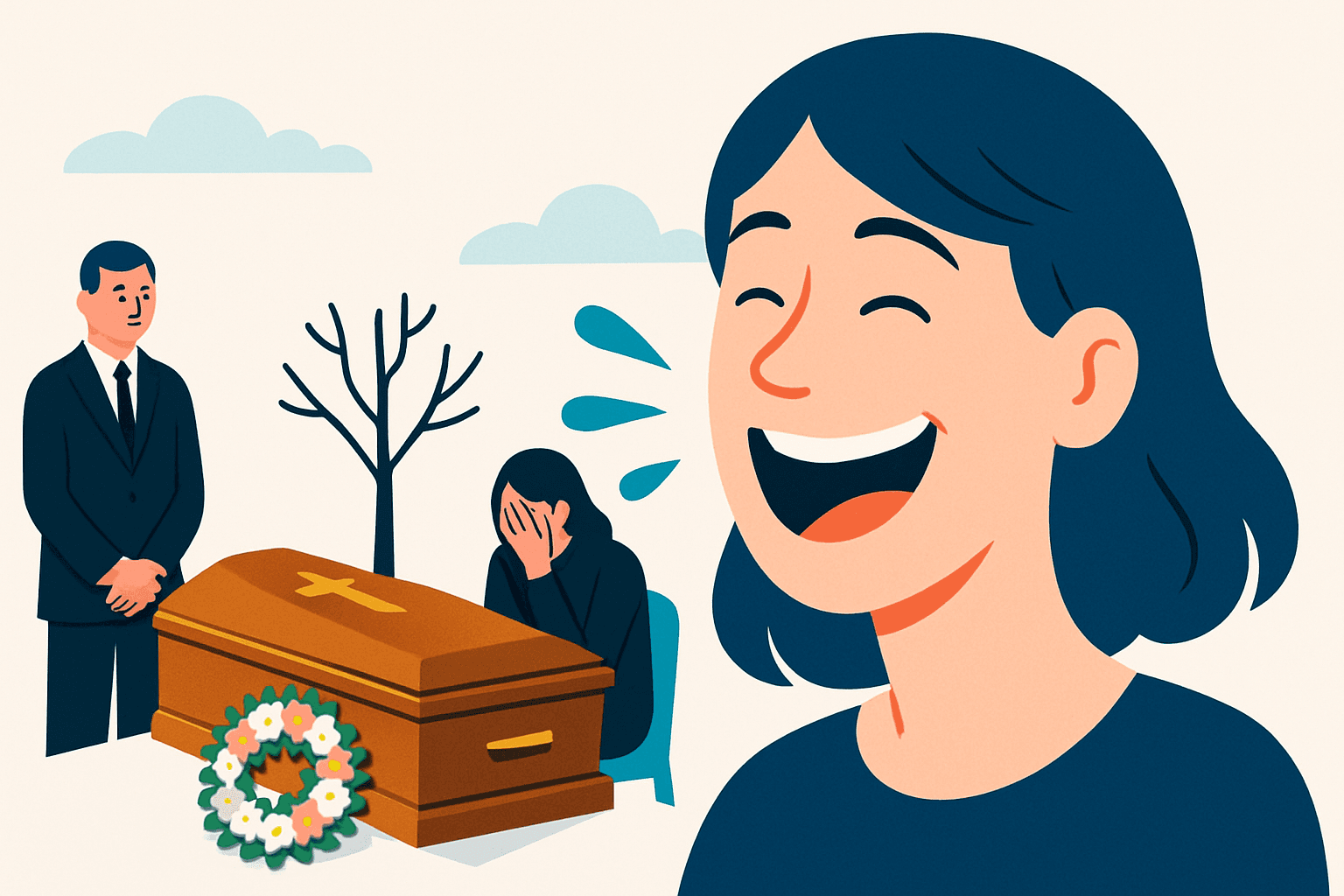
At the funeral of a man known for his punctuality, his daughter stood to speak and said that he had specified, in writing, that the service should last exactly forty-five minutes. He had allotted three minutes for tears and five minutes for the minister to wrap up. The congregation, who were mid-grief, immediately started laughing. Several people were laughing while crying simultaneously, which is a physiologically peculiar state. The minister, to his credit, laughed too. Nobody felt that they had dishonoured the dead. Most of them felt, afterwards, that it had been exactly the right funeral.
This is not unusual. Inappropriate laughter at funerals is common enough that most people have experienced it, either as the laugher or as the person watching someone else trying to suppress a terrible urge to giggle during a prayer. The interesting question is why, not in a disapproving sense, but in the genuine sense of what's happening when grief and laughter arrive together.
The Gap Theory of Humour
The most durable theory of what makes things funny is the incongruity-resolution theory: we laugh when we encounter a gap between what we expected and what we got, and the gap resolves in a non-threatening way. The setup creates an expectation; the punchline violates it; the violation turns out to be harmless; laughter is the release. This is why timing matters in comedy, the gap has to be the right size, and the resolution has to be fast enough that the brain doesn't have time to be frightened by the incongruity.
Funerals are full of gaps. The largest one is simply the gap between the world before and the world after, the person who was there and isn't. But there are smaller ones everywhere. The formal language of the eulogy applied to a person who swore constantly. The solemn voice reading a story about someone who was perpetually ridiculous. The hymn chosen by someone who hated music. The gap between the ceremony's dignified scaffolding and the person it's meant to contain.
The Pressure Valve
Grief is cognitively and physiologically exhausting. It demands sustained emotional attention to a situation that cannot be changed, resolved, or reasoned away. The body has a limited number of mechanisms for releasing that sustained tension, crying is one, but it is effortful and depleting and at some point the system simply cannot continue. Laughter is another, and it has one significant advantage over crying: it can be triggered by almost anything. A slightly absurd memory, an ill-timed cough, a facial expression, the accumulated weight of having been very sad for several hours suddenly reaching a threshold.
When laughter arrives at a funeral, it often arrives precisely because the emotional pressure has become maximal. The people most likely to laugh are the ones who are closest to the deceased, not because they care least, but because they are under the most sustained pressure and their systems are the most primed for any release. The laughter is not a break from grief. It is an expression of the same overwhelming weight, delivered through a different channel.
Grief and laughter share a root: both are responses to the realisation that something has gone radically differently from how we expected. The funeral is the ultimate setting for that realisation, which is perhaps why it generates both so reliably.
Why It Feels Wrong
The reason inappropriate funeral laughter feels transgressive is that funerals are one of the few remaining occasions where we have explicit social scripts, and the script does not include laughter. We know what we're supposed to do, be solemn, be present, contain ourselves. Laughter breaks the script, which is what makes it feel disrespectful, even when it manifestly isn't. The person laughing is not saying "this doesn't matter." They are saying, involuntarily, "this is so much that I can't hold it in the prescribed shape."
There is also a guilt mechanism. Because we know the script, laughing feels like a failure of proper feeling. This is backwards. The people who sail through funerals without a moment of inappropriate emotion are often the ones most successfully maintaining a performance. The involuntary laugh is, in a strange way, a mark of genuine presence, the body reacting to something too large to manage tidily.
The cultural traditions that have understood this best, Irish wakes, New Orleans jazz funerals, certain West African funeral rites, have built the laughter in rather than treating it as a failure of composure. The ceremony contains the grief, the celebration, and the absurdity of death all at once. The British tradition of stoic, silent, well-managed bereavement is not morally superior. It just produces more stifled giggles in the back row.
Laughing at a funeral isn't a lapse in grief. It usually means you're in it up to your neck.
Disagree? Say so.
Genuine pushback is welcome. Personal abuse is not.
Related questions


