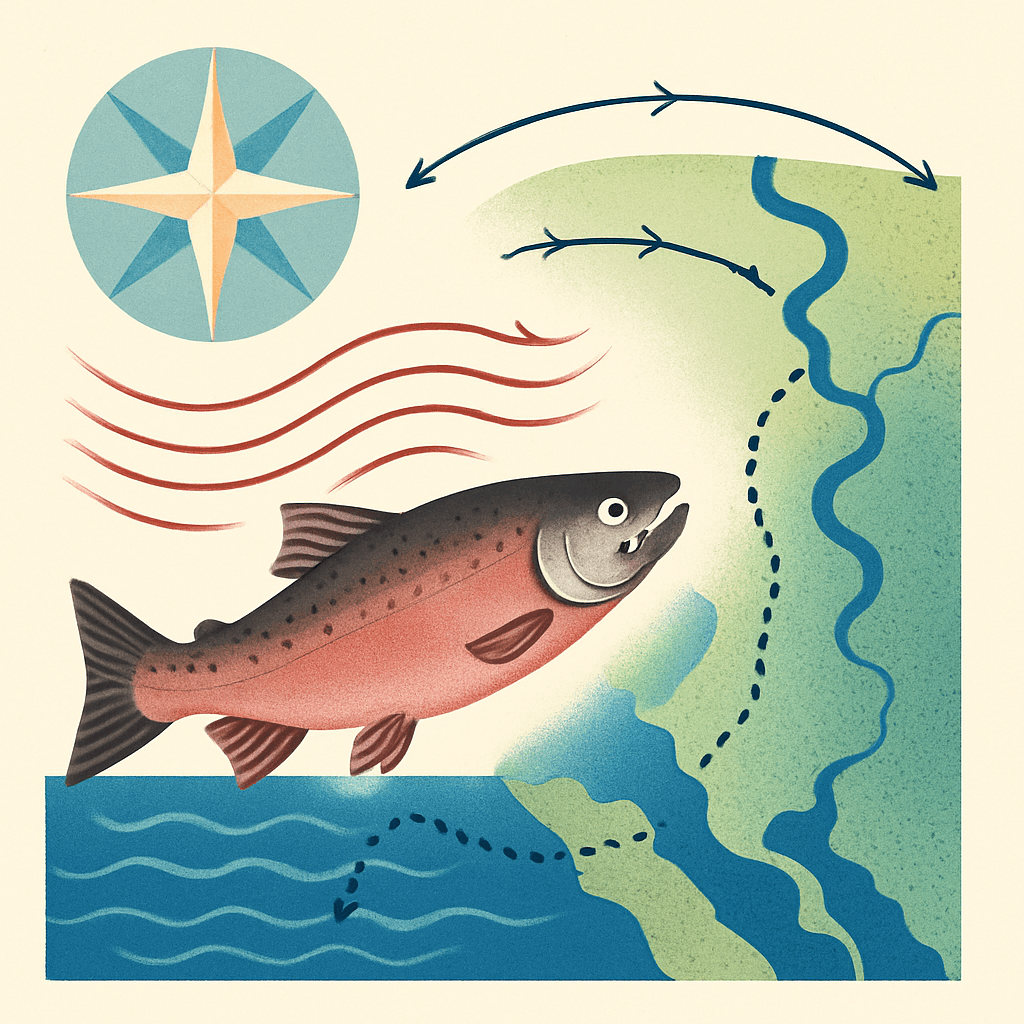
A salmon hatches in a specific stretch of a specific tributary of a specific river system. It spends the first months or years of its life there, then migrates to the ocean, where it may roam thousands of miles over several years. And then, when it is time to reproduce, it returns: not just to the same river, but to the same section of the same tributary where it was born. The navigational precision required for this journey is extraordinary, and the mechanisms that make it possible are more sophisticated than they might at first appear.
The Smell Map
The primary mechanism for finding the natal stream is olfactory imprinting. In the first weeks of life, young salmon memorise the specific chemical signature of their home water. Rivers have distinct chemical compositions: different mineral content, different organic compounds from the surrounding vegetation and soil, different microbial communities. Each tributary within a river system has a slightly different signature from the main stem and from other tributaries.
Salmon imprint on this signature during a sensitive period in their development, storing it in long-term memory. When they return years later, they are essentially following their nose upstream, detecting the chemical gradient of their home water and moving towards higher concentrations of the specific compounds they remember. Studies in which scientists experimentally altered the chemical signature of streams during the imprinting period found that fish returned to the altered stream rather than the original one, confirming that the imprinted smell, not the location itself, is what they are tracking.
Finding the Right Ocean
The smell imprinting explains how salmon find their home river once they are in the right vicinity, but it does not explain how they navigate across thousands of miles of open ocean to get to the right coastline in the first place. For this, salmon appear to use magnetoreception: the ability to detect Earth's magnetic field and use it as a navigational compass.
Research published in Current Biology found that salmon have magnetic material in their bodies and can detect both the inclination and intensity of the magnetic field, which vary across the ocean's surface in ways that provide both directional and positional information. Salmon appear to use this magnetic map to navigate toward the general area of their natal river, at which point the olfactory system takes over for the final approach.
The Cost of the Return
Pacific salmon do not feed when they re-enter fresh water. They live entirely off fat reserves accumulated in the ocean. The journey upriver, often hundreds of miles against strong currents, over waterfalls, through shallow stretches, takes weeks and consumes the majority of their body mass. By the time they reach their spawning grounds, many are visibly deteriorating. They spawn and then die, their bodies providing nutrients to the stream system that will feed the next generation.
Atlantic salmon can survive to spawn multiple times, though many do not. The Pacific species are more extreme: the return journey is a terminal act, and the remarkable navigational feat that precedes it is performed by an animal that will not survive to use the capability again.
Disagree? Say so.
Genuine pushback is welcome. Personal abuse is not.
Related questions