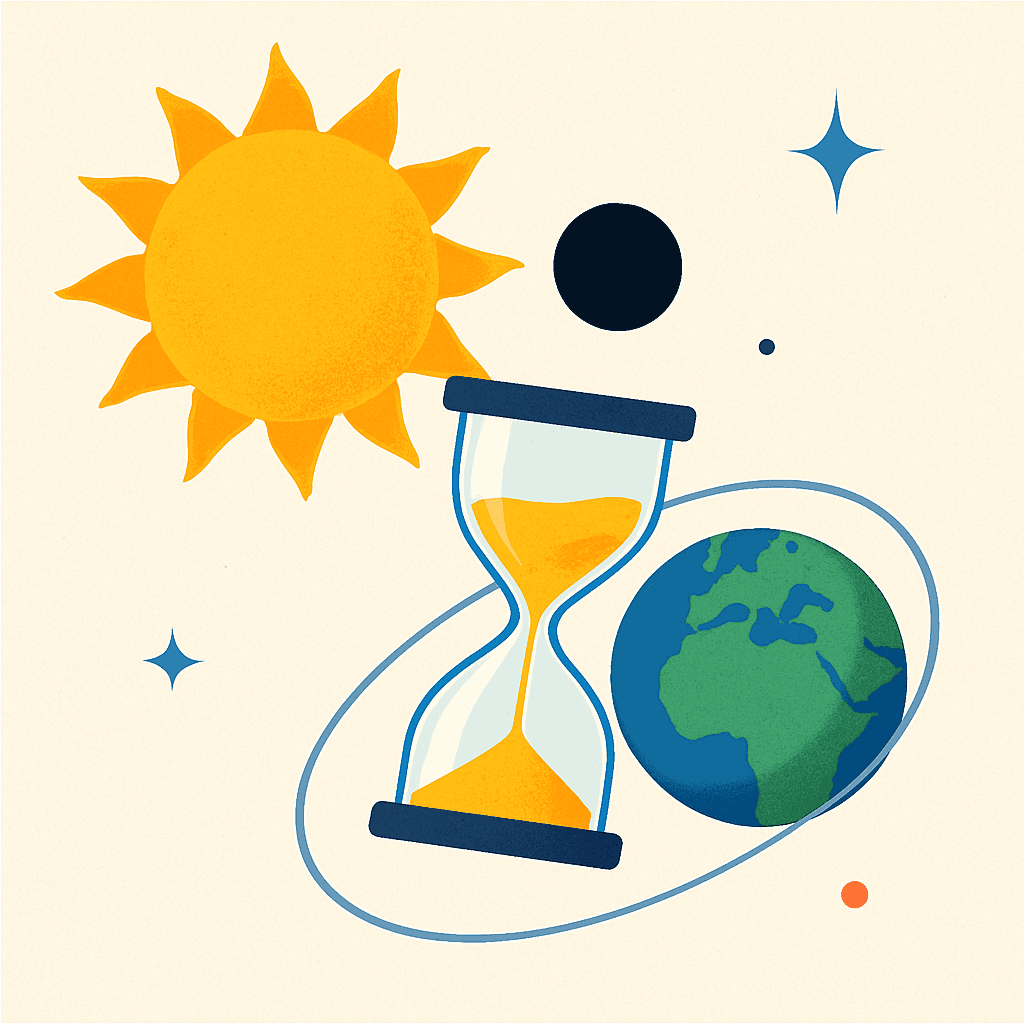
The Sun is approximately 150 million kilometres from Earth. Light travels at about 300,000 kilometres per second. Divide one by the other and you get roughly 500 seconds, or eight minutes and twenty seconds. That is how long it would take for the light currently leaving the Sun to reach us. It is also, by a principle of relativity that Einstein established, how long it would take for the gravitational effect of the Sun's disappearance to reach us. For eight minutes and twenty seconds after the Sun vanished, everything would appear normal. The sky would still be blue. The grass would still be green. The solar system would still be orbiting the position where the Sun had been.
And then.
The First Hours
At 8 minutes and 20 seconds, the sky goes dark. Not gradually. Instantly. There is no equivalent transition for the human experience. The Sun would not set. It would simply not be there any more. The Moon, which reflects sunlight, would also immediately go dark. Stars would be visible that had not been visible in daylight.
At the same moment, the gravitational anchor holding the planets in their orbits would be gone. Earth would immediately begin travelling in a straight line at its orbital velocity of about 30 kilometres per second, heading out into interstellar space. The other planets would do the same. The solar system would dissolve into a collection of rogue bodies drifting in different directions.
What Would Survive
The answer is: more than you might think, at least for a while. Life at deep-sea hydrothermal vents, which depends on geothermal energy rather than sunlight, would be almost unaffected. The Earth's core would continue generating heat for billions of years. Humans, with sufficient technology and energy, could theoretically survive in insulated underground habitats, using geothermal or nuclear energy. Some bacteria and extremophiles would survive in subsurface environments.
Whether a meaningful human civilisation could survive is a harder question. The loss of agriculture within weeks, the collapse of the food chain, the need to generate enough energy to keep enclosed environments warm: these are challenges of an order that would test civilisation to destruction in its current form. Some humans might survive in purpose-built underground habitats if the technology and organisation existed. Most would not.
The Thought Experiment's Actual Value
Nobody is suggesting the Sun will disappear (it will eventually expand and engulf the inner planets, but not for about five billion years, which is a different kind of problem). The value of the thought experiment is what it reveals about dependency. We tend to think of the Sun as a pleasant environmental feature, something that provides warmth and light and makes holidays better. The eight-minute thought experiment makes clear that it is not an amenity. It is the entire foundation of the biosphere. Everything biological on the surface of this planet is, at root, a mechanism for capturing and processing energy that left the Sun eight minutes ago.
The next time you sit in sunlight, you are receiving energy that left its source before you finished reading the previous paragraph.
Disagree? Say so.
Genuine pushback is welcome. Personal abuse is not.
Related questions