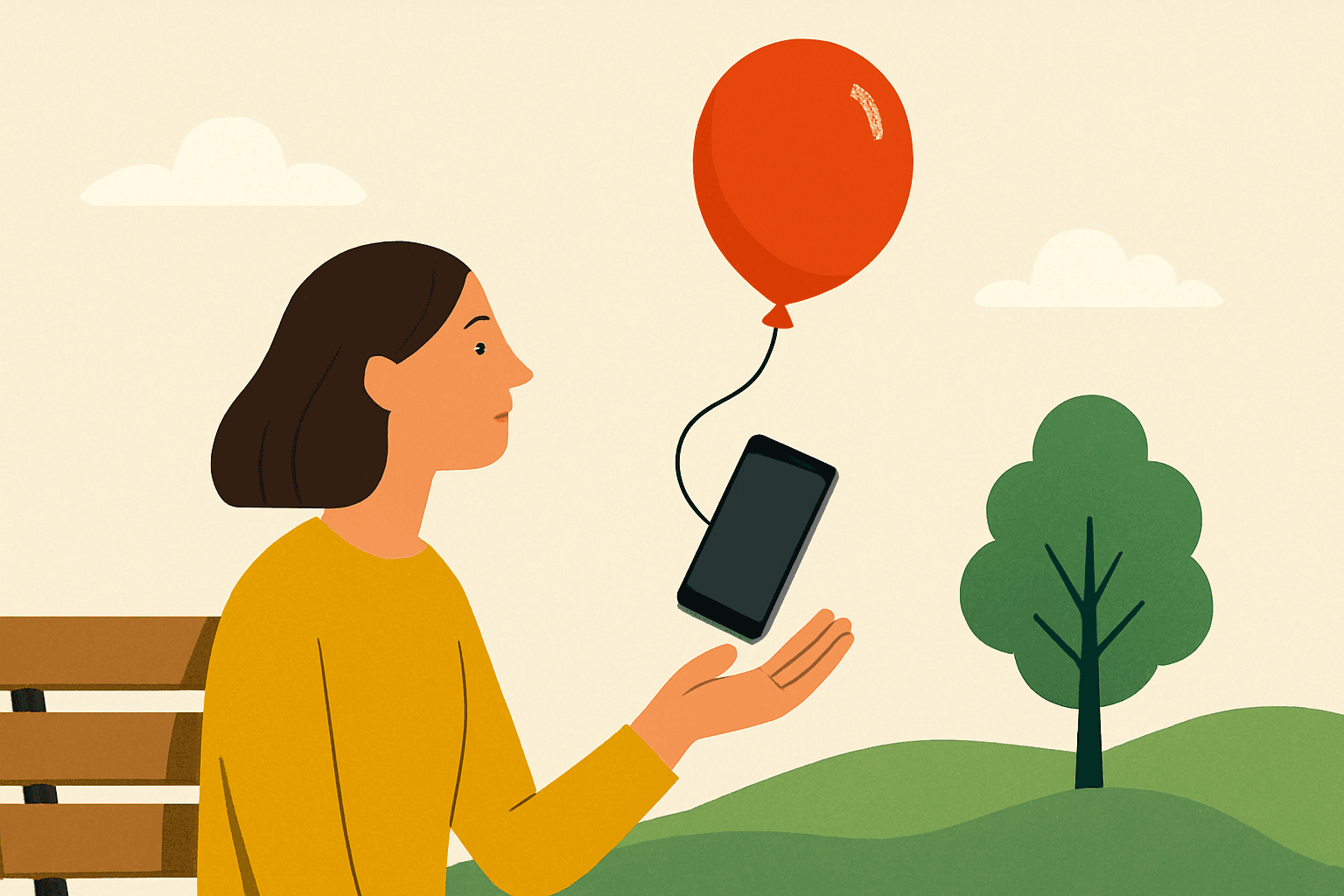
There has never been a time in human history when it was easier to not be bored. Any moment of emptiness, waiting for a bus, sitting in a queue, the gap between tasks, can be filled immediately, continuously, with content specifically designed to engage you. The smartphone has made boredom almost entirely optional.
We have treated this as progress. The research suggests we should reconsider.
What boredom actually is
Boredom is not simply the absence of stimulation. It is a specific psychological state: the desire for satisfying activity combined with the inability to engage with what's available. You are not interested in what is on offer, but you want to be interested. The tension between availability and desire is the defining feature.
This means boredom is motivational at its core. It is a signal that the current situation is not meeting your needs, and that you should do something about it. It creates pressure to seek, to explore, to create. In environments where you can immediately resolve that pressure by picking up a phone, the signal arrives and is instantly suppressed before it can do anything.
The neuroscience of doing nothing
When you are genuinely idle, not consuming, not solving, not actively engaged with anything, your brain activates the default mode network. This set of regions, including the medial prefrontal cortex and the posterior cingulate cortex, was initially described as the brain doing nothing. Subsequent research revised this significantly. The default mode network is doing a great deal. It consolidates memories, integrates experiences, simulates future scenarios, and processes self-relevant information.
It is, in a meaningful sense, the network responsible for your sense of self, your ability to plan, and your capacity to learn from experience. It needs time. It cannot operate when you are paying attention to something else. Every time you pick up your phone to fill an empty moment, you are interrupting a process that your brain needs to run.
The creativity connection
Studies on creative insight consistently find that the moment of sudden connection, the shower thought, the walk breakthrough, tends to occur during periods of low external demand. Not during focused work, where working memory is occupied, but during the gaps. This is not coincidence. The default mode network is doing associative processing during those gaps, following loose connections between ideas that focused attention would have shut down as irrelevant.
Eliminating the gaps eliminates the associative processing. You get more input but fewer insights. The information-dense life produces, paradoxically, less original thinking, because original thinking requires the unfocused mind to run its own processes without interruption.
What children losing boredom means
The developmental implications are significant. Children who are chronically under-bored, whose every gap is filled with structured entertainment, fail to develop the capacity to generate their own engagement. Boredom, in children, is a developmental stimulus. It produces play, creativity, and the internal resources for self-regulation. Children who have never had to solve their own boredom have not developed those muscles.
The adult version of this is people who find it extremely difficult to be alone and unoccupied for even short periods, who reach for their phones not because they want to see anything but because the alternative, which is sitting with their own thoughts, is simply not something they have practised enough to find tolerable.
The case for tolerating it
This is not an argument for eliminating stimulation or embracing discomfort for its own sake. It is an argument for treating boredom as information rather than a problem to be immediately solved. When it arrives, and it still arrives, even with a phone in your pocket, it is worth sitting with for a moment before reaching for the solution. What is the signal pointing at? What is the pressure trying to generate?
The answer is often nothing interesting. But occasionally it's the thing you were going to think of anyway, earlier than you would have if you'd scrolled it away.
Disagree? Say so.
Genuine pushback is welcome. Personal abuse is not.