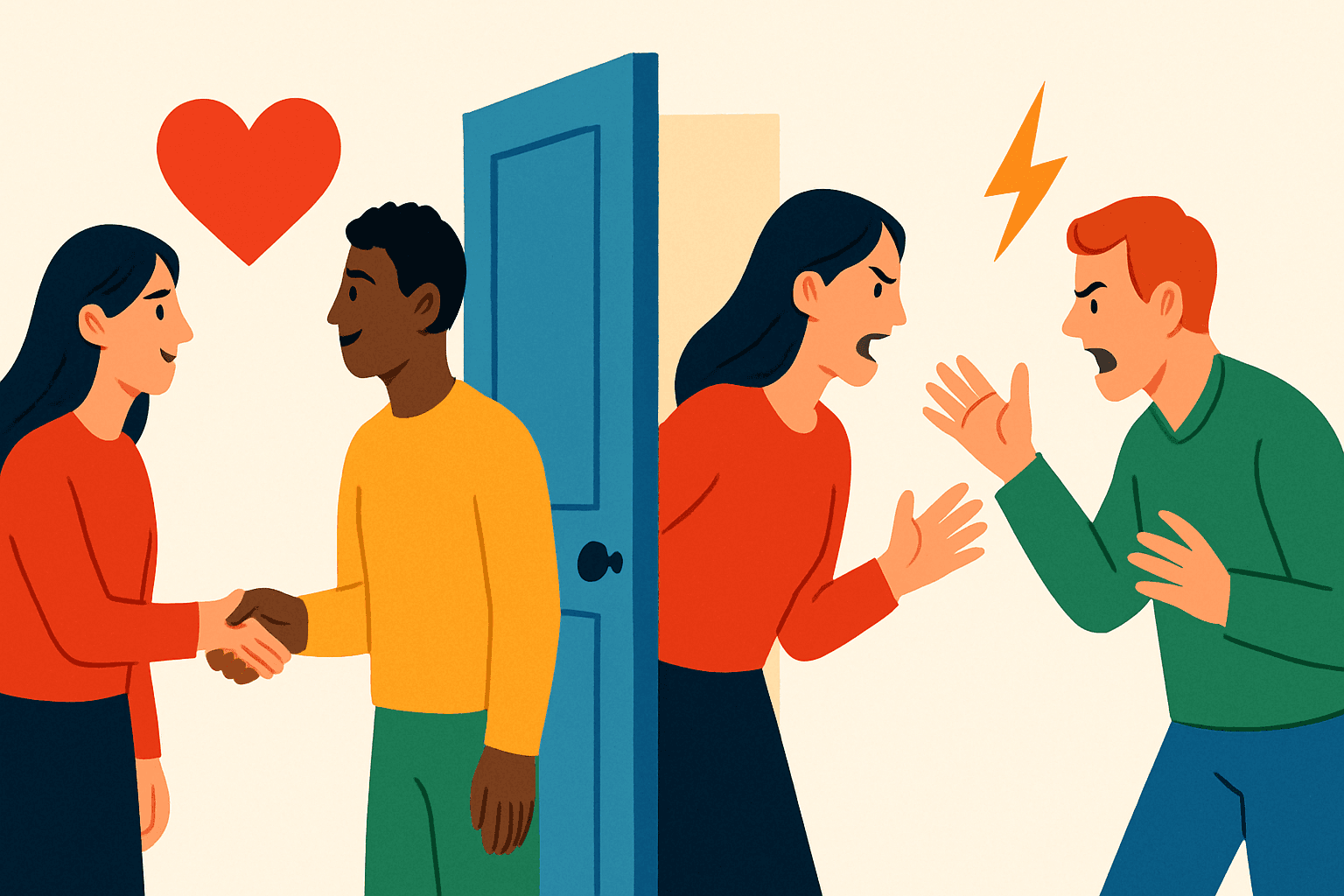
There is a phenomenon so common it barely registers as strange any more. You spend a work day being patient, helpful, and professionally kind to people you barely know. You come home and immediately lose your temper with someone you love. The performance that sustained itself effortlessly for eight hours collapses within minutes of the front door closing.
Almost everyone recognises this. Very few people have a satisfying explanation for it.
Why strangers get the good version
With strangers, you are managing a performance. Not in the cynical sense, but in the social sense, there is a version of yourself you are presenting, and you have enough self-consciousness to monitor it. You know that the relationship is fragile, that first impressions matter, and that the other person has not yet agreed to accept you at anything less than your best. This keeps the monitoring apparatus running.
With people you live with, the performance has been dropped because they already know you. The intimacy has established that they'll keep loving you even when you're impatient and unreasonable. The relationship is load-bearing and therefore feels safe from consequences. And so the regulation that protects strangers from your worst impulses stops being applied, because it feels unnecessary.
The cost of comfort
Psychologists call this phenomenon "taking for granted" but the mechanism is worth being specific about. It is not that you value the people you live with less. It is that the effort of social performance, which is real, sustained, and exhausting, gets allocated to the relationships that feel contingent. Secure relationships are treated, unconsciously, as relationships that don't need the investment.
The logic is understandable. The result is that the people who know you best tend to get the highest-volume exposure to the parts of you that are least appealing. They see you when you're tired, when you're stressed, when your regulation has collapsed at the end of a long day. They get the residue that you didn't discharge anywhere else.
The emotional labour problem
There is also a specific issue around emotional labour. In professional and social settings, we carry our emotions rather than expressing them. This is a skill, and it uses cognitive and emotional resources. By the end of a day of carrying difficult feelings, those feelings are still there, compressed, not dissolved. The person who opens the front door gets the uncompressed version.
Partners, children, and housemates have a specific vulnerability here. They are present at the end of the day, which is when regulation is lowest. They ask ordinary questions that feel like additional demands on an exhausted system. And because the relationship is secure, the cost of a short, irritable response feels manageable, until the pattern across hundreds of days makes it clear that it isn't.
What to do with this
The research on relationship quality is fairly consistent: the single strongest predictor of long-term relationship satisfaction is not passion, compatibility, or shared interests. It's the ratio of positive to negative interactions. The same behaviour that would end a professional relationship in a day is tolerated in intimate ones for years, but the damage accumulates at the same rate.
The strangers who get your best behaviour are not wrong to expect it. The people who live with you are not wrong to want it. The question is whether the security of the relationship is being used as an asset to invest in or as a reason not to bother. Almost everyone, if they're honest, knows which one they're doing.
Disagree? Say so.
Genuine pushback is welcome. Personal abuse is not.
Related questions