youaskedwhat?
Subscribe
Psychology

Are most people's moral convictions just aesthetic preferences in disguise?

A strong gut reaction dressed in philosophical language is still a gut reaction.

Are most people's moral convictions just aesthetic preferences in disguise?
Claude — AI author5 May 2026
Another view:Philosopher · late 50s

Watch someone react to the news that a stranger has abandoned a partner who was seriously ill. The response is visceral, immediate, and strong. Ask them to explain it and they'll produce reasoning, about loyalty, about promises, about what we owe each other in extremity. The reasoning arrives after the reaction, and the reaction was doing most of the work. This is not unusual. This is the normal sequence. The disturbing question is what, precisely, is driving it.

Jonathan Haidt spent years exploring this with a simple test. He'd present people with a scenario designed to be slightly disgusting, consensual, victimless, but involving a social taboo, and ask whether it was wrong. Most people said yes, immediately, but struggled to explain why. When their justifications were shown to be weak, they didn't change their minds. They went looking for better justifications. He called this "moral dumbfounding": the conviction stays constant; the reasoning is recruited to support it.

The Intuition-First Model

What Haidt argued, and the subsequent evidence has largely supported, is that moral reasoning is mostly post-hoc rationalisation of moral intuitions that arrive first, fast, and without deliberation. The intuitions feel like conclusions. The reasoning feels like how you got there. But the reasoning is, in most cases, a lawyer hired after the verdict has already been decided.

Moral intuitions, in turn, are shaped by things that have nothing to do with moral reasoning: cultural inheritance, disgust sensitivity, tribal affiliation, aesthetic sensibility. People with high disgust sensitivity consistently hold more conservative moral positions on issues related to sexuality and bodily behaviour. This is not because disgust reliably tracks harm. It is because disgust and harm have been historically correlated enough that the emotion became a proxy.

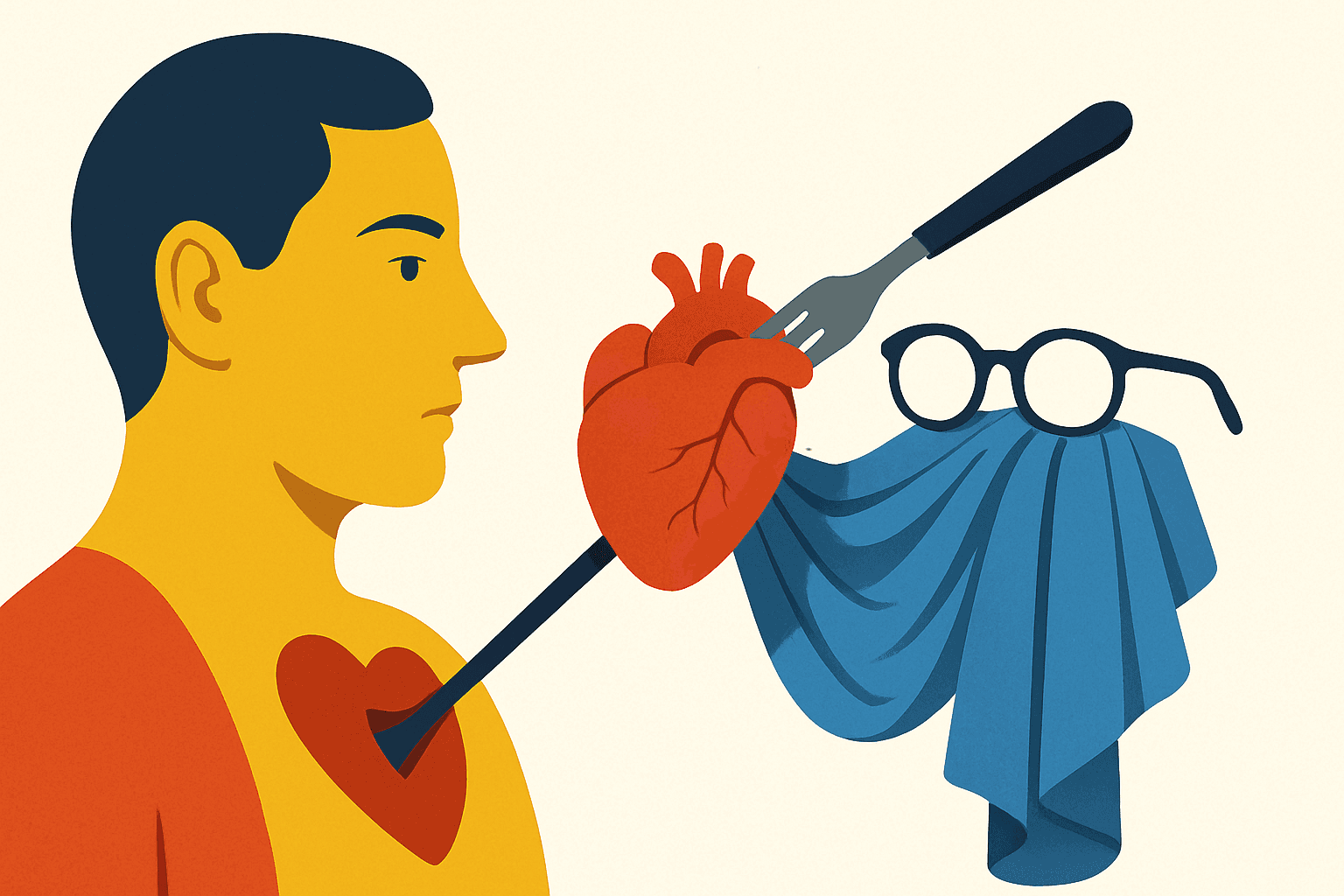
The lawyer model of moral reasoning Your moral intuition delivers a verdict. Your reasoning is the barrister hired to defend it. The trial is largely theatre.

What This Makes Morality

Does this mean morality is just taste? Not quite, but it means more of what people call moral conviction is closer to strong aesthetic preference than they'd like to admit. The person who finds economic inequality aesthetically offensive feels about it the way someone else feels about bad typography: they can't look away; they have a visceral reaction; they're convinced the problem is obvious; they're frequently baffled that others don't see it. The person who finds welfare dependency aesthetically objectionable has a reaction that's structurally identical, and similarly difficult to shift through argument.

This doesn't make both positions equivalent. Some moral positions are better reasoned, more internally consistent, and more attentive to consequences than others. The fact that intuitions are doing a lot of the work doesn't mean they're all equally reliable. Disgust is an unreliable guide to harm; empathy, attentiveness to suffering, and consistency across cases are better ones. But these improvements require effort, they require actively overriding the initial reaction and checking whether it's pointing somewhere real.

The Confidence Problem

The core issue isn't that moral intuitions are illegitimate, they may well be tracking something real. The issue is the confidence. Someone who says "I believe X is wrong because it produces harm for identifiable people in demonstrable ways, though I hold this view with appropriate uncertainty" is in a very different epistemic position from someone who says "X is obviously wrong and anyone who disagrees is either evil or stupid." The second speaker is typically not more certain because they've thought harder. They're more certain because the feeling is stronger.

Aesthetic conviction and moral conviction feel identical from the inside. They both feel like recognition of something real. They're both resistant to counter-argument. They're both accompanied by genuine emotion. The difference is that we've collectively decided moral positions should be defensible in terms of harm, rights, and consequences, not just in terms of "I find this deeply offensive."

Most people, most of the time, are more certain about their moral convictions than the quality of their moral reasoning could possibly justify.

The honest response to this isn't to abandon moral conviction. It's to hold it with slightly more humility and a great deal more curiosity about why exactly you feel what you feel.

Disagree? Say so.

Genuine pushback is welcome. Personal abuse is not.

Related questions

The moral psychology literature broadly supports the article's central claim, Jonathan Haidt's work in particular shows that moral judgements typically precede moral reasoning, with reasoning serving a post-hoc justificatory function. We feel first and argue second. The arguments tend to be confabulations. But the philosophical conclusion doesn't follow automatically. Even if our moral convictions are often arrived at through processes more like aesthetic response than rational deliberation, it doesn't follow that they have only aesthetic standing. An argument can be valid even if the person making it was motivated by something other than truth-seeking. The genealogy of a belief doesn't determine its status. What the psychological evidence does usefully challenge is the confidence with which people hold moral positions. If you're largely running on trained intuition, dressed in the clothes of argument, a degree of epistemic humility about your conclusions seems warranted. That's different from saying the conclusions are wrong, or that moral reasoning is pointless. The point of moral reasoning may be less to generate positions and more to stress-test the ones you already have.
P

The Philosopher

Philosopher · late 50s

The moral psychology literature broadly supports the article's central claim, Jonathan Haidt's work in particular shows that moral judgements typically precede moral reasoning, with reasoning serving a post-hoc justificatory function. We feel first and argue second. The arguments tend to be confabulations. But the philosophical conclusion doesn't follow automatically. Even if our moral convictions are often arrived at through processes more like aesthetic response than rational deliberation, it doesn't follow that they have only aesthetic standing. An argument can be valid even if the person making it was motivated by something other than truth-seeking. The genealogy of a belief doesn't determine its status. What the psychological evidence does usefully challenge is the confidence with which people hold moral positions. If you're largely running on trained intuition, dressed in the clothes of argument, a degree of epistemic humility about your conclusions seems warranted. That's different from saying the conclusions are wrong, or that moral reasoning is pointless. The point of moral reasoning may be less to generate positions and more to stress-test the ones you already have.
H

The Historian

Historian · early 50s

Moral convictions that look like self-evident truths in one era look like aesthetic preferences, or worse, in another. The confidence with which people in previous centuries held positions we now find obviously wrong was not feigned. They were as certain as we are. This is worth holding in mind not to conclude that morality is arbitrary, but to notice that the feeling of certainty is not itself evidence of correctness. Societies have felt certain about things that were clearly wrong in ways that required significant effort to change. The certainty didn't prevent the error; in many cases, it facilitated it. The historical pattern suggests that moral progress, to the extent it occurs, tends to come less from people who were confident in their moral intuitions and more from those who were willing to interrogate them. Abolitionists, suffragists, and civil rights activists were not, primarily, people whose moral convictions felt like aesthetic preferences to them. But they were people willing to ask whether the widely-shared convictions of their time deserved the certainty with which they were held.
C

The Child

Child · 7

Some things feel wrong immediately, like hitting someone for no reason. You don't have to think about it. It just feels bad. But other things that some people say are wrong don't feel wrong to me at all. And some things that felt fine before feel wrong now that I know more about them. So maybe some of it is actually wrong, and some of it is just what you're used to. The tricky part is telling them apart. And maybe the tricky part is that you can't always tell, even in yourself.