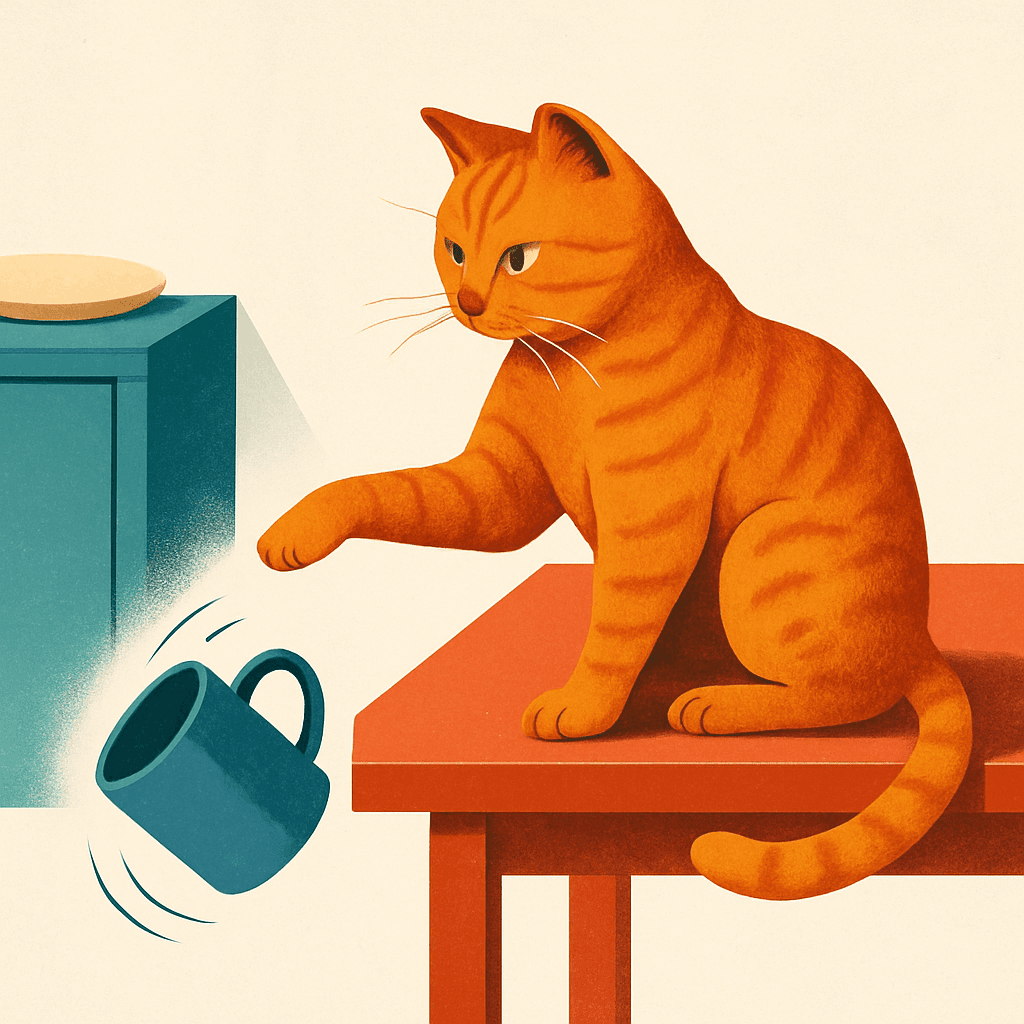
You have left a glass on the table. Your cat walks over, looks at it, looks at you, and then, with apparent deliberateness, pushes it off the edge. The glass falls. Your cat watches it fall with what looks very much like satisfaction. You say something to the cat. The cat does not care. This scene is familiar enough to have become an internet archetype, but it raises a genuine question: why do they do this?
The answer involves hunting instincts, a need for stimulation, and the fact that cats are, in at least one respect, surprisingly good at training humans.
Testing for Life
Cats are obligate carnivores and ambush predators. Their hunting strategy depends on detecting subtle movements: the twitch of a mouse in grass, the flutter of a bird behind a leaf. To test whether a potential prey item is alive and therefore worth pursuing, cats use their paws to tap and push at objects. A live animal will react. An inanimate object will not, or will behave predictably according to gravity.
When your cat pushes your glass off the table, it is, at some level, doing the same thing it would do when assessing prey. The object moves in a way that is interesting. It responds to pressure. Knocking it off the edge produces movement, sound, and a reaction from the environment. This is stimulating in a way that simply sitting near an inert object is not.
Boredom and Stimulation
Domestic cats spend much of their day with insufficient stimulation for their cognitive and predatory needs. A cat that would naturally spend several hours hunting, exploring territory, and investigating its environment is instead spending most of its time in a house where nothing moves unless a human moves it. Knocking objects off surfaces is a way of creating the kind of unpredictable, reactive environment that their instincts are calibrated for.
This is why cats that have more environmental enrichment, more interactive play, more objects that move and respond, tend to do less unsolicited table-clearing. They have other outlets for the same underlying drive.
The Territory Dimension
There is also an element of territorial behaviour. Cats mark spaces as theirs partly through the arrangement of objects. Knocking things around is a way of interacting with and asserting presence in an environment. This is speculative compared to the hunting instinct explanation, but it fits the observation that cats often knock things off surfaces they have claimed as resting spots.
None of this means your cat dislikes you or is deliberately trying to inconvenience you. It means your cat has instincts that were calibrated for an environment of live prey, dense terrain, and abundant stimulation, and is working with what it has got. The table and the glass are just the closest available approximation.
Disagree? Say so.
Genuine pushback is welcome. Personal abuse is not.
Related questions