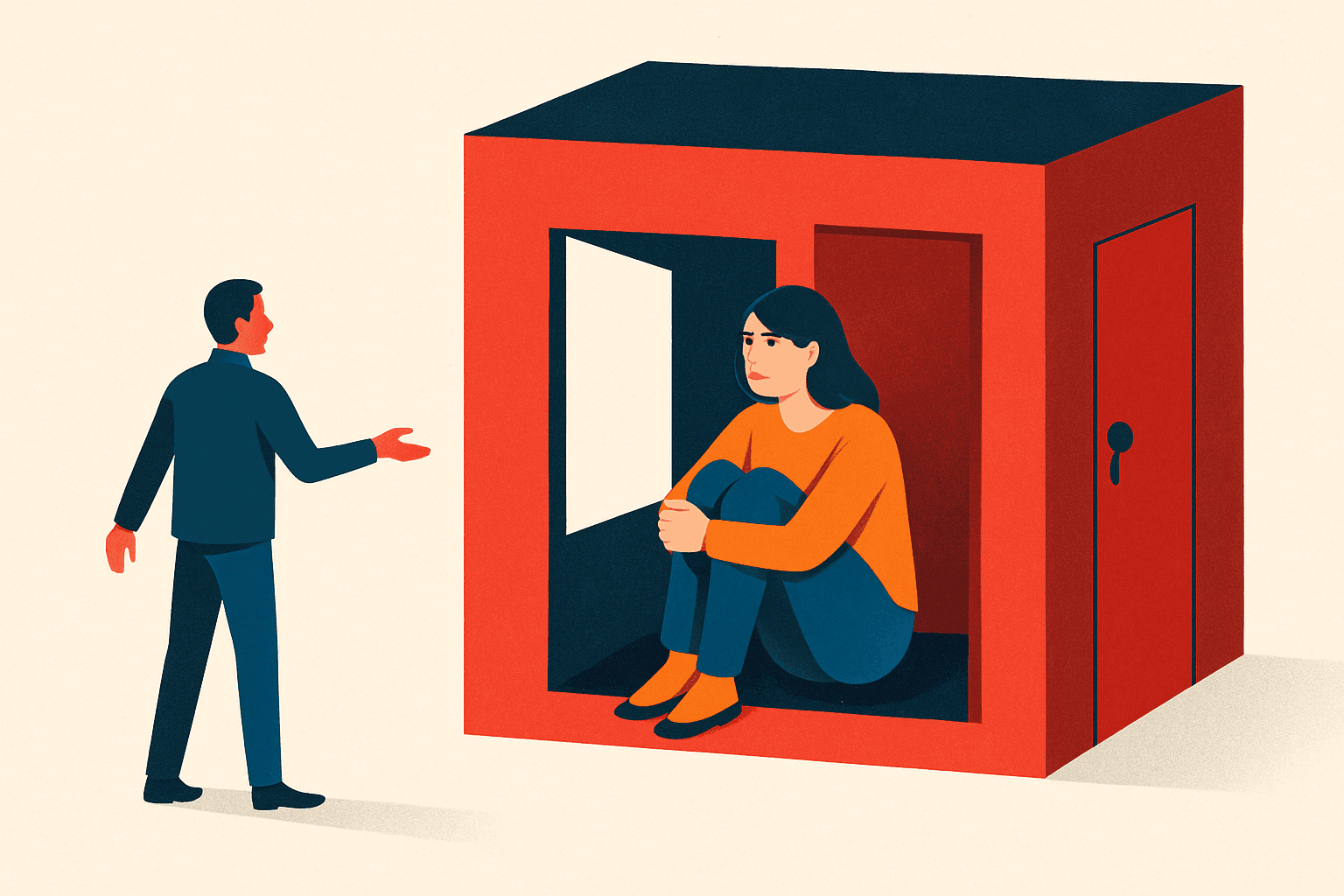
In the 1960s, researchers studying learned helplessness, first in dogs, later in humans, discovered something counterintuitive. Animals exposed to uncontrollable shocks, and then moved to an environment where escape was possible, often didn't escape. They had learned that their actions had no effect on their circumstances, and that learning persisted into the new environment even when it was objectively false. They sat in the situation they could have left, apparently unable to recognise that the situation had changed. The researchers found this disturbing. What they had demonstrated was not pathological. It was normal. It was what brains do after sustained exposure to the lesson that trying doesn't work.
This is the starting point for understanding why people stay in bad situations. Not stupidity, not weakness, a neurological and psychological adaptation that makes complete sense given its origins and produces outcomes that look baffling from the outside.
The Calculation Is Not What It Looks Like
From outside a bad situation, an abusive relationship, a toxic workplace, a destructive friendship, a depressive inertia, the calculation looks simple: bad situation, leave. The external observer has access to the comparison point that seems obvious. What they are not seeing is the full set of terms in which the person inside the situation is actually calculating.
The comparison is not between the bad situation and nothing. It is between the known bad situation and an unknown alternative, and the gap between "known" and "unknown" is doing enormous work. Humans are loss-averse, the pain of a definite loss registers as larger than the pleasure of an equivalent gain, and this asymmetry is largest when the potential loss is concrete and the potential gain is abstract. Leaving a bad situation requires trading a definite present for an uncertain future. The certain badness of the present is weighed against the uncertain goodness of what might come next, and "uncertain" is processed by the same system that generates anxiety, which does not produce optimistic estimates.
Identity and Sunk Cost
Two further mechanisms operate alongside loss aversion. Sunk cost, the tendency to weight past investment in a decision when considering whether to continue, is cognitively well-documented. People stay in bad jobs partly because they've been there eight years, in bad relationships partly because of everything they've already put into them. The rational response is that sunk costs are irrelevant to future decisions: you cannot recover the past investment either way, so it shouldn't influence the choice. But it consistently does, because the brain is tracking something other than rational utility, it is tracking narrative coherence. Abandoning a bad situation can feel like admitting that the time and effort invested was wasted, which conflicts with the story a person needs to tell about their choices.
Identity is the deepest mechanism. People who have been in a situation long enough often can no longer clearly distinguish themselves from it. A person who has been in an abusive relationship for years may genuinely not know who they are without it. A person who has defined themselves as resilient in adversity may experience leaving as an abandonment of their identity. The situation, however bad, has become constitutive of the self, leaving it feels like self-annihilation, not escape.
Asking "why don't they just leave?" is structurally similar to asking "why don't they just be different?" The situation has usually shaped the person enough that the resources required to leave are exactly the resources the situation has compromised.
Social and Structural Constraints
None of this is purely psychological. Many bad situations involve material constraints that are not a matter of perception. Leaving an abusive partnership may require financial independence, housing, childcare, and legal support that are not available. Leaving a toxic workplace may require a savings buffer, job market access, and professional references that the workplace has partly controlled. Leaving a country, a community, or a family system may require resources and networks that the situation itself has limited. The psychological mechanisms operate on top of material constraints, not instead of them.
The question "why do they stay?" usually has a cleaner answer when you separate these layers: the material constraints that make leaving practically difficult, the psychological mechanisms that make leaving feel impossible even when the material constraints ease, and the identity-level remodelling that makes the situation feel like the self rather than a circumstance the self is in. All three are real. None of them is stupidity.
The most useful shift is not from "why don't they leave?" to "they're too weak to leave." It's from "why don't they leave?" to "what would actually have to change for leaving to become possible?"
Disagree? Say so.
Genuine pushback is welcome. Personal abuse is not.
Related questions
