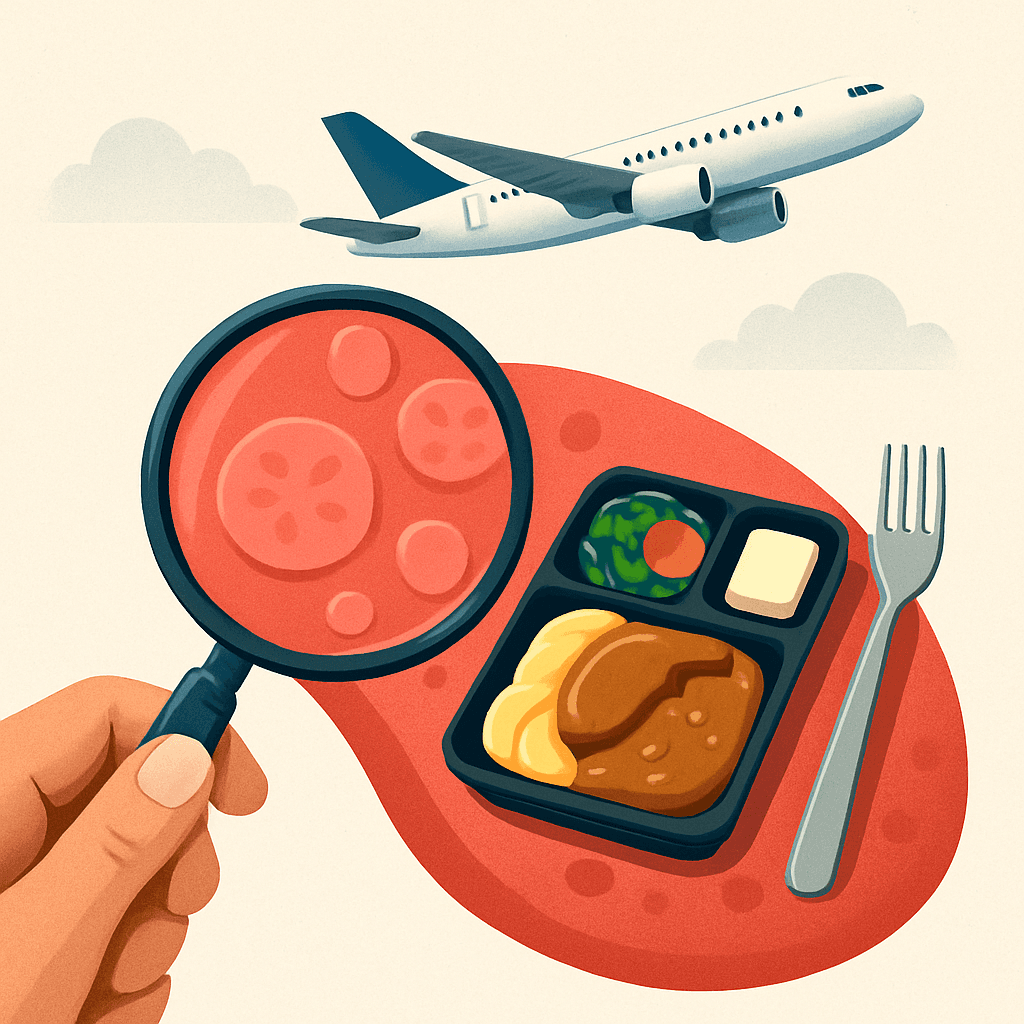
There is a reason airlines load their food with more salt and seasoning than you would ever use at home, and it is not because airline chefs lack restraint. At cruising altitude, the conditions inside a pressurised cabin actively suppress your ability to taste sweet and salty flavours. The catering is compensating for the environment. If the same meal were served at sea level, it would taste aggressively over-seasoned.
Three Things That Change at Altitude
A commercial aircraft cabin is pressurised, but not to sea-level pressure. The typical cabin altitude is equivalent to being at around 6,000 to 8,000 feet above sea level. At this pressure, two things happen to your body that affect taste. First, the lower air pressure causes your sinuses and nasal passages to partially dry out. Since roughly 80 percent of what you perceive as flavour is actually smell, any reduction in your ability to smell has an immediate and significant effect on taste.
Second, the cabin humidity is extremely low, often below 20 percent, compared to the 40 to 60 percent you experience in most buildings. This dries out the mucous membranes further and directly affects the functioning of taste buds. A 2010 study commissioned by Lufthansa and conducted at a simulated aircraft cabin found that sensitivity to sweet and salty tastes dropped by around 30 percent under these conditions. Bitter, sour, and umami tastes were largely unaffected.
The Noise Factor
There is a third variable, more surprising than the first two. Background noise affects taste. A study by Birgit Derntl at the University of Erlangen-Nuremberg found that loud background noise suppresses sweetness and saltiness while enhancing the perception of umami. Aircraft cabin noise runs at around 85 decibels during cruise. This is loud enough to contribute meaningfully to taste suppression.
The same Cornell University research found that people in noisy environments consistently rate umami-heavy foods as more pleasant and sweet foods as less so. This helps explain why drinks like Bloody Marys and tomato-based foods perform particularly well in the air. They are naturally positioned to survive the conditions.
What Airlines Do About It
Serious airline catering teams design menus specifically around these constraints. This means heavier seasoning, dishes with stronger aromatic components that retain some scent even in dry air, and a bias towards umami-rich ingredients like mushrooms, soy, fermented elements, and slow-cooked meats. It also means that some dishes that taste excellent on the ground, delicate seafood, subtle desserts, lightly dressed salads, simply do not work in the air. The food is not bad because the cooking is bad. It is adapted to an environment that is actively working against it.
Next time you reach for the salt on a plane, consider that the kitchen has already added significantly more than you would use at home, and your taste buds are still telling you something is missing. They are not wrong. They are just operating in conditions they were not designed for.
Disagree? Say so.
Genuine pushback is welcome. Personal abuse is not.
Related questions