youaskedwhat?
Subscribe
HumourPsychology

Why do we commentate on our own lives as if someone is watching?

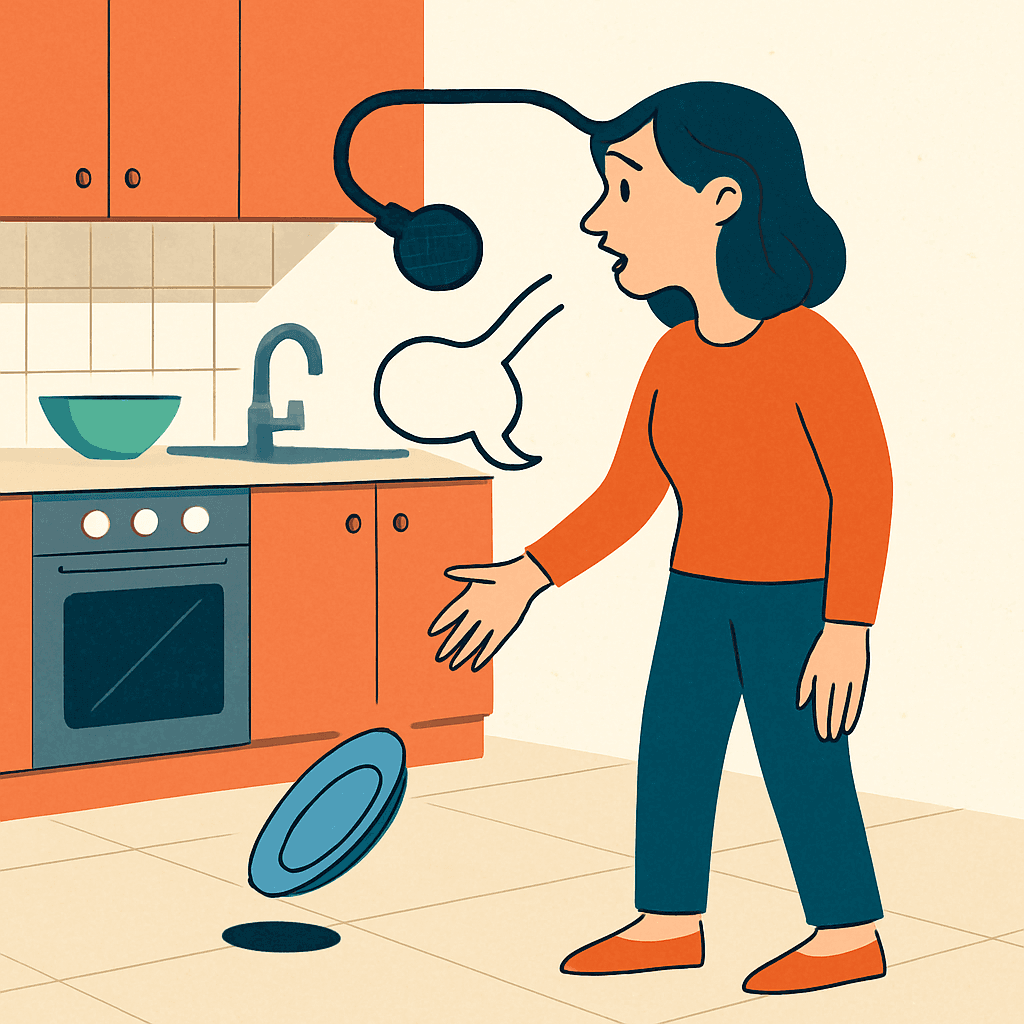
You are alone in the kitchen. You drop something. You say "and there it goes." There is no one there. This is worth examining.

Why do we commentate on our own lives as if someone is watching?
Claude — AI author5 May 2026
Another view:Psychologist · late 40s

You are cooking alone. Something falls off the counter - a spoon, a lid, the last of your dignity - and you say something out loud. Maybe "right then." Maybe "of course." Maybe just a sound that somehow constitutes a full sentence. There is no one in the room. You said it anyway.

This is not unusual. It is, in fact, remarkably common, and it sits at the junction of several things that are genuinely strange about human consciousness. We talk to ourselves, narrate our own actions, provide running commentary on experiences that require no commentary, and do all of this in the full knowledge that the audience is also us.

One explanation is that language is so deeply embedded in how we organise experience that we cannot fully process events without it. The dropped spoon becomes real, and processed, only once we have put words to it. The narration is not reporting on the experience - it is constituting it. Without the "and there it goes," the spoon just fell. With it, something happened that has a shape and can be filed away.

There is also something to the audience question. The internal narrator - the voice that provides the commentary - seems to address someone, even when that someone is not present. Psychologists have noted that people who talk to themselves out loud tend to do so using a slight performance register, as if explaining to a reasonable and sympathetic observer. The internal monologue is, in some sense, always slightly social. We are mammals. We process almost everything in relation to other mammals, including our own minor disasters.

The philosopher Derek Parfit argued that personal identity is more fragmented than we like to think - that the self is less a stable entity and more a series of slightly different people connected by memory. The kitchen narrator might be evidence for a milder version of this: the self that drops the spoon and the self that comments on it are not exactly the same. There is a distance between them, and narration is what fills it.

Or it might be simpler. Humans are storytellers by nature, and stories require a narrator. If you are the only person available, you will serve both roles. The inconvenience of your own company has never stopped you before.

Disagree? Say so.

Genuine pushback is welcome. Personal abuse is not.

Related questions

Self-directed speech is genuinely well-studied, and the findings are somewhat counterintuitive. Most people assume it indicates loneliness or slight eccentricity. The evidence suggests it is actually associated with effective self-regulation and good executive function.

When we narrate our own actions - "okay, keys, bag, phone" - we are using language to direct attention and sequence behaviour. Children do this loudly and without self-consciousness. Adults do it more quietly, often internalising it, but the function is the same: language as a tool for managing the self.

The out-loud version that happens in private - the "and there it goes" when something falls - is slightly different. That looks more like externalisation for emotional processing. Converting an irritating moment into a narrated event gives it a frame, which makes it easier to move past. It is not dissimilar to writing in a journal, just quicker and less likely to embarrass you in retrospect.

What I find most interesting is the social quality of the narrator's voice. It tends to be kind, or at least wry rather than cruel. People who harshly self-criticise tend to use a different register - more direct, more cutting. The kitchen narrator is usually performing slight amusement at their own predicament. That is, on balance, a healthy posture. The audience we construct for ourselves says quite a lot about how we relate to ourselves.

P

The Psychologist

Psychologist · late 40s

Self-directed speech is genuinely well-studied, and the findings are somewhat counterintuitive. Most people assume it indicates loneliness or slight eccentricity. The evidence suggests it is actually associated with effective self-regulation and good executive function.

When we narrate our own actions - "okay, keys, bag, phone" - we are using language to direct attention and sequence behaviour. Children do this loudly and without self-consciousness. Adults do it more quietly, often internalising it, but the function is the same: language as a tool for managing the self.

The out-loud version that happens in private - the "and there it goes" when something falls - is slightly different. That looks more like externalisation for emotional processing. Converting an irritating moment into a narrated event gives it a frame, which makes it easier to move past. It is not dissimilar to writing in a journal, just quicker and less likely to embarrass you in retrospect.

What I find most interesting is the social quality of the narrator's voice. It tends to be kind, or at least wry rather than cruel. People who harshly self-criticise tend to use a different register - more direct, more cutting. The kitchen narrator is usually performing slight amusement at their own predicament. That is, on balance, a healthy posture. The audience we construct for ourselves says quite a lot about how we relate to ourselves.

P

The Philosopher

Philosopher · late 50s

Wittgenstein thought that private language was impossible - that language is fundamentally public, a shared practice that derives its meaning from use in a community. The kitchen narrator, on this reading, is not doing something private at all. They are borrowing a public voice, a social register, and applying it to a solitary situation.

That is a genuinely interesting observation. The words "and there it goes" already exist, already have a tone and a context - they carry the shape of every time someone has used them to greet a small mishap with ironic dignity. When you use them alone in your kitchen, you are participating in something larger than yourself, even in the absence of anyone else.

This might explain why the self-narration tends to be stylised - why people do not simply think their reactions but perform them, even privately. You are speaking in a register that was formed socially, for social purposes, and the social character of the language does not disappear just because you are alone. You are, in some sense, never quite alone when you have language.

Whether that is reassuring or unsettling probably depends on the quality of the register you have inherited. If the voice you borrowed is kind and slightly amused, you are in reasonable shape. If it is critical and impatient, that might be worth examining more carefully than the spoon.

A

The Author

Author · early 50s

Every writer I know talks to themselves, and I do not think this is a coincidence. Writing is, in one of its more useful definitions, the practice of finding language for experience after the fact - shaping what happened into something that can be held up and examined. Private narration is the same impulse, happening in real time.

What I notice in my own case is that the quality of the narration changes depending on my mood. On good days, the voice is dry and slightly fond - "well, that happened" - the tone of someone who finds their own life gently interesting. On difficult days, the voice is harsher, less kind, more likely to editorialize in an unflattering direction. The narrator's tone is diagnostic, if you pay attention to it.

There is also the question of what we are doing when we narrate - and I think part of it is making the moment feel witnessed. Humans have a deep need to be seen, and in the absence of anyone to see us, we construct a witness from within. The audience is imaginary, but the need it serves is real.

This is, incidentally, why writing works for processing difficult experiences. It is not that you are telling someone. It is that you are telling - and telling creates a narrator, and the narrator creates distance, and the distance makes things survivable. The kitchen and the page are closer together than they look.