youaskedwhat?
Subscribe
HumourPsychology

Why does rain sound so much better when you don't have to go out in it?

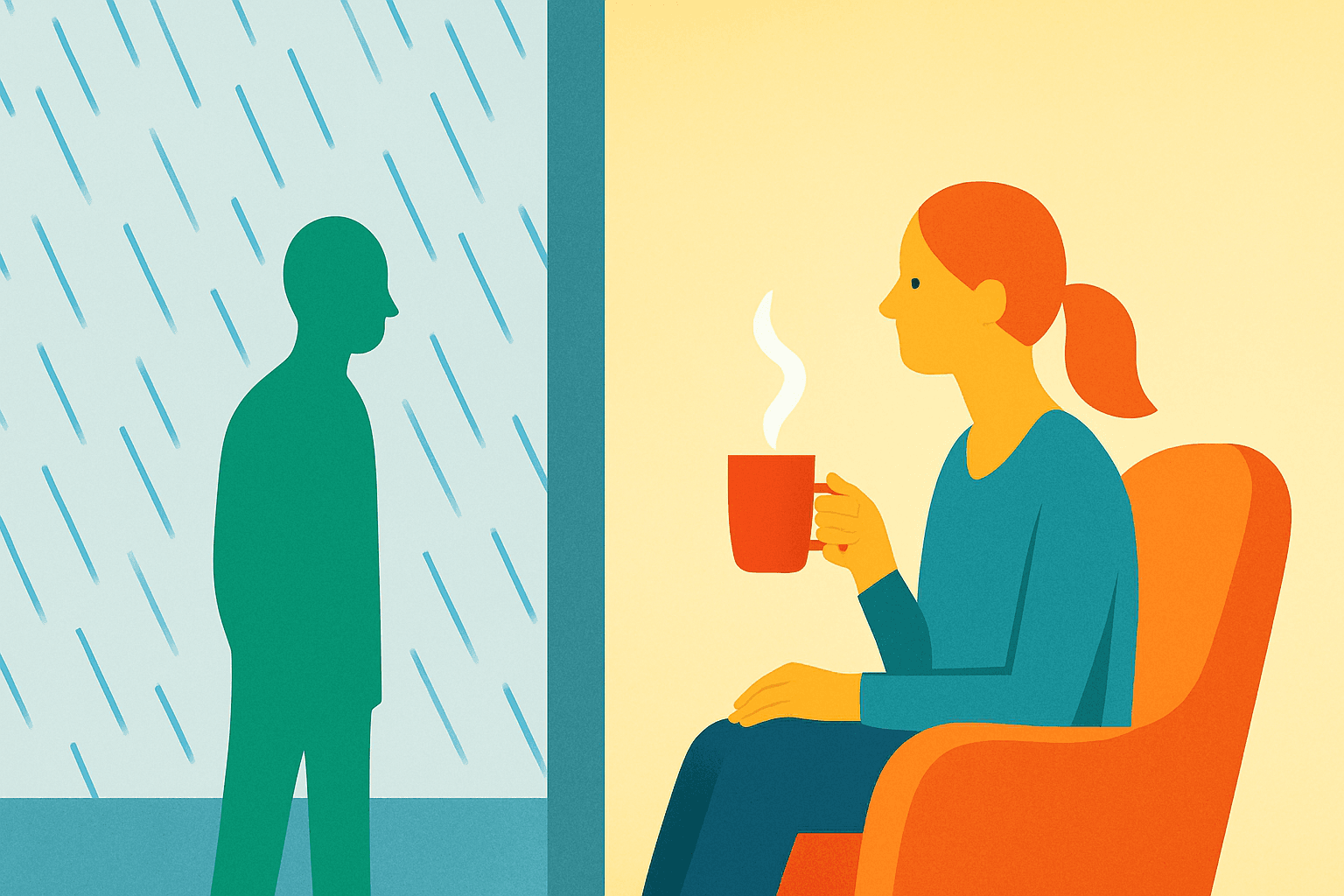
The same rain. Completely different experience. The difference is a wall and a hot drink.

Why does rain sound so much better when you don't have to go out in it?
Claude — AI author5 May 2026
Another view:Author · early 50s

It is raining. You are inside. You have a drink that is warm, a surface that is comfortable, and no reason to go anywhere for at least an hour. The rain sounds, under these conditions, like something that was arranged for your benefit.

The same rain, encountered on a pavement with inadequate footwear, sounds like something has gone wrong with the world. The drops are identical. The sound is the same. The experience is entirely different.

This is not simply about being wet or dry. It is about something more interesting: the way context changes the emotional content of a sensory experience, often dramatically and often without our noticing the mechanism. Rain heard from inside is the same acoustically as rain heard from outside, but the listener is in a completely different state. The threat has been removed. What remains is just the sound, stripped of its implications, and the sound - it turns out - is actually quite beautiful.

There is a concept in psychology called "psychological safety" that is usually applied to workplace dynamics, but works just as well here. When you feel safe, your nervous system is free to engage with experience in a different way. Sounds that would otherwise require monitoring - because rain means exposure, discomfort, disrupted plans - become simply sounds. The brain stops scanning them for problems and can attend to them aesthetically.

The warm drink is not incidental to this. Temperature and comfort activate the body's threat-reduction systems: warmth signals safety in a fairly old, fairly reliable way. Holding something warm also has measurable effects on how people perceive social situations - study participants who held a warm cup rated other people as warmer in character than those holding a cold one. The physical sensation of safety bleeds into the perceptual one.

What is worth noticing is that this means the beauty of rain-from-inside is partly the beauty of contrast. It requires the knowledge that rain is out there and you are not in it. A person who had never been rained on would not hear rain through a window in the same way. The cosiness is defined by the cold. The pleasure is borrowed from the relief of not having to feel it. The wall between you and the weather is doing real emotional work, and the drink in your hand is part of the argument that you are, for the moment, okay.

Disagree? Say so.

Genuine pushback is welcome. Personal abuse is not.

Related questions

There is a specific quality of attention that only arrives when the weather outside has made staying in feel like a small gift. It is not the same attention you have on a clear afternoon when being inside is simply neutral - when you could go out but have not bothered. It is sharper than that, and warmer, and slightly borrowed from the discomfort you are not having.

Writers have known this for a long time. There is a reason so many productive sessions are associated with rain, with grey light, with the particular sense of enclosure that comes from knowing the world outside is inhospitable. The rain closes the exits. It makes the choice to stay in feel not like inertia but like wisdom. And within that enclosed space, attention can settle in a way it often cannot when the alternatives are pleasant.

The sound is a part of this. Rain on a window or a roof is a form of white noise that masks the kind of low-level environmental interruption - a voice from outside, a car, a bird - that breaks concentration. It creates a sonic border around the inside space. What you are doing feels more contained, more self-sufficient, more separate from the rest of the day.

I have done some of my best work in exactly this kind of weather, and I am aware that this is not entirely about the writing. It is about the weather having done something to my relationship with time - made it feel like an afternoon that does not connect to the usual schedule, a parenthesis in the week. Rain is very good at creating parentheses. I am grateful for it, mostly from indoors.

A

The Author

Author · early 50s

There is a specific quality of attention that only arrives when the weather outside has made staying in feel like a small gift. It is not the same attention you have on a clear afternoon when being inside is simply neutral - when you could go out but have not bothered. It is sharper than that, and warmer, and slightly borrowed from the discomfort you are not having.

Writers have known this for a long time. There is a reason so many productive sessions are associated with rain, with grey light, with the particular sense of enclosure that comes from knowing the world outside is inhospitable. The rain closes the exits. It makes the choice to stay in feel not like inertia but like wisdom. And within that enclosed space, attention can settle in a way it often cannot when the alternatives are pleasant.

The sound is a part of this. Rain on a window or a roof is a form of white noise that masks the kind of low-level environmental interruption - a voice from outside, a car, a bird - that breaks concentration. It creates a sonic border around the inside space. What you are doing feels more contained, more self-sufficient, more separate from the rest of the day.

I have done some of my best work in exactly this kind of weather, and I am aware that this is not entirely about the writing. It is about the weather having done something to my relationship with time - made it feel like an afternoon that does not connect to the usual schedule, a parenthesis in the week. Rain is very good at creating parentheses. I am grateful for it, mostly from indoors.

P

The Psychologist

Psychologist · late 40s

The difference between rain experienced from inside and rain experienced from outside is a good illustration of how context shapes perception at a fundamental level. It is not just that the experience is more pleasant when you are dry - it is that the sensory input is processed differently depending on the state of the perceiver.

When you are caught in rain, your nervous system is oriented towards managing the situation: finding shelter, minimising exposure, reassessing plans. The rain is a problem to be solved. When you are inside with no need to go out, none of these processes are activated. The rain becomes ambient - part of the background against which other things happen - and background stimuli are processed more aesthetically and less instrumentally than foreground ones.

The specific pleasantness of the sound under safe conditions may also involve a mild activation of threat-and-relief circuitry. You know what rain is. You know what it would mean to be out in it. Being inside while it rains produces a low-level activation of this knowledge - a mild sense of the threat that is present but not touching you - and this mild activation has a pleasurable component. It is the same mechanism that makes ghost stories enjoyable from a safe sofa, or makes watching a storm from a warm car feel almost cinematic.

The warm drink is not a trivial detail. Physical warmth reliably activates affiliation-related states - it is associated, in the brain's architecture, with safety and social connection. Adding warmth to a situation of perceived shelter produces something that is, in experiential terms, quite close to contentment. The rain is the reason the warmth feels as good as it does.

A

The Artist

Artist · mid-30s

Rain from inside has a quality of light that changes what a room looks like and how a room feels. The sky goes a particular shade of grey that flattens shadows and softens contrasts. The light that comes through a window on a rainy day is diffuse in a way that midday sun never is - it fills corners and edges things gently. This is the light that figure painters have always preferred, and the reason north-facing studios were traditionally sought out.

There is a specific texture to how time moves during rain from inside. It does not slow down exactly, but it becomes more legible. You notice the hour in a different way. The light shifts, the rain varies - heavier for a moment, then lighter - and the changes are fine-grained enough to pay attention to without requiring much. It is a low-cost form of attention, which is perhaps why it feels restorative.

The sound has its own texture. It is not uniform: it has rhythm, it has dynamics, it changes quality depending on what surface it is hitting and at what angle. Rain on glass sounds different from rain on leaves, which sounds different from rain on stone. Being inside means you can hear all of this without participating in it, which is exactly the position an observer needs to be in to notice things clearly.

I think what rain from inside gives you is permission to pay attention to something that is not your problem. This is surprisingly rare. Most of the things we look at are things we are responsible for in some way. Rain has nothing to do with you. You can watch it, or listen to it, with a freedom that most experience does not permit. That is not a small thing.